English



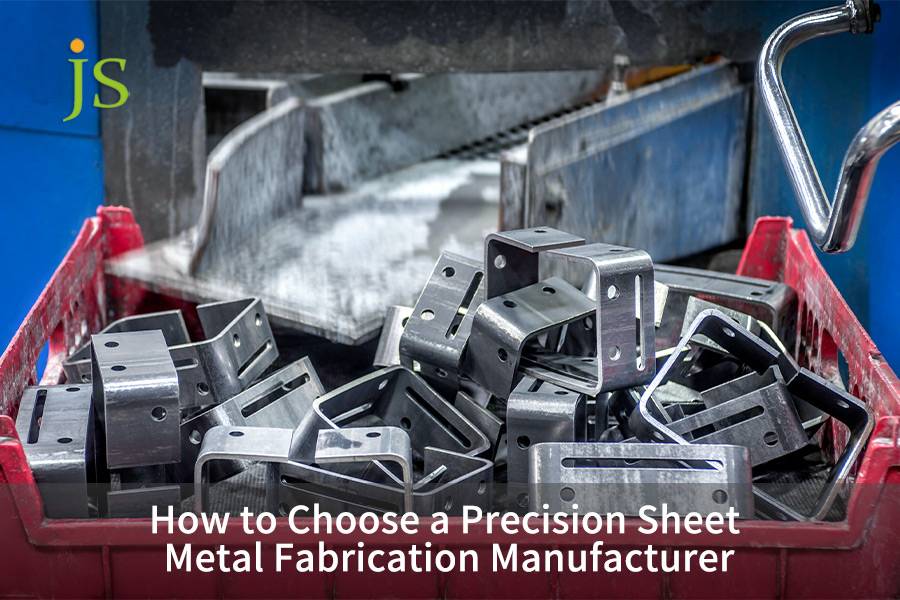

Precision sheet metal fabrication manufacturer selection should go beyond just per-piece pricing. It needs to be done by closely examining different factors like whether the supplier has the ability to produce work at micron level, use automatic springback to compensate without affecting product quality, and whether the manufacturing process is capable of keeping up the same level of precision in large lots.
The article discusses various aspects, like machine parameters, design for manufacturing metrics, quality control, and cost structure.
Quick Overview of Key Evaluation Metrics for Precision Sheet Metal Fabrication Manufacturers
Choosing a reputable precision sheet metal fabricating company should involve, for a start, checking how good their multi-axis CNC machine is and what kind of angle tolerance control ±0.3° . It is also necessary on design for manufacturing (DFM) unfolding algorithms and no-mar delivery systems. These items will help to avoid assembly clashes and costly engineering mistakes.
|
Evaluation Dimensions |
Traditional Job Shop |
JS Precision Standard |
Acceptance Thresholds |
|---|---|---|---|
|
Angle Tolerances |
±1.0° – ±1.5° (experience-based) |
±0.3° – ±0.5° (Laser Angle Measurement) |
Verify 4-to-8-axis CNC with laser angle feedback |
|
Linear Tolerances |
±0.3 mm – ±0.5 mm |
±0.05 mm – ±0.10 mm |
Require 8-axis backgauge; dimensional lock ≤±0.1mm |
|
Crowning System |
None or manual shimming |
Dynamic Hydraulic Crowning |
Full-length angle consistency on 3m plates |
|
Surface Protection |
Visible die marks, post-grinding |
No-Mar Polyurethane Bending |
Zero marks for medical/electronics enclosures |
|
DFM Response |
Make-as-drawn, disputes after failure |
Offline CAM simulation + trial bending |
24-hour DFM feedback; nesting utilization ≥85% |
Data source: JS Precision 2025 supplier audit database. ASTM A1008/A1008M-25 mechanical property tables.
How to Evaluate the Precision and Angle Tolerance Control of a Sheet Metal Manufacturer?
A precision sheet metal fabrication manufacturer checks machine localization and springback by using 4-to-8-axis CNC press brakes equipped with Laser Angle Measurement and Hydraulic Crowning, restricting angle tolerances to ±0.3° and linear dimensions to ±0.05 mm.
Sheet Metal Springback: Pain Points and High-Precision Control Solutions
- Main Reason for Springback: Differences in sheet thickness and in yield strength of sheet cause substantial changes in springback. The small-scale traditional shops are manually making the trial bends and the obtained angle tolerances are about ±1.0°, and the assemblies suffer from gaps.
- Hardware Basis to Deliver Precision Sheet Metal Capabilities: A capable precision sheet metal manufacturing company will be utilizing 4- to 8-axis CNC servo bending equipments integrated with real-time laser bending angle measurement systems.
- 100 Hz Closed-Loop Correction: The laser sensors detect bending angles 100 times per second, supplying the real-time feedback required to perform over-bending correction and limit the angular tolerance variation to only ±0.3°.
Deflection Prevention and ASTM Material Data Compliance
- Hydraulic Deflection Compensation: For sheets longer than 2 meters, the machine must be equipped with automatic hydraulic or mechanical deflection compensation system for the bending operations so that angular variation due to deformation in the center area can be avoided.
- Batch-to-Batch Variations in Mechanical Properties: The standard ASTM A1008/A1008M-25 sets a range of yield strengths from 140 to 275 MPa for CS grade cold-rolled carbon steel and from 150 to 240 MPa for DS grade, very large variations.
ASTM A1008/A1008M-25 Standard: The yield strength of CS grade is 140-275 MPa, DS grade is 150-240 MPa, and the elongation rate A50 is not less than 30% -40%.
JS Precision's CNC machine with dynamic angle compensation system is the way to increase angular consistency across the complete batch to over 98%.
Want to systematically evaluate your sheet metal supply chain? Contact JS Precision for a free supplier audit framework, and we will assist you in completing 32 quantitative reviews across 6 dimensions to accurately identify potential risks.
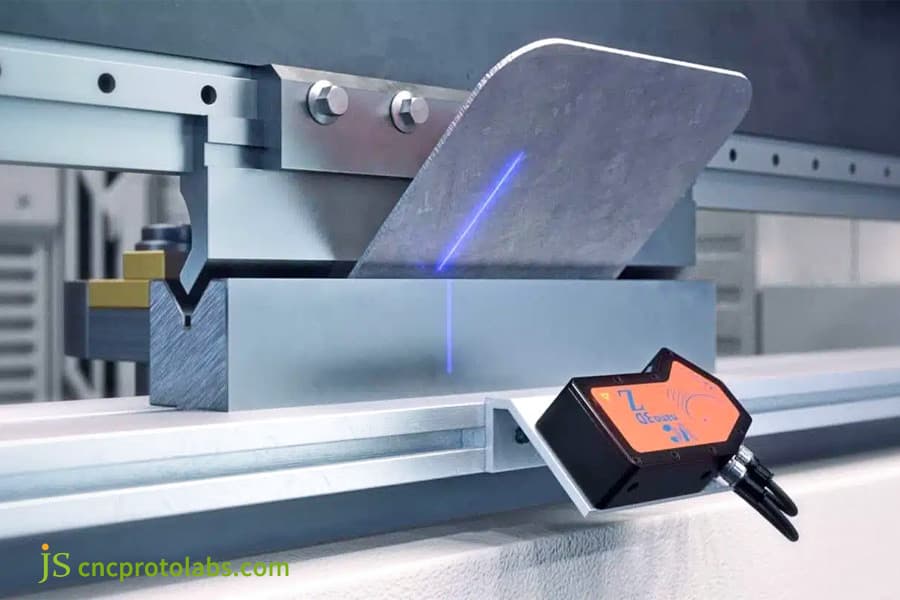
Figure 1: Laser guided sheet metal bending machine controlling angle tolerance.
How Does a Professional Custom Sheet Metal Fabrication Service Provide DFM Optimization?
Custom sheet metal fabrication service fixes flat patterns with the help of 3D offline CAM simulations and changes the default K-Factor (0.44) with material-specific databases to ensure the First-Time-Yield above 96.5%.
3D Simulation and Flat Pattern Calibration
- 24-Hour DFM Response: Premium custom sheet metal fabrication service execute 3D simulations and identify the interference of the bending tools using CAM software in a 24-hour timeframe after getting the drawings.
- K-Factor Calibration Needs: A precise setting of the K-Factor is necessary. If we take the default value (0.44) the resulting flat-pattern's dimension deviation will be from 0.5mm to 1.0mm.
- Company's own Database: High precision custom sheet metal service produce their own K-Factor database from tensile test data from the sample sheets.
Deformation Prevention and Tooling Clearance
- Relief Slots: Recommendations are given to add relief holes in regions where hole-bend wall distance is less than 2.5 times the sheet metal thickness. In fact, this way of design helps to remove cracks in materials caused by the bending stress.
- Gooseneck Tooling: Deep cavity bending or reverse bending can be made through gooseneck tooling (high profile) without any collision problems.
- First-Time Yield Data: Results of the JS precision MED-ENC-2025-007 project showed that the tooling change costs related to trial-and-error could be reduced by 80% and the proportion of the samples getting good yields at the first time could be increased up to 96.5% with design accuracy of DFM for relief slots and K-Factor adjustments of correct.
From our point of view, when we took client's original drawings and applied them the basic K-Factor of 0.44 our mistake accumulated up to 2.5 mm for 14 bends. After the K-Factor database reconstruction and relief slot integration the tolerances were set tight enough for clearance assembly (less than 0.3 mm).
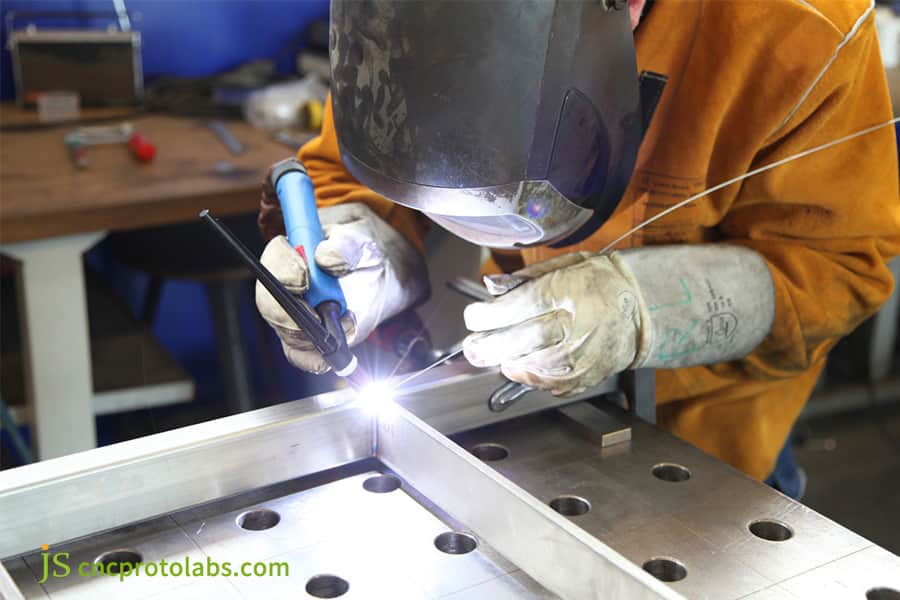
Figure 2: Worker performing TIG welding on metal frame for custom fabrication.
What Are the No-Mar Bending Standards in Precision Sheet Metal Fabrication Services?
Precision sheet metal fabrication service employs a combination of polyurethane protective films, rotating dies (Rolla-V), and nitrogen-assisted laser cutting (99.999%) to prevent die marks on brushed stainless steel and anodized aluminum, which allows for about 85% less post-process polishing.
Scratch-Prevention Tooling Systems
- Polyurethane Protective Film: Top precision sheet metal fabrication manufacturers use polyurethane protective film to cover the bottom of their dies so that no scratches are left when the sheet metal is compressed and the V-grooves are in contact.
- Rolla-V Die (Rotating No-Mar Bottom Die): In this kind of no-mar bottom die system, the sheet metal comes in contact with the die in a rolling manner, not sliding, through Rolla-V rotating bottom dies.
- Rigid Polyurethane Bottom Die: When high tonnage sheet metal bending is involved, sheet metal formers replace anodized steel dies with rigid polyurethane bottom dies to ensure that a brushed finish or anodized layer gets no damage.
Laser Cutting Integration and Cost-Reduction Parameters
- High-Purity Nitrogen-Aided Cutting: Nitrogen of ≥99.999% purity is utilized in laser cutting for producing dross- and oxidation-layer-free edges.
- Removing Datum Discrepancies: Burrless edges free of oxidation allow the bending datums to be more accurate, resulting in a grinding, polishing, and polishing time reduction of 85%.
- Measurable Cost Downgrading: A JS Precision project on medical cases made of AL 5052-H32 saw a drop in post-processing per unit cost from US$4.20 to US$0.63 with the implementation of 'No-Mar' process.
Are your aluminum parts anodized or stainless steel ones brushed suffering bad coating quality? Check JS Precision's 'No-Mar' bending case studies to see how the zero-indentation technique is executed.
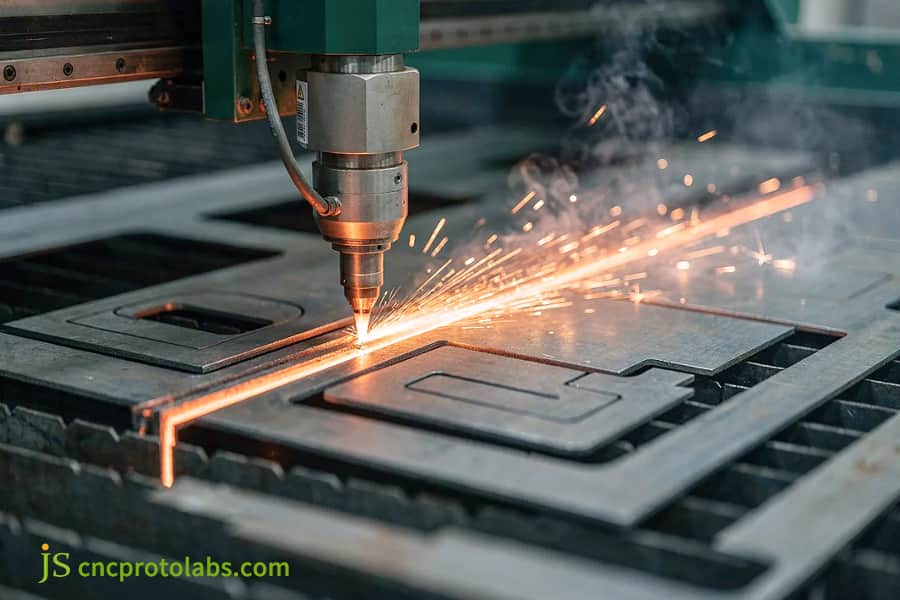
Figure 3: CNC laser cutting machine processing sheet metal with sparks.
What Are the Core Sheet Metal Fabrication Cost Factors and Quoting Traps?
The major sheet metal fabrication cost factors are material utilization, tooling costs, cycle time, and assembly integration. The use of CAM nesting can bring 85-92% material utilization, whereas one-piece sheet metal designing can reduce welding labor by about 70%.
Material Utilization and Tooling Considerations
- Nesting Efficiency Algorithms: To understand the sheet metal fabrication cost factors, It is best to look up nesting algorithms. CAM-based automatic nesting increases the material utilization for the standard sheets (1220×2440 mm) to the level of 85-92%.
- Tooling NRE: Decide between using CNC bending services (zero investment tooling) or progressive dies for the manufacturing of sheet metal components.
Bending-over-Welding Integration and One-Stop Manufacturing
- Bending without Welding: A multi-bend process that integrates several (4-5) previously welded components into one item cuts the labor requirements for welding and grinding by 70%.
- Cutting down on Overall Management Expenses: Substitution of welding with bending slashes total operational expenses by as much as 22 percent.
- Complete Supply Chain under One Roof: We make sure that the workshop is able to provide us with powder-coated parts, screen-printed ones, press-fitted parts and even the assembly of hardware so that no losses are incurred through shipping the pieces between various suppliers.
|
Cost Component |
Traditional Multi-Vendor |
JS Precision Turnkey |
Saving |
|---|---|---|---|
|
Material (Nesting 85-92%) |
Base |
Base |
Baseline |
|
Tooling NRE (per piece) |
$0.35 – $1.20 |
$0.00 – $0.50 |
Up to 60% |
|
Welding & Grinding labor |
$2.80 / piece |
$0.84 / piece |
70% reduction |
|
Surface Treatment transfer |
$1.50 / piece |
$0.00 (in-house) |
100% saving |
|
Supply Chain Management |
22% overhead |
0% (single source) |
22% reduction |
Data source: JS Precision 2025 cost accounting database. MED-ENC-2025-007 project actuals.
Need a cost analysis with no surprises? Send us your drawings and JS Precision will give you a quote in two hours with a breakdown of materials used, labor required, and our complete single-source offering.
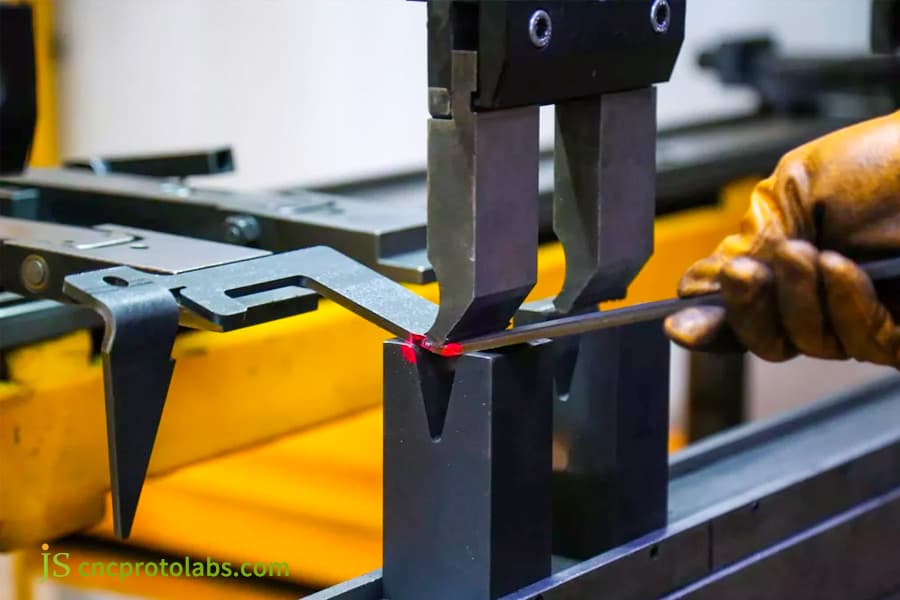
Figure 4: Worker operating press brake to bend metal sheet part.
How to Conduct Sheet Metal Supplier Evaluation and On-Site Audits using Standardized Metrics?
A sheet metal supplier evaluation involves checking ISO 9001:2015 certifications, 4-to-8-axis CNC positional accuracy of ≤ ±0.03 mm, CMM inspection, and customer PPM rate below 300 that are accompanied by 24-hour 8D corrective action protocols.
System Certification and Process Quality Control
- ISO 9001:2015 System Review: During supply assessments review the ISO 9001:2015 system which regulates the control of operational processes.
- Mill Test Report (MTR): precision sheet metal fabrication manufacturer who deal with customers are generally required to show the mill test reports (MTRs) together with raw material certificates so that there is compliance with standards like ASTM A1008.
- FAI (First Article Inspection) Process: The first product should be tested for its dimensionality by either a CMM (Coordinate Measuring Machine) or a 3D laser scanner fully.
ISO 9001:2015 standard prescribes that The organization will have control over production and service provision to ensure conformity of products and services and corrective actions for non-conforming output will also be taken.
Scrap Rate and Response Timeliness
- Scrap Rate PPM Requirement: Go through the batch scrap rate customer PPM records for the last 12 months. That PPM scrap rate limit should be < 300 ppm.
- 8D Response of Issues: If there is an immediate need, suppliers should be able to generate an 8DB corrective action report as soon as an issue is identified by the client.
- Supplier Audit Process: JS Precision has set up a supplier sheet metal evaluation structure which clients can adopt directly to evaluate their current sheet metal providers' supply chains without having to create one themselves.
Supplier Quantitative Audit Scorecard
|
Audit Category |
Scoring Criteria |
Weight |
Passing Threshold |
|---|---|---|---|
|
Quality System |
ISO 9001:2015 certified, MTR traceability |
25% |
≥ 20/25 |
|
Equipment Specs |
4-to-8-axis CNC, laser angle feedback, CMM |
25% |
≥ 20/25 |
|
Process Control |
FAI workflow, SPC data, PPM < 300 |
25% |
≥ 20/25 |
|
DFM Response |
24-hour feedback, K-Factor database |
15% |
≥ 12/15 |
|
Corrective Action |
8D protocol, 24-hour response time |
10% |
≥ 8/10 |
|
Total Score |
— |
100% |
≥ 80/100 |
Data source: JS Precision 2025 supplier audit database. ISO 9001:2015 quality management system requirements.
Short version, any precision sheet metal fabrication manufacturer who is qualified should be certified that they meet mandatory requirements in three key areas: quality systems, equipment specification, and process control.
JS Precision Case Study: High-Precision Bending and No-Mar Forming for Complex Medical Enclosures
JS precision used a sheet metal fabrication service to overcome the problem of 2.5mm gap in AL 5052-H32 CT enclosure with cutouts, gooseneck tooling, and 8th axis laser correction (±0.2°), which led finally to achieving 99.4% FTY and reducing 32% costs.
Problems faced by the customers
One well-known western medical imaging equipment producer was running into problems with their internal precision control chassis design of AL 5052-H32 aluminum alloys for CT scanners. This design required lots of sequential bends, which due to accumulated errors had produced a 2.5mm gap on the cover plate, thereby affecting the lighting. And, there were some very visible dents which had damaged the surface and the defect rate was as high as 28%. Also, the deep cavity construction was not compatible with the conventional tooling leading to a tensile deformation issue.
JS Precision's Three-Step Solution
- Design for Manufacturing (DFM) Re-engineering: Re-bending order was established with an offline CAM. New micro-lasers, 2.0×1.5 mm deep relief holes were placed strategically on deeper areas to relieve tensile stress and So to prevent stress cracks.
- Tooling Protection: A unique sheet metal fabrication solution was implemented where they devised a Gooseneck punch that would provide the required clearance. And, the bottom die was protected with an indentation-free high-polymer polyurethane film.
- Dynamic Compensation: Call the 8-axis CNC bending machine, activate the laser real-time angle measuring instrument in precision sheet metal capabilities, and control the tolerance of each bending angle within ± 0.2 °.
Lesson Learned: Micro-cracking Caused by Rolling Grain Direction
During the initial stage of sampling, it did not realize that the team had to consider the rolling direction of the AL 5052-H32 aluminium sheet. Bending the metal along the grain direction resulted in micro cracks as large as 0.1 mm. Engineers who were already familiar with the work of the MED-ENC-2025-007 project, made quick decisions about changing the nesting orientation so that the fold line was perpendicular 90 to the grain direction, thereby removing the cracks.
Final Results
- FTY & Clearance: FTY was improved up to 99.4% whereas the clearance was kept consistent within the margin of ≤0.3 mm.
- Surface Finish: It was found that no surface damage was detected, there was no scratches or indents, and the coating defect was lowered from 28% to 0.5%.
- Cost Reduction: Through detailed analysis and cost-cutting methods at the unit level, the total unit cost could be reduced by 32%.
You can contact the JS Precision engineering team for exclusive solutions and free sample welding trials, allowing precision sheet metal capabilities to create a cost reduction of over 30% for you.
Why Partner with JS Precision for Your Long-Term Precision Sheet Metal Fabrication Services?
JS Precision is a precision sheet metal fabrication manufacturer that mainly uses Trumpf lasers, Bystronic and CMM labs, and Amada press brakes in our fabrication work, can do 3-to-5-day prototyping and can deliver full production with ±0.05 mm precision.
- Trumpf + Bystronic + Amada Hardware Matrix: Being a top-grade global precision sheet metal fabrication manufacturer, JS Precision relies on Trumpf fiber laser cutting machines, together with Bystronic/Amada multi-axis CNC servo bending systems as well as CMM and 3D laser scanning quality inspection equipment.
- 15 years of custom OEM experience: We offer sheet metal fabrication services to medical semiconductor communication and industrial automation clients, with the 0.5-6 mm full process chain.
- 3-5 days rapid prototyping: supports rapid prototyping to mass production of 100,000 pieces, and gives transparent quotation and one-on-one DFM optimization support.
- Source factory price: When you select JS Precision as your sheet metal fabrication service provider, you get the benefit of ISO 9001:2015 quality assurance and the cost of directly from factory without any middlemen.
FAQs
Q1: How do you evaluate the tolerance control capabilities of a precision sheet metal manufacturer?
Ask about whether the CNC press brakes are fitted with multi-axis backgauges and whether there is a real-time laser angle measurement system, and then request a CMM inspection report of full dimensions. A high-grade precision sheet metal shop should be capable of meeting angle tolerances as low as ±0.3° and keeping dimensional tolerances ±0.1 mm.
Q2: What is the K-Factor in sheet metal bending, and why is it vital for DFM?
K-factor is a ratio that shows how close the neutral axis comes to the original thickness of the material on bending and this ratio changes drastically based on the kind of material. Relying on standard values would probably lead us to a miscalculation of flat pattern size between 0.5 mm to 1 mm, the expert manufacturers keep a private K-factor list to reach the desired precision.
Q3: What causes bending surface marks, and how does JS Precision achieve no-mar bending?
Contact or pressure between the sheet metal and the die edge is a common source of scratches. No-mar bending is the method of JS Precision which involves polyurethane covering (or a Rolla-V V-die), by 99% reduction of the dents, a feature that is suitable for brushed or anodized surface finish parts.
Q4: How can buyers avoid hidden quotation traps when sourcing sheet metal fabrication services?
Review the quotation detail to include not-only material price and laser cutting/bending operation times, but also tooling setup (one-time charge of engineering cost) and surface treatment costs. Be alert of the trap of low per unit price-high total cost from tooling by getting honest quotation that mentions nesting efficiencies and submiting technical drawings to achieve best price.
Q5: Why is choosing a turnkey sheet metal fabrication provider critical for supply chains?
Sheet metal fabrication refers to various operations like cutting bending welding, component installation, and paint application. Delegating such tasks to several vendors adds the chances of transit damage, delivery delays, and accountability disputes among parties. A single-source manufacturer would take care of the product quality and probably save you about 20% overhead.
Q6: How do I request a sheet metal fabrication quote from JS Precision, and what files are needed?
For an accurate quote from JS Precision you should supply 3D CAD models like STEP, IGES, or X_T files and 2D engineering drawings in PDF format highlighting critical dimensions, plus clearly stating the type of metal, number of units, and any finishing required. The engineers can prepare a DFM report and quote within 2 to 12 hours.
Q7: CNC Sheet Metal Bending vs. Progressive Stamping: Which One to Go For?
The decision is determined by the volume of the product and your budget for tooling. CNC metal bending does not involve the use of dedicated tooling. This makes it suitable for prototype and small-run manufacture (1-5,000 units) with quick delivery and easy design changes. But, progressive stamping needs tooling which costs vary from a few thousand to several tens of thousands dollars and the production volume should exceed 10,000 units, this method can be very suitable.
Q8: What is the typical rapid prototyping lead time for the overseas clients of JS Precision?
Quick turnaround is one of JS Precision's hallmark features, e.g. We can do a DFM assessment within two hours of receiving your drawings. The sample parts production takes about 3-5 working days. Delivery via DHL or FedEx only adds 3-4 days which gives your R&D a very tight schedule.
Summary
To ensure a successful project outcome while keeping it within the time, quality and cost frames, one must choose a precision sheet metal fabrication manufacturer with appropriate certifications and experience. Multi-axis CNC operations, DFM (Design for Manufacturability) capability in assessment, mark-free processing methods and measurable quality control standards should be key considerations for securing a genuine engineering capability partner.
Want quality sheet metal parts and overall lower procurement cost? You are welcome to approach JS Precision engineering team and let us take care of all your precision sheet metal fabrication needs. Just upload your STEP-CAD drawings to our team of senior engineers who would carry out a thorough FREE DFM feasibility analysis as well as give you detailed quotation within 2 hours only. Send an email to our engineering team to begin a high-precision sheet metal manufacturing collaboration!

Disclaimer
The contents of this page are for informational purposes only. For JS Precision Services, there are no representations or warranties, express or implied, as to the accuracy, completeness, or validity of the information. It is the buyer's responsibility to identify specific technical requirements and request a formal parts quotation. Please contact us for more information.
Resource