English



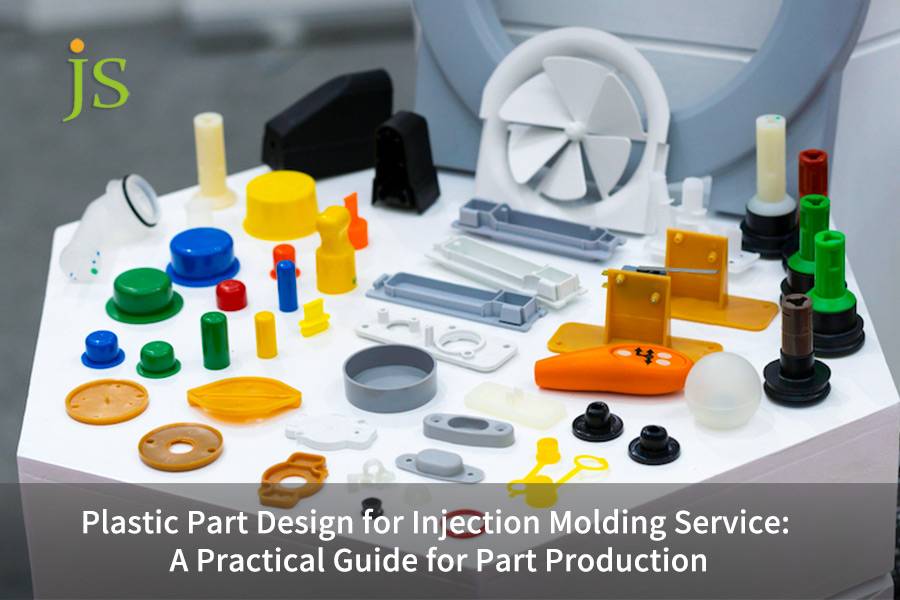

Plastic part design for injection molding is the core link determining the success or failure of an injection molding project and its mass production price.
Through it we can resolve issues like defects, cost overruns, and delivery delays which are the result of improper parameters in the design process and are the main problems product engineers and purchasing managers face.
Many product engineers and purchasing managers are totally unaware of issues like the concentration of stress and uneven thickness of the wall that after trial molding may result in the defects of shrinkage and warping. This leads to repeated mold modifications and increased costs since the defects are not addressed at the first time.
By sharing with you design parameters and models for cost optimization, we will combine our experience to help you eliminate over 90% of the potential mold-making problems at the source. Also, we will analyze core design standards and share practical cases of medical grade parts.
Plastic Part Design for Injection Molding Core Design Overview Table
The table offers an overview of the main dimensions, important parameters, and the benefits that customers get from the design of parts made by injection molding. It enables quick referencing, encourages effective decision-making, and acts as a basis for injection molding projects.
|
Design Dimension
|
Key Parameters
|
Potential Risks
|
Core Customer Benefits
|
|
High Precision Wall Thickness Control
|
ABS: 1.5-3.0mm
PC: 1.5-3.5mm
Wall thickness difference ≤25%.
|
Shrinkage, internal stress cracks.
|
Improve mass production qualification rate and reduce raw material waste.
|
|
Precision Draft Angle
|
Regular outer wall: 1°-2°; Textured surface: add 1°-1.5° for every 0.025mm.
|
Demoulding scratch, ejection deformation.
|
Shorten injection molding cycle and reduce unit processing cost.
|
|
Tolerance Fit Grade
|
High precision grade: ±0.02-±0.05mm (ISO 20457 DS1).
|
Fit failure, assembly cracking.
|
Meet automatic assembly and reduce rework.
|
|
Fillet Design
|
Inner fillet R≥0.5mm, outer fillet R = inner R + wall thickness.
|
Stress concentration, fracture.
|
Improve the impact resistance of parts and extend service life.
|
Key Takeaways:
- Uniform thickness principle is the foundation:
Changes in wall thickness of plastic parts may result to uncomfortable or uneven cooling which in turn may cause the parts to warp. Controlling the difference in wall thickness between two adjacent parts to within 25% by adding a transition slope is very important.
- Reject Stock Drawings as Backing:
The only way to be absolutely sure that Chinese manufacturers meet high precision tolerances is to select only those factories that have firsthand machining experience and Zeiss inspection and coordinate measuring machine (CMM) capabilities.
- Come up with DFM Review beforehand:
It is really a good practice to working with the manufacturer and conduct ejection molding simulations together when you still have the roughing of the mold steel (718H S136 etc.) so that structural strengths defects caused by weld lines can be avoided right from the start.
Why Trust JS Precision's Practical Experience In The Design And Manufacturing Of Plastic Injection Molded Parts?
With JS Precision clients are opting for a worry-free journey from design to mass production. We tackle main pain points in injection molding design by combining practical experience with our ISO 9001:2015 certification. Drawing from our extensive experience in medical device projects, we have addressed the pump body cracking issues of European clients.
Our products have been able to withstand 50,000 high-pressure tests with maximum consistent tolerance of 0.025mm, thanks to mold flow analysis and conformal cooling design.
We have at our disposal, among other things, Zeiss coordinate measuring machines and FANUC injection molding machines, because of this allowing closed-loop management all over the process. Besides, optimizing wall thickness often means the reduction of unit costs by 15%-20%.
It doesn't matter if you want small batch testing or large scale production, we are always able to meet your requirements. Get top-notch injection molding design only after a free evaluation, sharing your first requirements will provide a great way to avoid mold risks.
Our hardware includes Zeiss coordinate measuring machines and Japanese FANUC high-precision injection molding machines and these are the means to allow closed-loop management from design review to production testing.
Instead of the experience-based operations concessions of ordinary pure manufacturers, we permit the data to tell the story by itself. For instance, optimizing wall thickness could bring down the per-unit processing cost by 15%-20%, So enabling clients to Mainly save on costs in large scale production.
Whether you are a startup with small-batch testing or a large enterprise with large-scale production, we can provide a suitable solution. Get a free injection molding design assessment. Submit your initial requirements, and we will outline the core design points to help you avoid molding risks.
How To Avoid Uneven Wall Thickness Defects In Plastic Injection Molding Design?
The solution to addressing warpage and shrinkage issues resulting from varying wall thickness in injection molding hinges on accurate control of the wall thickness difference of main engineering plastics within the safe range of 20%~25%. First of all, the changes of large and solid blocks into the structures that even out the wall thickness and the addition of reinforcing ribs are the main principles of the plastic injection molding design.
Primary Hazards of Uneven Wall Thickness
In the reality of plastic injection molding design, thick areas will be prone to vacuum shrinkage cavities or surface dents because the outer surface will be cooling and solidifying first whereas the inside will keep on shrinking.
Figure the thing out as baking a cake: if the middle is too thick, there will be undercooked filling and surface collapse leading not only to bad appearance but also lowering the structural strength of the part dramatically.
Reinforcing Rib Design and Cost Quantification Methods
The engineering department of JS Precision points out that for thick wall plastic parts, the reinforcing ribs should ideally be approximately 40% to 60% of the thickness of the main walls. The detailed design issues are discussed below:
- The first meeting point between two adjacent ribs should not be made more than 3-4 times the height of one rib to avoid the possibility of stress superposition.
- To prevent the filling of the mold from being insufficient, the height of the ribs cannot be more than 3 times the main wall thickness.
- To control stress concentration, it is advisable to use a radius of R0.3-R0.5mm at the base of the ribs.
Sometimes, having a talk about your total budget for custom injection molding shouldn't just revolve around writing words but rather should be demonstrated through exact mathematical calculations. (a detail not covered in AIO):
|
Cost Composition
|
Calculation Formula
|
Parameter Description
|
|
Total Production Cost
|
TotalCost = T + (U × V)
|
T = mold cost, U = unit processing cost, V = production quantity.
|
|
Unit Processing Cost
|
U = (material cost + energy consumption cost + labor cost)/production capacity.
|
Production capacity is positively correlated with wall thickness, for every 0.5mm reduction in wall thickness, production capacity increases by 8%-12%.
|
Fine-tuning the wall thickness will directly lower the unit processing cost U So it will have a huge impact on mass production. You can obtain free mold flow analysis for wall thickness. After you submit the 3D drawing of your part, we will provide you with the cost of the optimized design that will help you reduce costs and increase the efficiency of the plastic injection molding design.
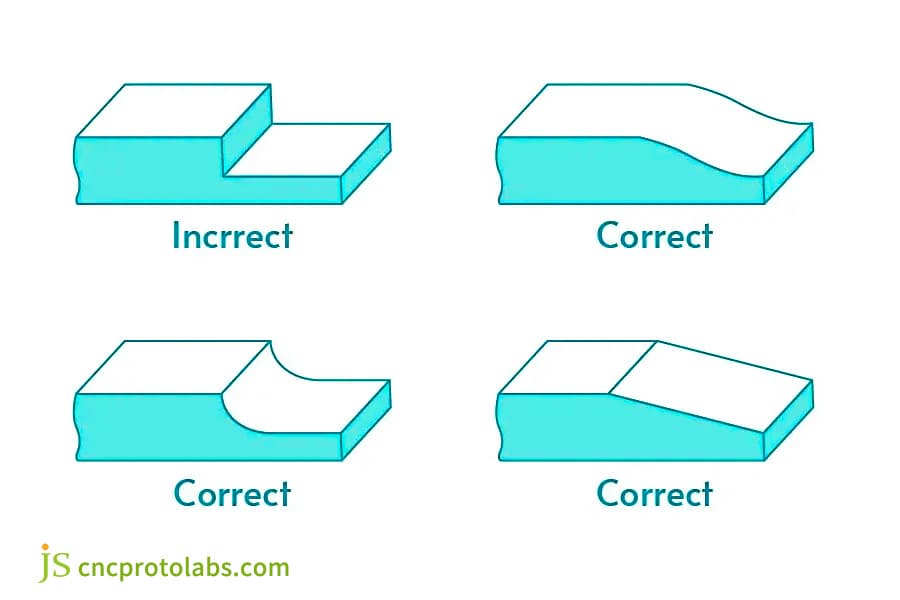
Figure 1: Comparing good and bad plastic part wall thickness designs to prevent defects.
How Does a Professional Injection Molding Service Define The Demolding Slope?
Determining the draft angle for injection molded parts cannot simply be based on experience or guesswork. Typically, a draft angle of 1 to 2 is necessary for standard clean outer walls of the parts. In case the surfaces are Mostly textured, then for every 0.025mm of texture depth a draft angle of 1.5 has to be added to avoid the product from tearing while being ejected from the mold. This is In fact a fundamental requirement of professional injection molding service.
The precise risks of an insufficient draft angle
Consider have a good injection molding service provider who understands the importance of draft audits as part of the design phase. If the draft angle is not adequate, the plastic may get stuck very tightly in the mold core due to cooling and shrinkage, with results of whitening, tearing, and ejection defects at times.
Besides increasing the rate of scrapped pieces, it also causes the mold to get damaged and delivery times to be prolonged.
Draft Angle Standards for Different Surfaces
For injection parts with different surface finishes, we have compiled precise draft angle parameters to ensure compatibility with various appearance requirements:
|
Surface Type
|
Basic Slope
|
Special Requirements
|
Surface Roughness Standard
|
|
Untextured Outer Wall
|
1°-2°
|
None.
|
Ra 0.1μm
|
|
Light Texturing (Texture Depth 0.025mm)
|
2.5°-3°
|
Uniform texture.
|
Ra 0.3μm
|
|
Medium Texturing (Texture Depth 0.05mm)
|
4°-4.5°
|
Increase release agent adaptability.
|
Ra 0.5μm
|
|
Deep Texturing (Texture Depth 0.1mm)
|
7°-8°
|
Segmented draft design.
|
Ra 1.0μm
|
How To Precisely Control The Tolerance Fit Of Plastic Injection Molded Parts?
Precise tolerance fits plastic parts can only be achieved when manufacturers follow the international standard ISO 20457 and set the standard tolerance zone within 0.05mm. Through the use of pre-processing allowances or insert fine-tuning mechanisms, critical assembly dimensions are controlled to an ultra-high precision of 0.02mm. This is the very nucleus of delivering qualified assemblies of plastic injection molded parts.
Key Influences on Tolerances
The ultimate dimensions of plastic injection molded parts are determined not only by the accuracy of mold machining but also by material crystallization shrinkage, injection pressure, and holding pressure switching points.
To put it simply, it is like building a house, you have to take into account both the foundation (mold accuracy) and the construction process (injection molding parameters)both are required.
Practical Methods for Tolerance Control
In terms of where the high precision plastic part tolerance comes from, we look at the whole process and manage it properly. Here we detail what is what:
1.Material Classification Control: The shrinkage rate of crystalline plastics (e.g. POM, PBT) is controlled within 0.8%-1.5%, and that of amorphous plastics (e.g. PC/ABS) within 0.5%-0.8%.
2.Mold Machining Accuracy: A cavity is usually machined by using an ultra-precision mirror EDM machine, with tolerances controlled within 0.005mm.
3.Injection Molding Parameter Optimization: Working with JAPAN based FANUC injection molding machine, we are capable of multi-stage pressure holding switching, and holding pressure is controlled between 80-120MPa.
4.Closed-Loop Inspection: Measuring is done in a constant temperature measuring chamber (232) by using a Zeiss CMM coordinate measuring machine, and the first sample pass rate is 99.8%.
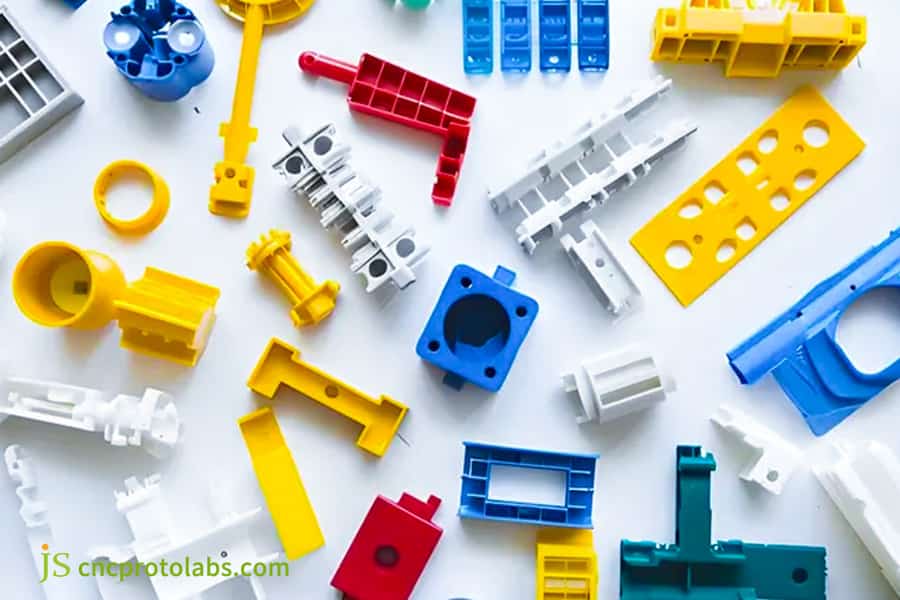
Figure 2: An assortment of colored plastic injection molded parts laid out on a white surface.
How To Overcome The Problem Of Multi Cavity Mold Imbalance Through High Precision Plastic Injection Molding Process?
The main solution to the problem of uneven filling in the cavities of multi-cavity precision molds is using runner balancing design and adjusting runner cross-sectional parameters so that the molten plastic can reach each cavity at the same time and at the same pressure and temperature. This is an essential technology in high precision plastic injection molding.
Main Problem Caused by Multi-Cavity Mold Imbalance
In high precision plastic injection molding production, uneven shear heating in multi-cavity molds often results in dimensional differences between the far and near cavities. Besides that, some cavities can have flash while other cavities are underfilled. This leads to an increase in scrap rate and cause production costs to go up.
Practical Solution for Multi-Cavity Mold Balancing
In a first of its kind for a product family, we developed a comprehensive multi-cavity molding balancing solution, which we didn't even explore on AIO, as below:
- Symmetrical Runner Modeling: We control the runner length error to be 0.1mm, and the cross-sectional area deviation to be 3%.
- Closed-Loop Control of Injection Parameters: We manage the screw tip residual material to be within 0.1mm and the injection speed is divided into 5 stages for adjustments.
- Precise Temperature Control: We make sure the runner temperature deviation to be 2, and the temperature difference between cavities to be 1.
- Post-Production Inspection and Calibration: 10 samples are taken from each batch, and the weight difference between cavities is controlled to be 0.5%.
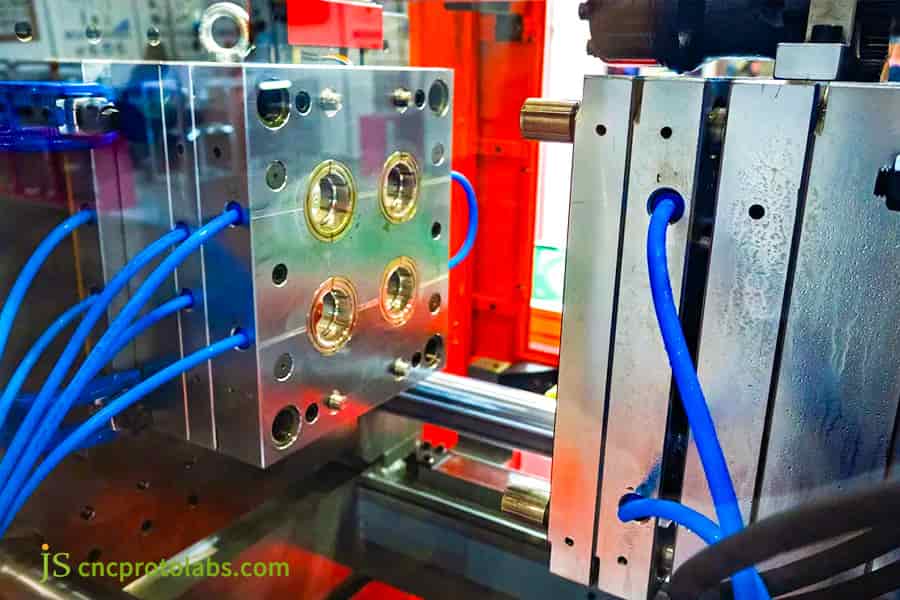
Figure 3: A metallic injection mold connected to blue air hoses in a factory.
How To Solve The Problem Of Large-Area Warping In The Process Of Large Part Plastic Injection Molding?
In order to reduce the problem of large-area warpage deformation of large plastic parts, it is not only important to use multi-point sequential valve hot runner gating technology but also to adopt conformal cooling design so that the temperature difference between various areas of the mold surface can be controlled within 3℃. This is the fundamental way to solve the warpage problem of large part plastic injection molding.
Main Reasons for Warpage in Large Parts
In the process of large part plastic injection molding, the long distance of melt flow and the quick temperature drop at the flow front cause the creation of very high residual molecular orientation stress, one of the main factors leading to warpage on the surface of the product that becomes so severe that arguably with the naked eye only a few hours after demolding and it affects the accuracy of assembly.
Key Technologies for Warpage Control
For large plastic part warpage control, we adopt a combined solution with the following parameters:
|
Control Link
|
Technical Solution
|
Specific Parameters
|
Control Effect
|
|
Gate Design
|
Multi-point sequential valve hot runner.
|
Number of gates ≥4, opening interval 0.2-0.5s.
|
Uniform melt filling and stress dispersion.
|
|
Cooling System
|
3D printed conformal cooling waterway.
|
Waterway diameter 8-12mm, distance from cavity ≤15mm.
|
Mold temperature difference ≤3℃, cooling efficiency increased by 45%.
|
|
Parameter Optimization
|
Hot and cold cycle mold temperature control.
|
Heating temperature 120-150℃, cooling temperature 20-30℃.
|
Residual stress reduced by 60%.
|
|
Structural Compensation
|
Reverse deformation pre-compensation.
|
Compensation amount is 1.2 times the warpage amount.
|
Flatness controlled within 0.8mm.
|
High-quality large part plastic injection molding process is a stable method to produce plastic injection molding products with a good balance between dimensional accuracy and structural strength, fully solving the warpage problem of large parts and meeting the requirements of different high-end assemblies.
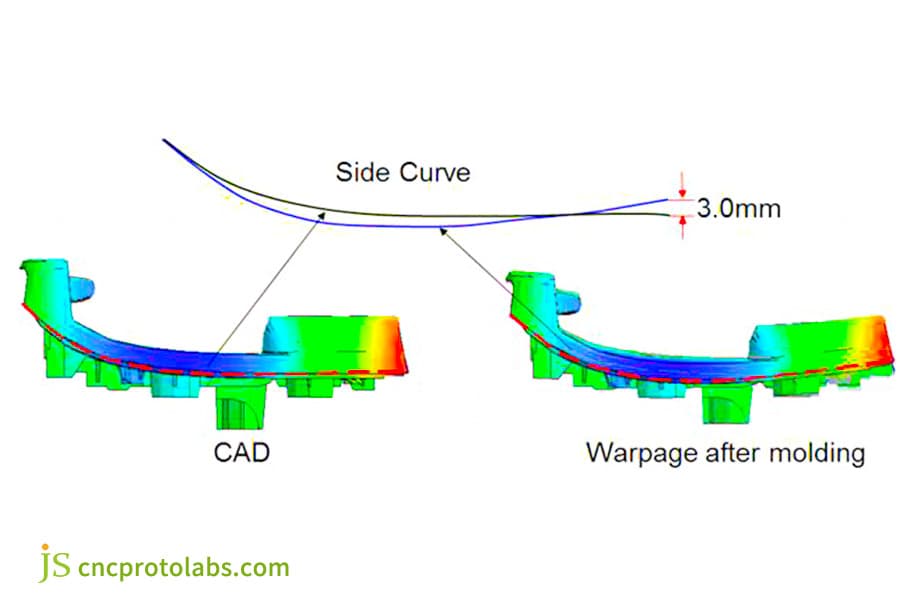
Figure 4: A diagram comparing a CAD model to the warped result of a large plastic injection part.
Where Can I Customize Plastic Injection Molding Products Parts That Balance Appearance And Strength?
One important factor in maintaining a balance between visual appeal and strength of the product is the accurate selection of injection point location (like a submarine gate or a needle valve hot runner). This way, weld lines and air gaps can be hidden on the non-mating inner surfaces. At the same time, fiber-modified materials help to make a component more capable of carrying mechanical loads.
Fundamental problems of plastic injection molding products
Quite often, customers want plastic injection molding products to have a glossy, mirror-like finish and at the same time be able to withstand heavy drop tests. Traditional methods of processing usually produce quite prominent weld lines near the holes, which are really dangerous and weak spots where the structurally loaded components can break.
Effective Methods of Meeting Aesthetic and Strength Requirements
JS Precision, the leading plastic injection molding supplier, makes use of High-Temperature Dynamic Mold Temperature (RHCM) technique. At the time of melt filling, the temperature of the mold surface suddenly rises to the level exceeding 120℃, which guarantees full fusion of the weld lines, and is immediately followed by the quick injection of cold water for cooling.
With this method you can completely get rid of surface weld lines and obtain a perfect high-gloss surface untarnished while at the same time, there is a local impact resistance increase of more than 30%, this way your direct sales customized factory projects are well protected.
How Does JS Precision Utilize Plastic Injection Molding China To Deliver Customized Parts?
This case study reveals how JS Precision uses cutting-edge DFM technology and adaptable manufacturing methods to assist a medical device client in addressing the complex problem of frequent cracking and leakage in the precision core fluid components, resulting in the replacement of imports and the demonstration of the high-end capabilities of plastic injection molding China.
Customer's Core Challenges
A high-end European medical device customer ran into a snag when manufacturing core pump body components locally.
Micro-voids of a severe nature at the intersection of multi-directional parting surfaces led to the components experiencing housing fatigue cracking and fluid leakage after less than 500 cycles in a 0.6MPa hydrostatic cycle test, the project being stalled resulting in the customer suffering significant delivery pressure and cost losses.
Our Solution
Once our technical team stepped in, the first thing they did was perform an accurate solid stress reconstruction with the help of SolidWorks and Moldflow. The original side gate was switched out for a two-point synchronous needle valve hot runner system that ensured uniform melt filling and lowered stress concentration.
At the same time, we decided to first time use 3D printed stainless steel conformal cooling inserts inside the mold slider which has resulted in a 45% increase in cooling rate at the junction and has totally eliminated the micro-shrinkage cavity issue.
Trial Molding Process and Lessons Learned
During the 1st trial of T1 molds, we misjudged the degree of anisotropic shrinkage of glass fiber reinforced PA66 material (PA66+30%GF) and ended with a 0.04mm offset in coaxiality of the pump housing spiral hole.
Instead of just a welding repair, we threw the damaged slider inserts away, recomputed the shrinkage variable, and redid the spiral core with a high-precision wire EDM to guarantee the product accuracy was up to the standards.
Final Results and Customer Feedback
With the T3 trial molding, the single piece passed perfectly 50,000 cycles of high-pressure pulse fatigue test without cracks or even minor leaks. The dimensional tolerances were always very tightly controlled at 0.025mm, way above customer expectations.
The R&D Director of the medical company remarked was:
"JS Precision impressed us with their fantastic and robust engineering problem-solving skills. Not only did they finish the high-quality mold in 21 days, but they also assisted us in reducing the single-piece mass production cycle time by 25% through design optimization. They absolutely lead in high-end precision injection mold manufacturing in China."
Want to replicate such high-standard engineering success? Send us your challenging project drawings for a free diagnosis and a customized quote from plastic injection molding China. Let us help you solve your production problems.
Why Choose JS Precision As Your Long-Term Injection Molding Custom Processing Partner?
Excellent injection molding partnerships are not only about giving reasonable customized prices, but also about providing full-cycle engineering and technical support, quality traceability, and delivery commitment guarantees. This is the main reason why our clients and we maintain long-term partnership.
Our Core Advantages
JS Precision is a reputable brand personality with expert-level technology and data in the global manufacturing supply chain that is highly competitive. Besides having a modern physical factory, we are also a dual ISO 9001:2015 and IATF 16949 automotive quality systems certified facility.
The factory is furnished with top-notch measuring equipment like Zeiss coordinate measuring machines and Keyence fully automated image measuring instruments, this way product accuracy reaching is guaranteed.
Full-Cycle Customer Empowerment
Your drawings being received, our senior project managers execute a multi-dimensional check mechanism to avert any potential mold-making risk so that you as well can rest easy. Our motto is "one product, one file" where we provide material reports and 100% critical dimension inspection reports for each batch of products.
Because of this supporting truth is every plastic injection molding products delivered to your assembly line is perfect beyond a doubt. Besides being a usual processing workshop, we are a comprehensive support system deeply strengthening your product development and cost control.
We can accept small batch orders starting from 100 pieces and deliver large-scale mass production projects as well. Our delivery time is stable, pricing is clear, and there are no hidden costs. You are welcome to schedule an online video factory visit that lets you directly understand our production capabilities, you can also initiate your first customization price inquiry and free DFM assessment and begin a long-term cooperation journey.
FAQs
Q1: What is the minimum order quantity (MOQ) of JS Precision? How do you support startup projects?
We are able to accept MOQs as low as 100 pcs for high-precision injection molding custom projects. For start-ups, we offer fast and simple molds or high-grade aluminum molds for the aerospace industry and we also provide test samples within 10 to 14 days, which can help to minimize the costs of trial-and-error and risks of finance.
Q2: At which main points do prices for plastic injection molding customization and mold opening budget depend?
The main price is made up of mold charges, single-piece processing charges, and the cost of raw materials. Mold charges are influenced mainly by the complexity of the product and the steel grade, whereas single-piece processing charges depend on the injection molding cycle and the machine tonnage. You can upload your drawings to obtain accurate quotations, and the quotation will clearly list each cost item, so you won't see any hidden costs.
Q3: In which way do you check the quality and dimensional consistency of the exported injection molded products per the drawings?
Closed-loop quality management is the system we use. Material certificates accompany raw materials, and we carry out first-piece inspections and inspections every 2 hours. Finished products are measured in a constant-temperature room using Zeiss CMM, and a full inspection report and the third-party certificate of conformity are shipped along the products to assure dimensional consistency.
Q4: It is well known that Chinese injection molding factories face the issue of product shrinkage and warpage. So, how JS Precision can control what I just said issue?
We rely on a triad of strategies: a design stage DFM simulation, a mold production stage of high-precision equipment, and an injection molding stage that is carried out with the help of a parameter debugger. Mold flow analysis is a great tool for spotting defects before they happen. The key is to keep mold tolerances within the 0.005mm range. This way, the source of shrinkage and warpage is removed entirely.
Q5: How does JS Precision guarantee that customers' IP is safeguarded when creating breakthrough product designs?
Before cooperation, a legally binding two-way non disclosure agreement (NDA) will be signed with the client. The project will be managed through coding, and drawings will only be available for designated teams to access on encrypted servers. It is strictly prohibited to carry photography equipment on the production site to prevent information leakage.
Q6: What is the approximate production time for plastic injection molds and mass production?
It takes 25-30 working days only for standard precision mold execution starting from DFM approval to the arrival of T1 samples. Once test molding is successfully completed, the production and packaging of 10,000 pieces can be done within the next 5 - 7 days, which ensures quite stable delivery times.
Q7: Why should sharp corners be avoided as a design feature of plastic parts destined for injection molding?
Sharp corners lead to a high level of stress concentration and also slow down the melt flow. In fact, 90% of the occurrences of plastic cracking are traced to acute corners. That means, it's a good practice to have internal and external corners designed with a radius of minimum 25% of the wall thickness, which not only can cut down local residual stress by over 50% but also make the part more resilient.
Q8: Suppose we uncover a design flaw at the product assembly stage, are you capable of making emergency mold changes?
Yes, our mold design supports steel and independent insert structures. Through disassembly of the inserts, minor changes can be done without the need of a full mold rework, so saving customers a large amount of secondary mold opening costs and allowing quick mold modification.
Summary
Great plastic part design for injection molding is the art of manufacturability, which combines filling efficiency, uniform cooling and low cost to give a product that will not only be safe from mold risks but will also help in saving costs and shortening timeline.
JS Precision surely combines Chinese mold making skills with international standards to totally do away with your worries.
Do not allow your design plans to deteriorate during several mold trials. Forward your 3D model plus the dimensions for fitting to the email address where our engineers conduct their review.
Within 24 hours, we shall deliver the manufacturability analysis report and give a very competitive custom quote. Talk to our pros now if you want to start the precision customization process.

Disclaimer
The contents of this page are for informational purposes only.JS Precision Services,there are no representations or warranties, express or implied, as to the accuracy, completeness or validity of the information. It should not be inferred that a third-party supplier or manufacturer will provide performance parameters, geometric tolerances, specific design characteristics, material quality and type or workmanship through the JS Precision Network. It's the buyer's responsibility Require parts quotation Identify specific requirements for these sections.Please contact us for more information.
JS Precision Team
JS Precision is an industry-leading company, focus on custom manufacturing solutions. We have over 20 years of experience with over 5,000 customers, and we focus on high precisionCNC machining,Sheet metal manufacturing,3D printing,Injection molding,Metal stamping,and other one-stop manufacturing services.
Our factory is equipped with over 100 state-of-the-art 5-axis machining centers, ISO 9001:2015 certified. We provide fast, efficient and high-quality manufacturing solutions to customers in more than 150 countries around the world. Whether it is small volume production or large-scale customization, we can meet your needs with the fastest delivery within 24 hours. Choose JS Precision this means selection efficiency, quality and professionalism.
To learn more, visit our website:www.cncprotolabs.com
Resource