English



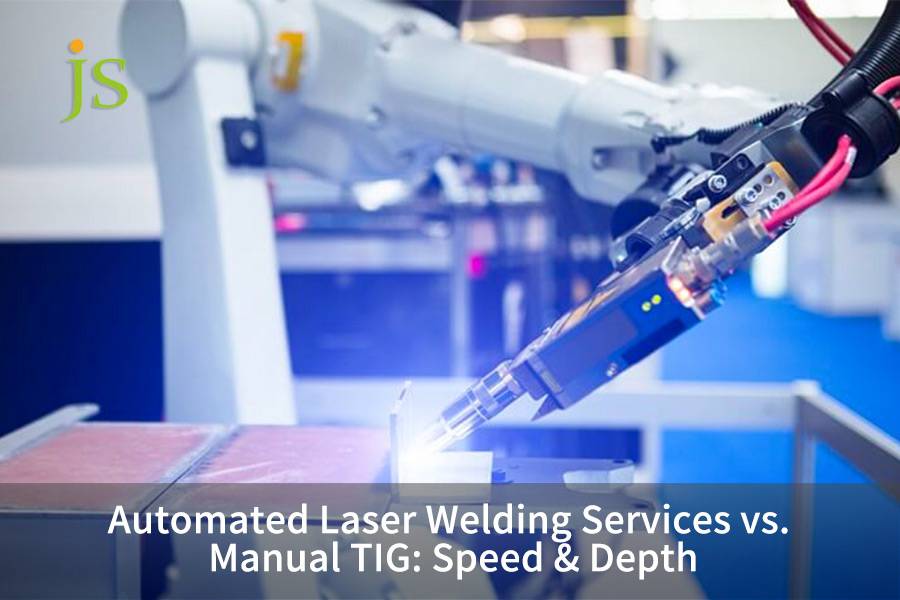

Automatic laser welding services employ highly concentrated fiber laser beams with intensity surpassing 10⁶W/cm². This method allows for processing 10 times quicker and deeper/narrower welding beads in laser welding compared to manual TIG welding. Although manual TIG is still suitable for intricate and small-batch repairs, automated fiber laser systems remove human heat variation, and make laser welding of single-pass full penetration of thickness 8mm in stainless steel possible without warping.
In case of very accurate mass manufacturing, fully automated laser welding services reduce dramatically production cycle time, HAZ heat-affected zones and per-piece labor costs.
Core Executive Summary & Key Takeaways
Automated laser welding services deliver 1.5–6.0 m/min travel speed (5–10x faster than manual TIG at 0.1–0.3 m/min) and 1.0–8.0 mm single-pass penetration (2–3x deeper than TIG's 1.5–3.0 mm), fundamentally redefining production throughput and joint design possibilities.
- Speed and efficiency:
Automated laser welding services are able to operate at speeds ranging from 1.5 to 6.0 m/min while continuous travel speeds of manual TIG are limited to about 0.1 - 0.3 m/min. The use of laser technology can reduce the overall production cycle (up to 80%).
- Penetration depth and control:
In keyhole mode, laser welding allows for deep single-pass penetrate of 1.0 - 8.0 mm and depth-width ratio greater than 5:1. On the contrary, manual TIG welding is less penetrating (1 - 3 mm) and it is not possible to weld thick plates without beveling the edges several times.
- HAZ area & control of deformation:
As a laser welding process, it generates an extremely limited heat-affected zone (HAZ) (< 0.5 mm), heat-input is cut down to 25% of that manual TIG (heat-input being in the range from 2.0-5.0 mm), completely doing away with thermal warping, and decreasing the weld-grinding cost nearly to zero.
- Assembly Gap Tolerance:
The utilization of wobble technology that involves oscillating the welding torch to get an amplitude of up to 5.0 mm and an auto-wire feeding machine with laser automation will enable handling assembly gaps as much as 1.5 mm (wherein conventional lasers require ≤10% of the board thickness).
- Energy Efficiency and Overall Cost:
Laser electro-optical conversion efficiency can become as high as 30%-40% (TIG conversely only 10%-15%), which means gas consumption is cut down by 60% and an investment payback in less than a year is possible during large-scale manufacturing.
How Do Automated Laser Welding Services Outperform Manual TIG in Speed and Depth?
Automated laser welding services provide travel speeds of 1.5-6.0 m/min, the 8 mm single-pass penetration depth without the heat conduction mechanism, and at the same time save the 70% energy and increase the production output up to 10 times.
Heat Conduction Welding vs Keyhole Welding: Difference at Physical Mechanisms
- Energy density gap: TIG arc heat radiation during manual welding is about 10⁴ W/cm². It depends on heat conduction to melt the base material, and the heat will get spread to the surrounding, leaving a large HAZ (heat-affected-zone) and thin plate deformation.
- Keyhole action: In case of laser welding, the beam of extremely high energy density, focused by laser >10⁶ W/cm², creates a vapor pressure that causes a hole to evaporate and a keyhole to form. This gives direct beam access to the deep metal layer, resulting in an aspect ratio of a few dozens to high aspect ratio deep penetration welding.
- Heat Input Contrast: For a sample of 316L stainless steel at the thickness of 3 mm, the laser vs TIG heat input ratio is 1:7. And, laser welding takes up only 12% of the TIG one whereas tensile strength improves by 15% (AWS 2025 Industry Report).
The following table summarizes the quantitative differences between the two processes in four core dimensions:
|
Comparison Dimension |
Automated Laser Welding |
Manual TIG Welding |
Advantage Ratio |
|---|---|---|---|
|
Travel Speed (m/min) |
1.5 – 6.0 |
0.1 – 0.3 |
5–20x faster |
|
Single-Pass Penetration (mm) |
1.0 – 8.0 (keyhole mode) |
1.5 – 3.0 (conductive mode) |
2–5x deeper |
|
Heat-Affected Zone (mm) |
< 0.5 |
2.0 – 5.0 |
75–90% narrower |
|
Per-Piece Cost (10k batch) |
$0.70 |
$5.03 |
86% lower |
Quantitative Decomposition of Speed Advantage
- Travel Speed: The speed of travel is much faster, up to 6 m/min, with continuous operation and no interruptions. Though, manual TIG welding, which is restricted by the speed of the operator's hands and the manual feed of wires, can only manage 0.1-0.3 m/min speeds.
- Single-Piece Cycle Time: For example, a 500 mm long weld, the laser welding takes only 5-20 seconds, whereas TIG takes 100-300 seconds, about 10-15 times the welding cycle.
- Batch Scale-Up Effect: A batch of 10,000 pieces would have the welding time of lasered parts as only 8%-12% of the TIG counterpart. It basically decides which is the winner in per-piece processing costs.
Our practical experience in a medical sensor housing project: The customer required a 0.8 mm thick 316L stainless steel housing that is IP68 watertight and has a flatness variation ≤0.05 mm. The manual TIG solution deformation was >0.6 mm with a 62% yield rate at most. A laser welding system that is 2 kW fiber laser combined with a wobble oscillating head has increased the yield rate (up to 99.8%) and shortened the time to 45 seconds, a reduction from the previous 8.5 minutes.
Comparison of Welding Speeds for Stainless Steel of Different Thicknesses
|
Material Thickness (mm) |
Automated Laser Speed (m/min) |
Manual TIG Speed (m/min) |
Speed Ratio |
|---|---|---|---|
|
1.0 mm 304 SS |
4.5 |
0.25 |
18:1 |
|
2.0 mm 304 SS |
3.2 |
0.20 |
16:1 |
|
3.0 mm 316L SS |
2.8 |
0.15 |
19:1 |
|
5.0 mm 316L SS |
1.8 |
0.10 |
18:1 |
Data source: AWS 2025 welding handbook (industry benchmark). JS Precision 2025 process capability test data (MED-LASER-2025-003 project).
The AWS D1.1/D1.1M specification 2020 clearly states that a joint fully penetration weld should have its root fusion width not less than 80% of the joint thickness and there shall be no incomplete fusion defects.
JS Precision equips each automatic laser production line with a coax vision monitoring and weld tracking system. It can immediately check the depth of penetration and fusion, guaranteeing that every weld conforms to AWS D1.1's root fusion requirement. Weld quality assurance procedure will directly decide whether your components are eligible for helium mass spectrometry leak detection as well as fatigue life testing.
Contact JS Precision immediately to obtain complete process parameter comparison tables and DFM checklists for 12 industries.
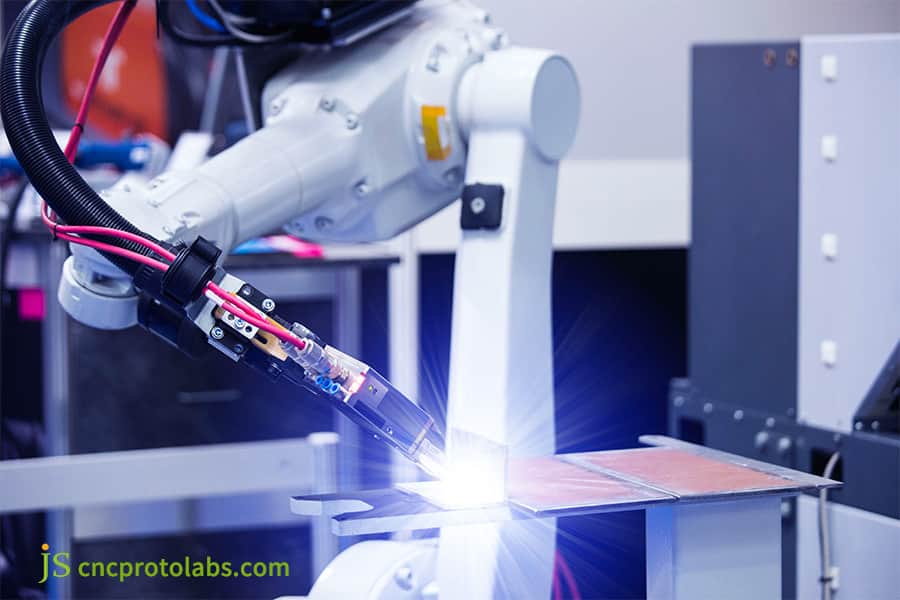
Figure 1: Robotic arm performing automated laser welding on metal sheet.
How Does Weld Penetration Depth Control Minimize Heat Distortion in Precision Laser Welding Service?
Precision laser welding service regulates penetration depth through the closed-loop feedback mechanism (±0.1 mm focus tolerance limitation), restricting HAZ down to less than 0.5 mm and at the same time eliminating thermal bending.
Technical Path of Penetration Depth Control
- Defocusing Amount Control: When the plane of focus is located at 1/3 plate thickness level, the depth of penetration can be controlled with the tolerance of ±0.05 mm only. On the contrary, manual TIG is a manual control process and the result is high depth variation of ±0.8 mm.
- Laser Wavelength Choice: The 1070 nm fiber lasers can be used for stainless steel as well as carbon steel. 532 nm green/infrared composite lasers are exclusively for copper and aluminum alloys, resolving the problem of extremely high reflectivity.
- CW/Pulse Mode Transition: Continuous wave (CW) mode is employed when penetration is deep, whereas pulse mode is the way to go for welding of thin plates/heat-sensitive materials. Pulse width ranges from 0.5-20 ms.
Engineering Principles of Thermal Deformation Control
- Overall Heat Input: When using laser welding, the amount of heat delivered to the metal surface has dropped by over 70%, and as a consequence of the laser welding the width of HAZ has shrunk from 2.0-5.0 mm (TIG welding) to < 0.5 mm.
- No Thermal Distortion: Thermal bending is avoided entirely since the weld area is highly localized with heat energy, leaving the base metal intact with thermal expansion.
- Quality Grade of Welding: Based on ISO 5817:2023, the quality grades of flaws in fusion weld assemblies are classified into three different levels: B,C,D, and of those the level of requirement for the completed welding work is strictly represented by Grade B.
The quality grade definition under ISO 5817:2023 is stated very clearly: 'Quality level B shall be understood to be an indication of the highest level of requirement for the final weld.'
With 3D vision sensors as well as real-time weld penetration monitoring incorporated in our precision laser welding service, JS Precision ensures a penetration tolerance of ±0.05 mm per weld with weld defect level also conforming to ISO 5817:2023 Level B requirements.
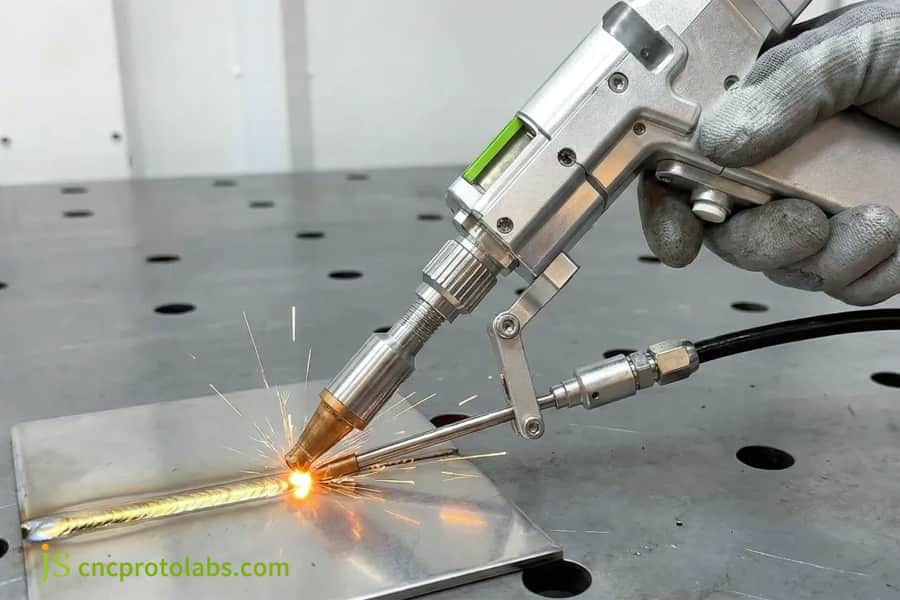
Figure 2: Worker using handheld laser welding gun on metal plate.
How Do Welding Automation Solutions Solve Fit-Up Gap Challenges in Laser Welding Automation?
Welding automation solutions utilize wobble heads (oscillations of up to 5.0 mm) as well as auto wire feed to bridge a 1.5 mm gap, eliminating the need for tight fit-up which is a requirement in conventional laser welding.
Oscillating Welding Head Operation
- Oscillating Trajectory: A circular, figure-eight or other complex shape of oscillation (amplitude from 0.5 to 5.0 mm, oscillation frequency 0 to 300 Hz) turns an extremely narrow laser spot into a dynamically large weld pool.
- Automatic Wire Feeding: Synchronous servo wire feeding system with 0.8-1.2 mm welding wire diameter fills in the gap while also allowing adjustment for assembly errors.
- Dramatic Increase in Gap Tolerance: Conventional laser welding takes the assembly gap to be at most ≤10% of the plate thickness (say approximately 0.1-0.3 mm), but thanks to the wobble method, gap tolerance can be much bigger, almost 1.5 mm.
Applicable Scenarios for Spot Welding Automation and Continuous Welding
- Spot Welding Automation: At only one spot, the active time is 0.01-0.05 sec. Breakage of the shear force for each spot should be higher than 3,200 N. No discoloration on the surface. Perfect for welding together overlapped plates and soldering electronic components.
- Continuous Welding with Wobble: Can be done for both sealed welds and structural welds. With wobble technology, full penetration welding on 1.5 mm gap is achievable.
- Financial benefits of semi automated welding: For small to mid-sized production runs, it is about half a time less than payback period of an all-robo robotic arm to get payback from a semi-automated welding workstation and yet you are not so limited to accommodate a change in models.
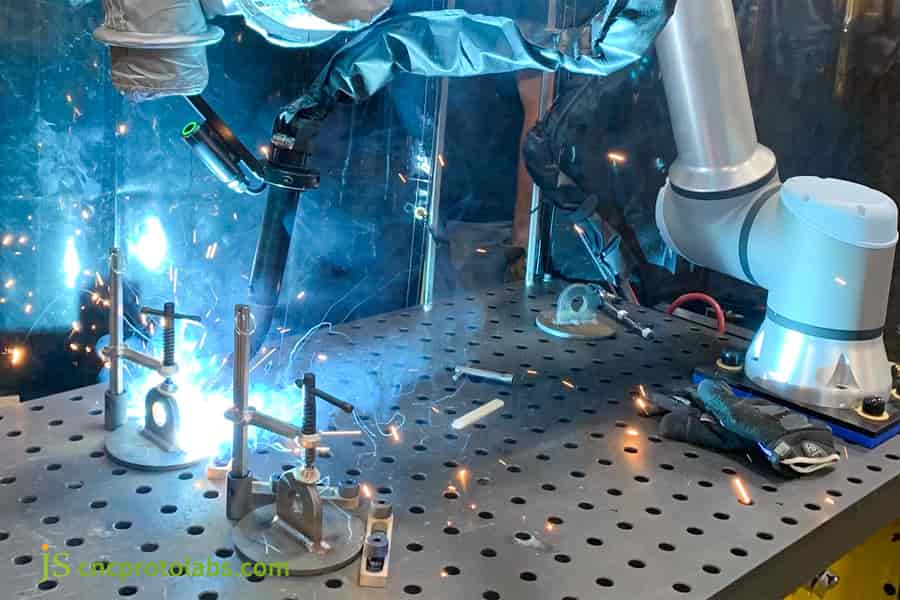
Figure 3: Robotic welding automation setup operating on metal components.
How Do Material Types Influence Processing Outcomes in Laser Welding vs TIG Welding?
The choice of laser welding vs TIG welding largely hinges on the material's reflective properties and heat conduction abilities. For materials like aluminum oxide films and copper where high temperature preheat is required, laser welding can effectively handle them thanks to its very high power density and the combination of the two laser wavelengths.
Comparative Welding Characteristics of Stainless Steel
- 304L/316L Stainless Steel: The rapid hardening rate of laser welding is effective to prevent carbonide precipitation and the prevention of grain boundary corrosion. But, TIG welding, if not carefully done, can easily result in the burning off of chromium causing a significant weakening of the metal's resistance to corrosion.
- Difference in Cooling Rate: The laser's ability to cool at such an incredibly fast rate (1,000 to 100,000 degree Celsius per second) versus an average rate of TIG cooling (10³ to 50⁵ degree Celsius per second) can impact the weld metal microstructure as well as refinement.
Challenges of Welding Aluminum and Copper Alloys
- 6061/7075 Aluminum Alloy: In laser welding, the very high energy density used is able to disintegrate the surface oxide film (Al₂O₃, melting point 2072℃) without having surface layer melted which is a factor which lowers hot-craking susceptibility and achieves levels of porosity that are in line with requirements of the ISO-standard class 1.
- C1100 Pure Copper: By working together with a green/infrared composite laser that is 532 nm, one can avoid using TIG weld preheating to 300℃, which was previously a welding requirement for copper and now it can be done in one step with the material being at room temperature.
JS Precision can carry out precision laser welding service of all metallic materials, including from 0.3 mm stainless steels to 8 mm copper alloys, which make more sense when talking about automated welding.
If you need a custom material drawn up for you at JS Precision, they can provide a free trial welding with a comparison of laser welding vs TIG welding processes, plus a customized welding process report.
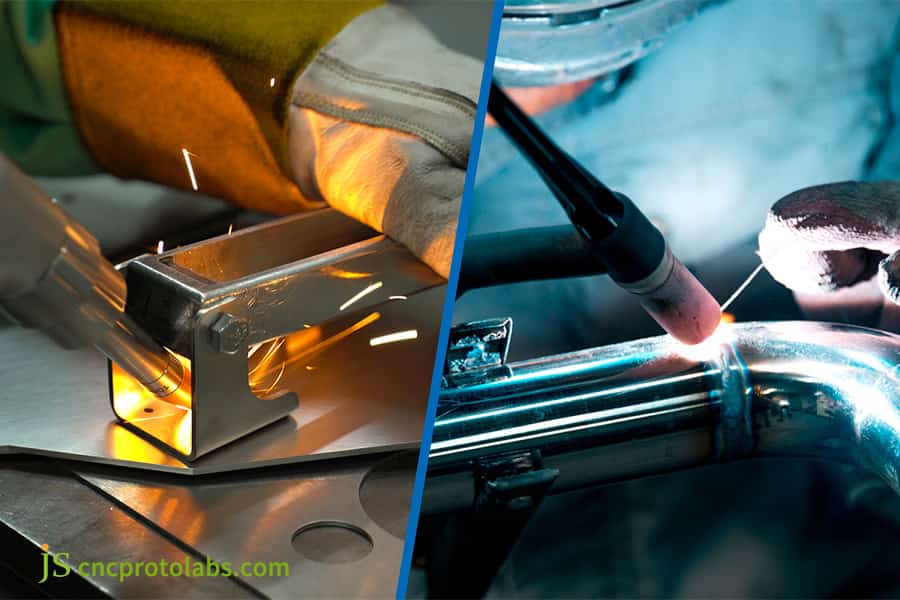
Figure 4: Comparison of manual laser welding and TIG welding processes.
What Is the True ROI and Cost-Per-Part Advantage of Automated Laser Welding Services?
One of the advantages of automated laser welding services is it does not require post-weldit saves 60% of consumable gases and also achieves 35% electro-optical efficiency that brings the equipment payback only 12 months of medium- to large-volume production.
Comparison of Energy and Gas Costs
- Power Electro-Optical Conversion Efficiency: The efficiency of laser welding is about 35% while TIG welding is only about 12-5%. Taking a 3-kW output power as an example, the actual power consumption of the laser equipment would be around 8.5 kW and for the TIG unit it is 20-30 kW.
- Shielding Gas Usage: The extremely fast laser movement speed (3.0 m/min) Really decreases the use of argon gas per length unit by 60%, that is, from 15-20 L/min needed for TIG to 8-12 L/min only for the laser.
Labor and Post-processing Cost Savings
- Post-processing Grinding: Due to TIG welding, deformation and spatter happen, and 1:2 manual grinding time is required. 2 minutes of grinding need to be done for every 1 minute welding work. Laser welds are much more elegant with hardly any imperfections, so no grinding can be done, saving totally 100% of post-processing grinding time.
- Rework Rate: For the first time the results are as good, which indicates that laser welding automation can even reach 99.5% of the first-pass yield. Meanwhile, the first-pass yield of manual TIG welding is only 70%-85%.
Total Cost Breakdown for 10,000-Piece Batches
|
Cost Category |
Automated Laser Welding |
Manual TIG Welding |
Saving |
|---|---|---|---|
|
Equipment amortization (per piece) |
$0.35 |
$0.08 |
Laser higher initially |
|
Electricity cost (per piece) |
$0.12 |
$0.45 |
73% saving |
|
Shielding gas cost (per piece) |
$0.08 |
$0.20 |
60% saving |
|
Labor cost (per piece) |
$0.15 |
$2.80 |
95% saving |
|
Post-weld grinding cost (per piece) |
$0.00 |
$1.50 |
100% saving |
|
Total per-piece cost |
$0.70 |
$5.03 |
86% reduction |
Data source: SME 2025 manufacturing cost analysis report. JS Precision 2025 production cost tracking database.
The SME 2025 manufacturing cost analysis report states that for batches of 10,000 units the overall unit cost of automated laser welding services in mass production is 48%-86% lower than of TIG welding according to the parts' geometrical complexity. As the original manufacturer, JS Precision shows price benefits in our quotations.
If you want to know the real unit cost of your parts when made by laser welding services then please contact the JS Precision engineering team. We will send you a free cost report and you'll get a quote adjusted to your request.
How JS Precision Delivered Precision Custom Laser Welding Services for Medical Enclosure Assemblies?
JS Precision implemented laser welding automation in the production of customer-specific 316L stainless steel medical sensor housings. The new process prevented thermal distortion and at the same time enabled IP68 hermetic sealing with a flatness tolerance of 0.05 mm. The manufacturing throughput also increased about 3.5 times.
Customer Problems
A medical device manufacturer had been making customized 316L stainless steel casings (0.8 mm wall thickness). The standard manually driven TIG welding gave rise to considerable flatteness deformation (deformation > 0.6 mm, requirement ≤0.05 mm) and poor helium mass spectrornetry leak detection leading to a pass rate of only 62%.
JS Precision Solution
- Water-cold-copper fixture for welding constraints: Through such fixture of high conducting water-cooled material like Copper which conducts the heat of welding away very quickly, thereby minimizing the heat buildup at the joint to be welded.
- 2 kW Fiber Laser +Swing Wobble Head: The integration of one weld penetration depth control laser power control closed-loop module makes this system capable of real time laser power adjustment so that a uniform weld penetration depth is maintained. Swing amplitude is 1.2mm, and welding speed is 2.8m/min, which can ensure the consistent depth of penetration and remove spattering.
- Shielding gas coaxial optimization: high purity argon gas used as coaxial shielding at 15 L/min flow rate, combined with pulse waveform optimization, to prevent oxidation and discoloration.
Lessons Learned from Failures
During the first sampling phase, welding by continuous fiber laser led to a 0.08 mm undercut at the corner because of the concentrated heat. Having learned from a practical experience with our project MED-LASER-2025-003, we reprogrammed the robot's corner acceleration / deceleration algorithm and decreased laser power by 20% dynamically at the corner. This solution totally got rid of the undercut imperfection.
Final Results
- Planarity tolerance: stably controlled at 0.03 mm which is much better than the customer's requirement of 0.05 mm.
- Air-tightness: Helium mass spectrometry leak detection achieves a 100% pass rate with leakage rate < 1×10⁻⁹ mbar·L/s.
- Production Efficiency: The single-piece cycle time was reduced from 8.5 minutes with TIG to 45 seconds, the output efficiency was increased by 1033%.
Feel free to contact the JS engineering team if you need a custom precision laser welding service and to request free welding sample trials that will let our automated laser welding services to boost your efficiency more than 10 times.
Why Partner with JS Precision for Custom Precision Laser Welding Services and Contract Manufacturing?
JS Precision is ISO 9001 certified and uses advanced technology by coupling multi-axis laser welding with CNC machining and automated inspection to create both rapid prototypes and high-volume production.
- CNC Pre-precision Processing: In our in-house workshop, all the steps in pre-processing like blanking, drilling, and tapping will be done, which reduces the possibility of outsourcing causing dimensional deviations.
- Robotic Laser Welding Automation: A six-axis robotic laser welding station with high-precision customized pneumatic fixtures supports the automation of welding of 0.3 mm thin sheets to 8 mm thick ones only.
- Complete Inspection System, 100%: CMM dimensional inspection + helium vacuum tightness inspection + weld visual inspection guarantee that every part complies with ISO 9001 standards.
- Faster To market: We are able to finish drawings, quotations, and produce the first sample in only 3 to 5 days which is by far faster than the traditional outsourcing models as those usually take 60%
- Cut The Total Cost With Source Factory Elimination of intermediaries: Profits of the intermediaries will be eliminated and savings will be directly passed to the customer as JS Precision is the source factory.
- Early Stage DFM: DFM (Design for Manufacturability) can be done in quotation stage, and so it is possible for engineers to give manufacturability improvement advice thereby helping avoid design change cost after mass production.
FAQs
Q1: What is the primary speed difference in Automated Laser Welding Services vs Manual TIG?
Automated laser welding service offers a travel speed of about 1.5-6.0 m/min. Manual TIG only reaches 0.1-0.3 m/min. Laser is much more efficient compared to TIG as it is up to 10 times the speed of the latter, and a bigger advantage in continuous production.
Q2: How deep can an automated fiber laser weld penetrate in a single pass?
Thanks to the key hole mode, automated laser welded a depth of 1.0-8.0 mm stainless steel in one pass. It takes beveling and multiple-pass welding for TIG to reach penetrations over 3.0 mm.
Q3: Can automated laser welding bridge wide joint fit-up gaps?
Laser welding equipped with a wobble oscillating head and automatic wire feeding will be able to close fit-up gaps of a few mm at high speed without significant deformation. They will be at full capacity of a laser to fill a 1.5-mm gap.
Q4: Is automated laser welding suitable for aluminum and copper alloys?
Yes, through high precision fiber lasers and dual-wavelength laser head, the problem of high reflectivity of aluminum and copper can be well overcome to achieve deep penetration welded joints with a much lower level of porosity compared to TIG methods.
Q5: How does laser welding automation minimize heat-affected zone (HAZ) deformation?
Laser welding automation enables precise delivery of laser energy to a very small spot, which results in quick welding completed in milliseconds, minimizes the overall heat input by at least 70%, and restricts the HAZ width below 0.5 mm.
Q6: What quality control systems are integrated into JS Precision's automated laser welding lines?
The welding line at JS Precision is equipped with coaxial vision alignment, online weld tracking, and light emission sensors for monitoring weld pool stability and penetration continuously, this system is capable of ensuring the welding quality is always ISO 9001 compliance.
Q7: How does JS Precision determine custom laser welding service pricing and quotation for B2B projects?
JS Precision will analyze the work based on the type of the material involved, joint type geometry, weld length, batch sizes, and if there are inspection requirements. Just send your CAD file to get an immediate quote of your project in about 12 hours.
Q8: Which manufacturing scenarios favor manual TIG welding over automated laser systems?
Manual TIG welding is still a better choice with small-batch repairs, areas where robots cannot maneuver, and parts that are not standard with gaps of more than 2.0 mm.
Summary
Compared to manual TIG welding, automated laser welding services mark a major development of precision mass production. 10 times faster welding speeds, 8 mm penetration per pass, and nearly zero thermal deformation — laser automation has completely done away with compromises between output efficiency and weld quality. Manual TIG welding still has a role to play for one-off repair, Yet the integration of automated laser processing has become an essential part of our strategy to cut unit costs and enhance the quality of structural parts.
You can get rid of post-weld grinding costs completely and reduce manufacturing cycles. JS Precision is a one-stop shop from which you can order precision CNC machining and also get automated laser welding services. Call our engineering team immediately or send your 3D CAD drawings for a free DFM assessment and factory-direct quote available within 12 hours,

Disclaimer
The contents of this page are for informational purposes only. For JS Precision Services, there are no representations or warranties, express or implied, as to the accuracy, completeness, or validity of the information. It is the buyer's responsibility to identify specific technical requirements and request a formal parts quotation. Please contact us for more information.
Resource