English



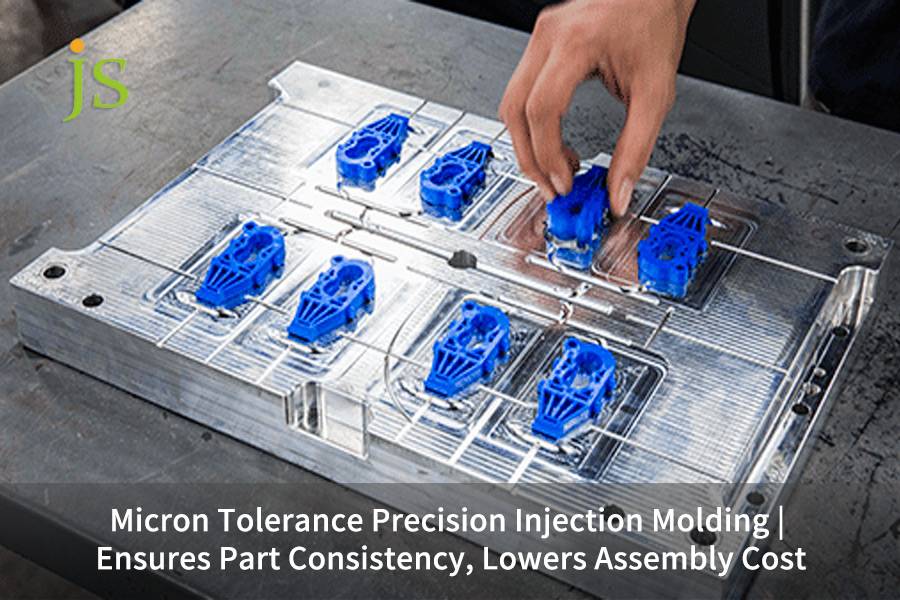

Precision injection molding is an essential technology to address the assembly challenges of complicated parts. For example, medical microfluidic chip assembly lines face a 20% leakage scrap rate, 100% manual visual inspection, and repeated adjustments of uneven sealing surfaces.
The root cause of these issues is the same: standard injection molding tolerances cannot satisfy the requirements of complicated assemblies. Each 0.1 mm variation is chipping away at your profits.
Core Answer Summary
| Process Technology | Precision Grade | Core Benefits |
| Precision Injection Molding | Micron level tolerance (±0. 005mm - ±0. 02mm). | Benefits: Better component consistency that enables automated assembly. |
| High Precision Injection Molding | Flatness control ≤5µm. | Results delivering such a quality of flatness lowered the sealing surface leakage rate from 20% to less than 1%. |
| Process Control Methods | Warpage control ≤±0. 05mm. | It makes the intermediate inspection and manual screening unnecessary. |
| Overall Cost Effectiveness | 10%-30% reduction in unit cost. | Manufacturing cost reduction of over 30% in total. |
Key Conclusions
- Micron level tolerance directly eliminates manual screening, enabling automated assembly
- 5µm flatness control reduces sealing surface leakage rate from 20% to less than 1%
- High precision injection molding controls warpage to ±0.05mm through mold flow analysis and conformal cooling
Why Trust This Guide? JS Precision's Experience In Precision Injection Molding
Specializing in precision injection molding, JS Precision is a professional manufacturer that embraces years of industry experiences. Our main strength is in our capability to use precision injection molding technology in the precision injection molding process itself.
We closely combine molding technology with the production challenges of the real world, proving our skills by means of real world case studies and accurate data.
We have provided premium service to clients in various sectors such as medical, automotive, and optical communications. We have successfully accomplished more than 1000 precision injection molding projects, among them 200+ medical microfluidic chip related.
We have assisted our clients in decreasing leakage and scrap rates from above 20% to under 1%, and cutting manufacturing costs by an average of 30%.
Our production is carried out strictly in line with the ISO 20457:2018 international standard, which is the most recent and authoritative standard for tolerances in plastic injection molded parts.
Besides that, we house high precision coordinate measuring machines (CMMs), white light scanners, and other inspection equipment, which has enabled us to build a thorough process control system that can consistently achieve micron level tolerance control from ±0.005mm to ±0.02mm.
In a case where our client required a precision automotive component, one of the techniques addressed to control the flatness of the component to 5µm was high precision injection molding.
As a result, the client was able to completely resolve the assembly interference issue that had been hindering them for a long time and they recognized us as a partner for the long term.
Our entire engineering team has more than 5 years of precision injection molding experience. This allows us to offer a wide range of services starting from mold flow analysis, mold design all the way to mass production, and also, we can prepare the products according to the needs of different industries.
No matter if it is about the tolerance control of a large injection molded part or sealing difficulties of complex components, we can come up with personalized solutions. Our deep knowledge in the area would be worth challenging any doubt of our clients.
Want to get a preliminary understanding of precision injection molding case studies? Contact our engineers to view complete project case studies for free and intuitively experience its real value in cost reduction and efficiency improvement.
What Is The Standard Tolerance For High Precision Injection Molding? How To Satisfy?
Many clients ask what the usual tolerances are for high precision injection molding and how they are achieved.
The short answer is, the normal tolerance range is ±0. 02mm to ±0.05mm, and with special requirements, it can be as tight as ±0. 005mm. These are the four core founding principles of the process through which we can guarantee these tolerances.
ISO 20457:2018 Tolerance Specification for Precision Injection Molding
ISO 20457:2018 is the most recent international standard for injection molding tolerances for plastics and it supersedes the older DIN 16901 standard. It ranks tolerances into general, precision, and ultra high precision levels.
High precision injection molding translates to IT10-IT12 levels, with the exact figures being set according to material shrinkage and geometric complexity. Our calibration machines have an order of magnitude better accuracy than the tolerances being measured.
Four Pillars of Process Support for Micron Level Tolerances
1.Mold Flow Analysis Software (Moldflow/Moldex3D):
With these solutions, you can accurately forecast how your material will shrink and warp, identify the best gate positions, and set the injection molding tolerances with full control right from the starting point.
2.Conformal Cooling Channel Design:
A change like this in your part cooling could even lead to a 56% reduction in the cooling time while, at the same time, your parts would suffer less from thermal stress deformation and show enhanced consistency. This design method makes your standard high precision injection molding stable and easy.
3.Real time Cavity Pressure Monitoring System:
Being equipped with this system, you will be able to keep pressure variations at a bare minimum level of 0. 08 bar, eliminate dimensional deviations, and secure stable injection molding tolerances.
4.Coordinate Measuring Machine (CMM) and White Light Scanner:
This technology allows for a full size closed loop feedback and continuous dimensional monitoring of the injection molding process, which can be automatically adjusted.
Moreover, it also contributes to checking the injection molding surface finish against the standards to a high degree of accuracy, thus assuring both the tightest tolerances and the best surface quality for injection molding.
| Process Pillar | Core Role | Key Data | Corresponding Tolerance Improvement | Applicable Scenarios |
| Mold Flow Analysis | Predicts shrinkage and warpage | Warpage prediction error ≤5% | Tolerance accuracy improved by 30% | Complex geometric parts |
| Conformal Cooling | Reduces thermal stress deformation | Cooling time shortened by 56% | Flatness improved by 60% | Thin walled, large area parts |
| Real time Cavity Pressure Monitoring | Stabilizes injection pressure | Pressure fluctuation ±0.08 bar | Dimensional fluctuation reduced by 40% | Mass produced precision parts |
| Full size Inspection | Real time feedback adjustment | Inspection accuracy ±1.5µm | Tolerance stability improved by 50% | Medical, high end automotive parts |
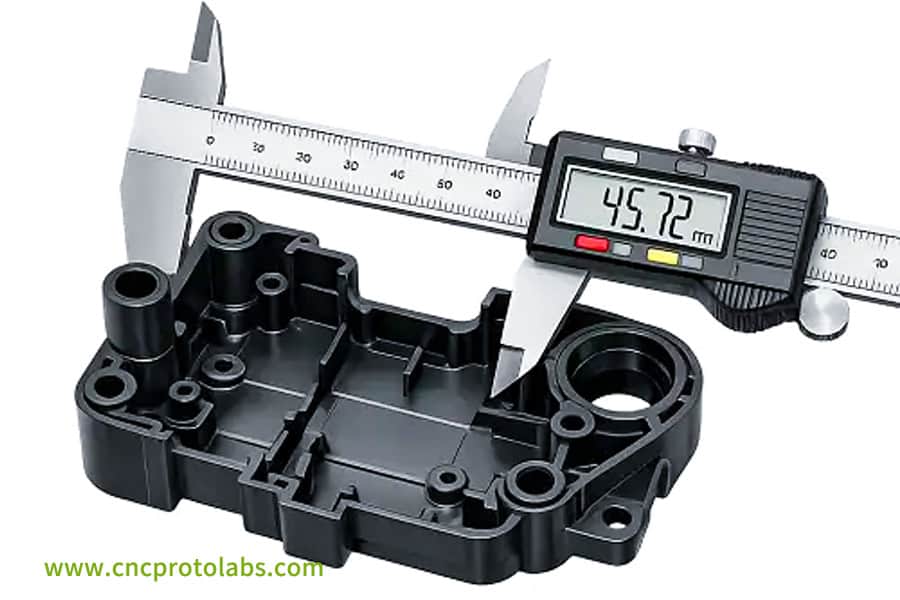
Figure 1: A digital CNC caliper is measuring the dimension of a black injection-molded part with a complex structure, showing a precision reading on its display.
What Is Precision Injection Molding And Why Does It Determine Assembly Costs?
One of the initial things that people inquire about after realizing the concept behind high precision injection molding tolerances, is, "What is precision injection molding? " It is a molding process that restricts component dimensions variations to a few microns.
Through the removal of manual screening, reduction of scrap and attainment of automated assembly, it indirectly and significantly affects the overall downstream manufacturing cost.
Fundamental Technical Characteristics of Precision Injection Molding
The fundamental characteristics of precision injection molding are reflected in its delicately controlled process:
- Controlling the cavity pressure curve has replaced conventional on/off methods, leading to more consistent melt filling.
- Mold temperature changes are limited to ±2℃, which helps injection molding tolerances stay consistent.
- Various levels of injection pressure curves are utilized to deal with complicated shapes, on the one hand, and on the other hand, to the best possible injection molding surface finish thus avoiding surface defects to influence assembly fit.
Invisible Factor That Is Driving Up Assembly Costs: Dimensional Fluctuations
Injection molded parts of the traditional kind that conform to tolerances ±0.1mm will have to be adjusted manually to a great extent and also require screening, which not only adds cost but also compromises efficiency.
Precision injection molding, on the other hand, reduces the tolerance of feature to ±0.02mm, thereby facilitating the robotic automated assembly. For a 0.01mm decrease in dimensional fluctuation, the assembly line cycle time may potentially be reduced by 2-3 seconds.
| Process Type | Tolerance Range | Assembly Method | Labor Cost Percentage | Assembly Cycle Time | Unit Assembly Cost |
| Traditional Injection Molding | ±0.1mm | Manual Screening + Fitting | 40% | 15 sec/piece | $0.8 |
| Precision Injection Molding | ±0.02mm | Automated Assembly | 5% | 6 sec/piece | $0.3 |
| High Precision Injection Molding | ±0.005mm | High Speed Automated Assembly | 2% | 4 sec/piece | $0.25 |
| Traditional Injection Molding + Manual Fitting | ±0.05mm | Manual + Semi Automatic | 25% | 10 sec/piece | $0.5 |
Which column in the table does your product assembly method and tolerance requirements match? Submit drawings to obtain free process selection analysis and potential cost savings calculation reports.
How To Solve The Problem Of Micrometer Level Tolerance In Injection Molding Large Parts?
The major challenge of tolerance control in injection molding of large parts is the uneven shrinkage of the parts. However, we can control tolerance to a micron level quite effectively through proper process planning.
Shrinkage Control Strategies for Large Parts
We execute three shrinkage control methods, which can also ensure the injection molding tolerances are achieved:
- Through independent zoned temperature control, we adjust for shrinkage non uniformity due to different wall thicknesses.
- By using low pressure injection molding we induce less internal stress and consequently deformation.
- Based on CAE analysis, reverse deformation compensation design predicts deformation and reverse corrects the mold. As a result, warpage is reduced by 82%.
Application of Conformal Cooling in Large Molds
Conformal cooling is a very effective method to tackle the tolerance problems in injection molding of large parts.
With 3D printed conformal cooling channels, the uniformity of mold temperature is enhanced by 40%, the cooling period is shortened by 56%, the unit cost is reduced by $0.01, and the flatness of the large parts is improved from ±0.15mm to ±0.03mm, thus satisfying the requirements of high precision injection molding.
Why Can't Standard Injection Molding Tolerances Alone Meet The Requirements Of Complex Assembly?
Many customers inquire why standard injection molding tolerance cannot suffice for complex assembly requirements. The main reason is that it can only guarantee a single measurement variation of 0.1mm, whereas the positional and flatness geometric tolerances needed in complex assemblies are not part of general standards.
The main difference between general and geometric tolerances
Standard injection molding tolerances and geometric tolerances have a fundamental disparity: the former only restricts one dimension and ignores spatial relations among features.
The ±0.02mm positional accuracy and 5µm flatness demanded for multi cavity fits and sealing are outside its prescribed limits and have to be obtained by precision injection molding.
The three major defects of complex assemblies
- Cumulative Tolerances: The addition of dimensional variations from multiple parts results in assembly interference, which is the primary issue with standard injection molding tolerances.
- Warpage: General standards do not regulate the overall deformation of parts. The fact that a single dimension complies with the standard will not prevent the formation of irregular assembly gaps, thus affecting the sealing accuracy.
- Burrs and Flash: Obtaining a clean part is still challenging in standard injection molding. These defects compromise the assembly fit and add to the costs of manual repair.
Struggling with the inability of standard injection molding tolerances to meet the needs of complex assemblies? Schedule a one-on-one consultation with an engineer to get a customized precision injection molding solution.
How To Solve Shrinkage And Warping Problems Through Process Control Under Micrometer Level Tolerances?
Shrinkage control and part warpage are the main issues in precision injection molding that allow one to achieve micron level tolerances. With a scientific approach to process optimization, performing warpage can be reduced from 1.85mm to ±0.30mm, a reduction of 82%.
Precise Shrinkage Compensation
Different shrinkage of materials impacts the injection molding tolerances. For example, PBT-GF30 ranges in its shrinkage rate from 0.2% to 0.8%, whereas PP ranges from 1.5% to 2.5%.
We use mold flow analysis for shrinkage prediction and enlarge the mold cavity by 1.003-1.025 times as a compensation measure. Working with glass fiber reinforced materials leads to a shrinkage reduction of 50%-80% in the longitudinal direction.
Three Level Intervention for Warpage Control
- Primary Intervention: Improve melt temperature, mold temperature, and cooling time to achieve a 3.25%-15% decrease in warpage which is the basic method of control.
- Secondary Intervention: Better mold thermal balance by keeping the temperature difference within ±5℃ to reduce thermal stress induced warpage and stabilize injection molding tolerances.
- Tertiary Intervention: Reverse or backward deformation compensation design. This approach entails forecasting deformation by means of mold flow analysis and hence perfoming a reverse correction of the mold. As a result residual deformation can be kept within ±0.05mm so as to meet the high precision injection molding requirements.
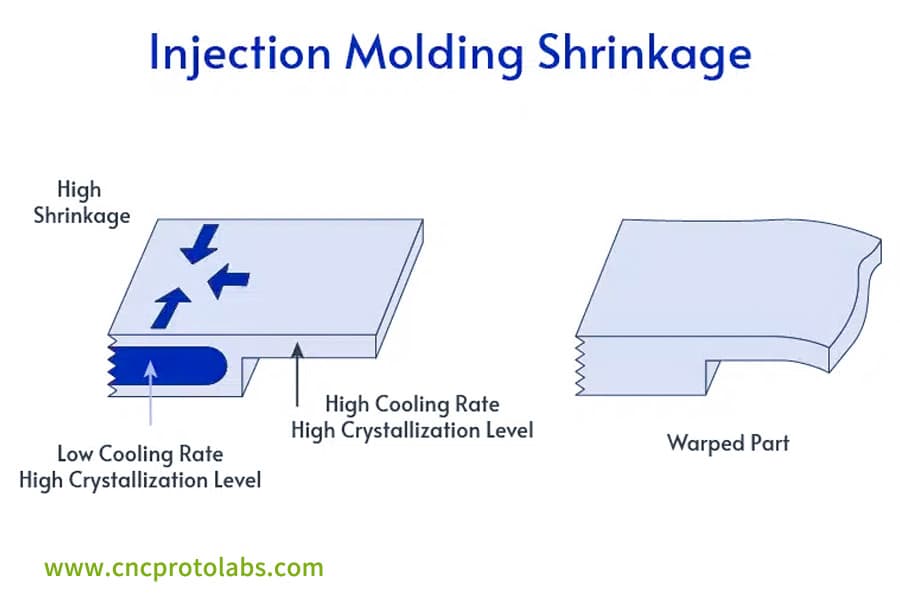
Figure 2: An infographic illustrating the causes of injection molding shrinkage and warping, showing a distorted part and labeling contributing factors.
How Can Micrometer Tolerance Be Directly Converted Into Specific Numbers To Reduce Assembly Costs?
Several customers worry about the cost effect of micron tolerance. Actually, it can control the flatness of sealing surfaces within 5µm, which allows automated assembly, removes the need for interim inspections, increases the yield rate from 80% to over 99%, and cuts down total manufacturing costs by more than 30%.
Cost Comparison of Medical Microfluidic Chips
Consider a medical microfluidic chip customer, for instance, where traditional methods require 100% manual screening due to significant dimensional fluctuations, which cause a 20% leakage and scrap rate and consequently, the cost is high.
After using precision injection molding, flatness is ≤5µm, which supports automated assembly, does away with inspections, and overall manufacturing costs are less by over 30%.
Quantitative Calculation of Cost Savings
- Get rid of the manual screening: Save 2-3 quality inspectors per assembly line. Annual labor cost savings: $60,000-$90,000.
- Scrap rate decrease: From 20% to 1%, thus the saving of material costs is 19,000 units per million units, around $9,500.
- Assembly speed acceleration: Cycle time down from 15 seconds to 6 seconds, assembly efficiency up by 60%, making unit costs more affordable.
Want to accurately calculate the cost savings for your product after adopting precision injection molding? Get a free cost calculation sheet, input your product output, material costs, and other parameters to quickly obtain an estimate.
How To Verify Whether The Supplier Has The True Capability Of High Precision Injection Molding?
Choosing a high precision injection molding supplier will probably have you checking out their testing capabilities, process control, and project case studies.
These things allow a thorough and accurate assessment of their real strengths. Also, these activities help one in avoiding the surprise of a huge gap between what is advertised and what is actually there.
Absolute Necessities for Testing Capabilities
High precision injection molding suppliers must have high precision testing equipment. They are capable of a CMM accuracy of ±1.5µm, and white light scanner is usable for checking dimensional tolerances and injection molding surface finish at the same time.
Additionally, they should offer FAI reports and process capability data with CPK≥1.33 to demonstrate that tolerance and surface quality can be maintained consistently.
Process Control Soft Capabilities
- Have the capability of mold flow analysis and be experienced in the usage of Moldflow/Moldex3D for process optimization. This is the main requirement for precision injection molding.
- Carry out cavity pressure monitoring in real time and injections are adaptively adjusted to variations of pressure so that injection molding tolerances can be maintained stably.
- Be certified to at least one of the following standards: ISO 13485 (medical) or IATF 16949 (automotive) to demonstrate the compliance of production processes to industry high end standards.
Three Key Points for Supplier Auditing
Auditing suppliers necessitates concentrating on three aspects: going through similar tolerance project case studies to verify practical experience, checking the operation data of the mold temperature control system, and making sure a strong material batch traceability system is in place to ensure quality consistency.
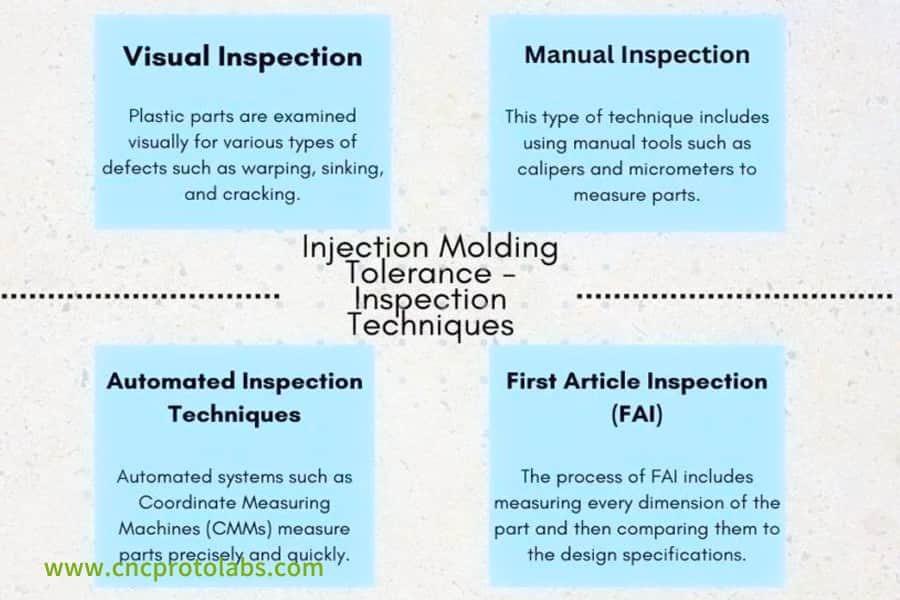
Figure 3: An infographic comparing different methods for inspecting the quality of injection molded parts.
Case Study Of JS Precision: The Flatness Of The Sealing Surface Of Microfluidic Chips Ranges From ± 0.1mm To 5 µ m
Theory should be put into practice. Therefore, we present a case study which demonstrates how high precision injection molding have been used to solve client's assembly pain points in microfluidic chips as well as cost reduction and efficiency improvement.
Challenges:
The microfluidic chip sealing surface of a medical device company is literally only 12mm×8mm and the flatness must be ≤5µm. Flatness achieved by traditional injection molding is ±0.1mm, giving rise to a 20% leakage and scrap rate, and an annual loss of more than $100,000.
It is tough to control the shrinkage and warpage of PBT-GF30 material, and the standard injection molding tolerances cannot meet the requirements.
Solution:
Our response to the client pain points was to layout a customized injection molding process with very high precision. Actions comprise:
1.To achieve 5% error, use Moldflow mold flow analysis software to foresee material shrinkage and warpage.
Integration with the part structure helps locate the best gate position, controlling the dimension variations to ±0. 01mm from the source and this serves as a basis for subsequent tolerance control.
2. For the mold cavity, mold flow analysis suggested a 0. 08mm reverse warp pre-set.
Three iterations were conducted using Moldex3D: the first compensation was 0.05mm, and the measured residual deformation was 0.03mm, the second compensation was 0.10mm, and overcompensation occurred.
Finally, lock 0.08mm to ensure that the natural rebound of the parts after demolding falls exactly at the center of the tolerance zone of ± 0.05mm.
3. Stainless steel insert 3D printing technology was used to manufacture conformal cooling channels.
They were designed in accordance with the cavity profile and temperature difference control was so strict that the temperature difference in different areas of the cavity was limited to ±2℃. This not only lowered the dimension deviation effects of thermal stress but also increased the cooling efficiency by 56% thereby ensuring tolerance stability.
4. We controlled holding pressure variations within ±0. 5% by using a real time cavity pressure monitoring system not only giving us immediate pressure data but also allowing us to perform adaptive adjustments that eliminated dimensional deviations due to uneven melt filling and ensured consistent part dimensions.
Final Results
With the above stated solutions, the flatness of the sealing surface of the customer's microfluidic chip was consistently controlled within 5µm, which led to a decrease in leakage defect rate from 20% to 0.5%, resulting in annual savings of $95,000 due to fewer scrap parts
At the same time, we managed to completely remove 100% of the intermediate visual screening process, which allowed us to lay off two quality inspectors per assembly line and save $60,000 in labor costs annually.
Besides that, We made automated high speed stacking assembly possible, making the assembly 60% faster and reducing the total manufacturing costs by 35%. Besides that, our clients have also become our long term partners.
Have a clear need for high precision injection molding? Submit your 3D drawings, and we will customize a solution for you and provide a quick and accurate quote to facilitate efficient implementation.
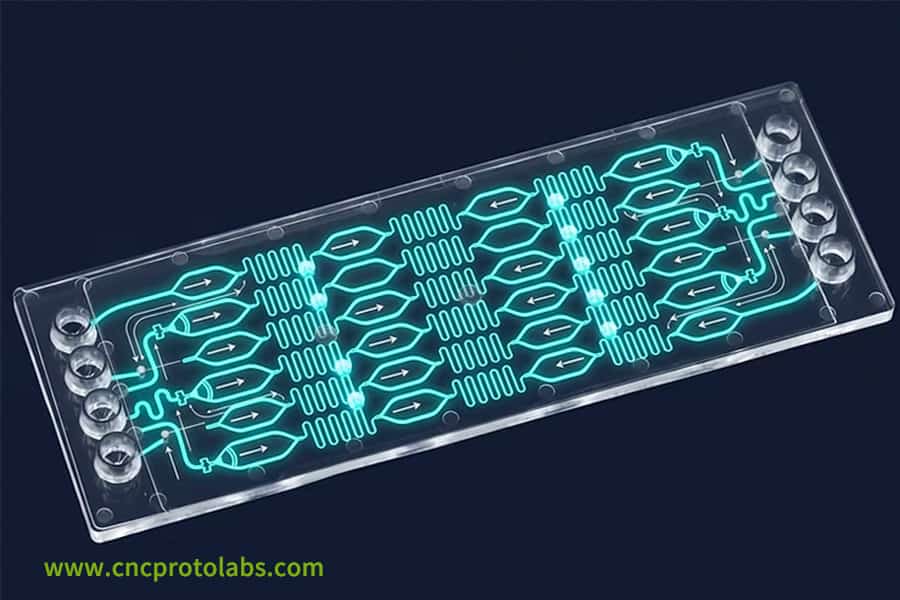
Figure 4: A precisely manufactured transparent microfluidic chip substrate with an intricate network of channels.
FAQs
Q1. What is the minimum tolerance achievable with precision injection molding?
Industrial grade precision injection molding can only go down to ±0.005mm. Standard mass production can reliably and stably produce ±0.02mm, which suffice for the assembly needs of most high end products.
Q2. What are the standard references for injection molding tolerances?
The most recent international standard for injection molding tolerances of plastic injection molded parts is ISO 20457:2018 which has superseded the old DIN 16901. We follow this standard throughout the whole process.
Q3. How do I determine if my part requires high precision injection molding?
If part assembly involves automation, sealing, and so on, and the assembly gap is less than 0.05 mm, then high precision injection molding is needed to guarantee assembly quality.
Q4. How are tolerances guaranteed for injection molding large parts?
Using zoned mold temperature control, conformal cooling, and anti deformation compensation design, 2-meter-class injection molding large parts can have their tolerance stabilized within ±0.1mm.
Q5. Why are standard injection molding tolerances unsuitable for complex assemblies?
Standard injection molding tolerances only regulate one dimension and therefore cannot refer to the essential geometric tolerances including positional accuracy and flatness that are necessary for complex assemblies.
Q6. How much does precisions injection molding cost more than ordinary injection molding?
The molds for precision injection molding are 20%-50% more expensive than ordinary injection molding molds however the unit price can be lowered by 10%-30% because of no additional processing. So it is more economical for long term mass products.
Q7. Are there any special material requirements for precision injection molding?
Precision injection molding uses specially engineered materials which are characterized by low shrinkage and high flowability. Besides the material batch stability must be certified so as to be able to maintain stable injection molding dimensions.
Q8. How much does mold temperature control affect tolerances?
Temperature changes in mold of ±5℃ can cause the shrinkage rate of material to change by ±00.05%, which in turn affects the dimensions of parts. We keep a very stringent mold temperature control within ±2℃.
Q9. How long does it take from design to mass production?
It takes 4-6 weeks for mold making, 2 weeks for T1 sample, and 2-3 rounds of process optimization. The entire time from design to mass production is roughly 8-10 weeks, effectively fulfilling mass production needs.
Summary
Precision injection molding is not only about making things more accurate but about completely changing the way manufacturing is done.
It goes beyond the boundaries of normal injection molding tolerances, resulting in cost reductions of more than 30%, and yield rates of more than 99% for complicated parts in areas like medical and automotive by using micron level tolerance control.
Order precision products and receive comprehensive professional support from JS Precision. Would you like to check if your part is a good candidate for precision injection molding? Send us your 3D drawings, and our experts will carry out a DFM feasibility analysis and provide you with a cost comparison report within 24 hours.
Let's find out how much "20%" savings we can offer you.

Disclaimer
The contents of this page are for informational purposes only.JS Precision Services,there are no representations or warranties, express or implied, as to the accuracy, completeness or validity of the information. It should not be inferred that a third-party supplier or manufacturer will provide performance parameters, geometric tolerances, specific design characteristics, material quality and type or workmanship through the JS Precision Network. It's the buyer's responsibility Require parts quotation Identify specific requirements for these sections.Please contact us for more information.
JS Precision Team
JS Precision is an industry-leading company, focus on custom manufacturing solutions. We have over 20 years of experience with over 5,000 customers, and we focus on high precisionCNC machining,Sheet metal manufacturing,3D printing,Injection molding,Metal stamping,and other one-stop manufacturing services.
Our factory is equipped with over 100 state-of-the-art 5-axis machining centers, ISO 9001:2015 certified. We provide fast, efficient and high-quality manufacturing solutions to customers in more than 150 countries around the world. Whether it is small volume production or large-scale customization, we can meet your needs with the fastest delivery within 24 hours. Choose JS Precision this means selection efficiency, quality and professionalism.
To learn more, visit our website:www.cncprotolabs.com
Resource