English




Sheet metal laser cutting cost ranges from €20–€135 per hour across Europe and China. In Europe, a benchmark hourly rate for suppliers is €65–125/hour. A benchmark rate in China is €18–38/hour. The price difference between China and Europe is determined mainly by sheet thickness, laser source power (from 3kW to 30kW), type of assist gas (99.999% liquid nitrogen vs high-pressure air), and nesting efficiency. Choosing laser cutting services from China can make a 35%–55% difference in the total landed cost if batches surpass 200 pieces or total weight surpasses 150kg.
Sheet Metal Laser Cutting Cost Overview: China vs. Europe
|
Metric |
Chinese Supplier |
European Supplier (DE/IT/PL) |
Technical & Cost Driver |
|---|---|---|---|
|
Average Machine Hourly Rate |
€20 – €42 / hr |
€70 – €135 / hr |
Electricity, depreciation, direct labor |
|
3mm 304SS Cutting Cost per Meter |
€0.50 – €1.05 / m |
€1.30 – €2.80 / m |
High-power laser adoption & liquid nitrogen supply chain |
|
Linear Tolerance |
±0.02 – ±0.05 mm |
±0.02 – ±0.05 mm |
Same-generation fiber laser source (IPG / Trumpf) |
|
Prototype Lead Time |
3 – 5 days (DHL/FedEx) |
5 – 10 days (ground) |
24/7 shifts & raw material stock |
|
Economic Break-even Point |
Batch >200 pcs or >150 kg |
Batch <50 pcs or <72 hrs lead time |
Sea freight fixed cost amortization |
Sources: JS Precision 2025–2026 project quotation database (1,200+ European projects); IEA (2026) Electricity 2026 report; ISO 9013:2017 thermal cutting tolerance classification.
Key Takeaways
- Pure processing cost reduction of 35%–55%: China gives big price benefits when cutting 304/316 stainless steel and 6061 aluminum medium-thick plates.
- High Purity nitrogen removes secondary operations: Ultra-pure nitrogen (99.999%) assist gas prevents oxidation on cut edges, eliminating secondary chemical cleaning and filing.
- Weight and batch amount have a great impact on the total cost: Prototypes and urgent orders should be made by local European suppliers to decrease logistics; but, for batch orders that include sea freight and duties, the landed cost in China will still be reduced by 35%–55%.
How Are Sheet Metal Laser Cutting Prices and Hourly Rates Truly Calculated?
Sheet metal laser cutting prices are built from four additive components: equipment depreciation hourly rate, assist gas consumption, piercing point labor, and net cutting length, multiplied by the nesting coefficient.
Cost Model Components
Cost Model Components Familiarizing one with the various elements that make up the cost of sheet metal laser cutting is one strategy to managing the costs. The total cutting cost follows the formula:
Total Cost = (Number of Piercings × Per Piercing Cost) + (Total Cutting Length ÷ Actual Feed Rate × Machine Time Rate) + Auxiliary Gas Volume Cost
The total cutting cost formula is the complete expression of laser cutting cost breakdown, which makes each cost transparent and facilitates customers to check whether the outsourcing factory quotation is reasonable item by item.
Cost Influencing Factors
- Piercing Time: 0.3–0.8 seconds/piercing; micro-hole arrays occupy 18%–25% of total machine time.
- Acceleration/Deceleration at Corners: dynamic corner paths, result in a slower effective cutting speed up to the range of 12%–20%.
- Cutting Speed Variance: A typical laser of 12 kW is cutting 3 mm stainless steel at 28 m/min, while using pure oxygen for carbon steel, it will be cut at 20 mm and 1.2 m/min, respectively, a 23× difference.
Industry Cost Structure and Depreciation Realities
AWS C4.6M-2006 (2012) outlines: Thermal cutting geometric tolerances should be classified per perpendicularity, average profile height, drag lines slag grooves, and top fillets.
JS Precision complies with the standard strictly. Besides that, European manufacturers usually depreciate heavy equipment after 8 or 10 years running their plant on single or double shifts while, JS Precision uses 3-year accelerated depreciation plus 24/7 operation which lowers unit fixed depreciation cost by 60%. European quotation rates are €1.5–2.5/minute, whereas the ones in China are only 0.35–0.70/minute.
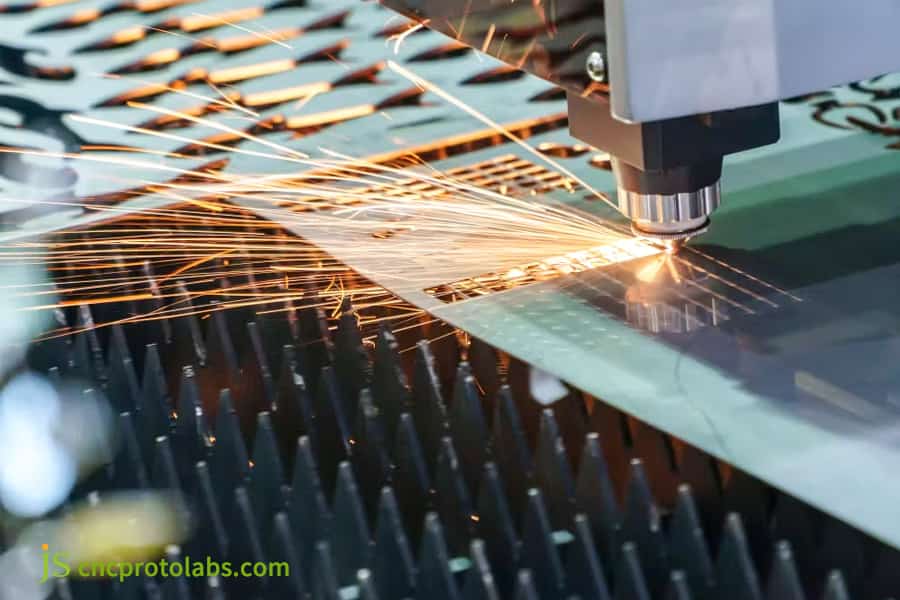
Figure 1: Laser cutting machine processing metal sheet with bright sparks.
What Drives the China vs Europe Laser Cutting Pricing Discrepancy?
China vs Europe laser cutting pricing discrepancy is not rooted in machine hardware, but in assist gas supply chain cost, industrial power rates, depreciation cycles, and full-process supporting distance.
Cost Structure Comparison: Europe vs China
A well-versed laser cutting cost comparison will take into account four main factors: energy gas depreciation, and logistics. What comes next table compares in detail the structural difference in costs between the Chinese and European suppliers:
|
Cost Component |
European Supplier |
China |
Cost Ratio (EU/China) |
|---|---|---|---|
|
Industrial Electricity |
€0.17 – €0.23 / kWh |
€0.08 – €0.09 / kWh |
2.5× – 3.0× |
|
Liquid Nitrogen (N₂ 99.999%) |
€0.85 – €1.20 / m³ |
€0.22 – €0.38 / m³ |
2.5× – 4.0× |
|
Equipment Depreciation Period |
8 – 10 years |
3 years (accelerated) |
60% lower per piece |
|
Shift Pattern |
Single/double shift |
24/7 continuous |
2.5× – 3× output |
|
Full-process Integration |
Cross-vendor logistics |
In-house bending, riveting, welding, finishing |
Eliminates 80% transit loss |
Sources: IEA (2026) Electricity 2026; ISO 9013:2017.
Compound Effect of Integrated Manufacturing
To European and American buyers, choosing industrial fabrication suppliers means looking not only at a machine-hour rate of one device but also at the supplier's ability to perform full-process integration (2026). In one factory, JS Precision combines laser cutting deburring CNC bending, PEM riveting, welding, and powder coating, reducing total finishing cost by ~45%.
ISO 9013:2017 details that, laser cutting of thickness ≤ 32 mm, with a perpendicularity tolerance of 0.05 + 0.003a mm, on average, laser cutting of thickness 32 mm, a roughness Rz5 = 10 + 0.6a μm shall be achieved through laser cutting.
- Gas pipeline: China's liquid nitrogen in bulk pricing average per ton is approximately €54/ton (Sci99 2026 semi-annual monitoring), whereas Europe's is at 0.85–1.20/m³.
- Electricity price differences: IEA (2026) confirms EU industrial electricity at 0.17–0.23/kWh is 250% of Chinese electricity prices of 0.08–0.09/kWh.
- Removal of logistics-related losses: Cross-supplier shipments incur €8–€15/box relabelling and €0.8–€1.2/kg multiple-stage transport costs.
Contact our JS Precision Engineers for a free price breakdown that will help you compare your current quotes from the European supplier with our one-stop manufacturing solution. Most clients save more than 30% in less than two business days.
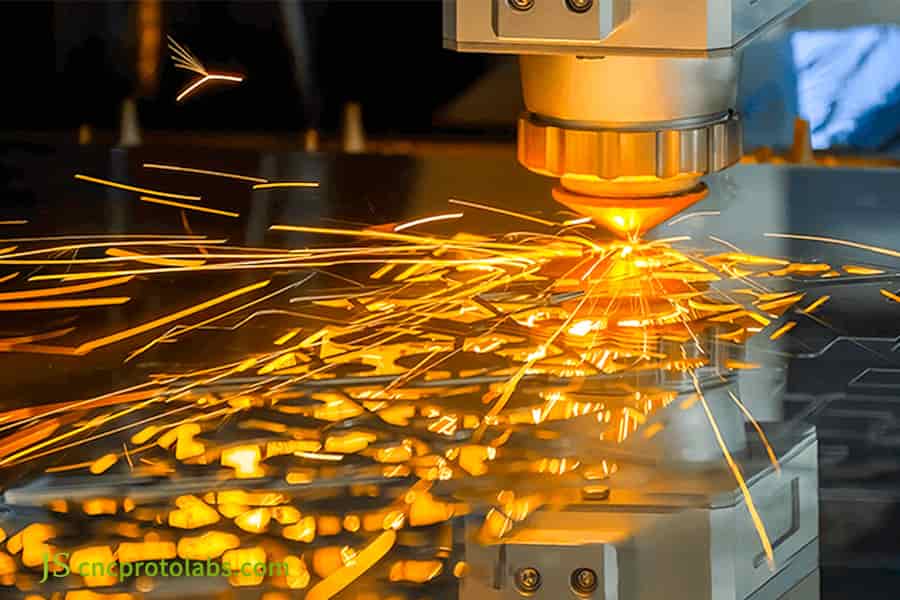
Figure 2: Fiber laser cutting machine emitting intense sparks on metal sheet.
Can China Laser Cutting Service Meet Strict Tolerances and Dross-Free Edge Quality?
China laser cutting service providers using mainstream fiber laser sources and CNC beds can stably achieve ±0.02 mm to ±0.05 mm linear tolerance and dross-free cut surfaces for sheets from 1 mm to 10 mm.
Edge Quality Control Mechanisms
Achieving precision sheet metal cutting results with high repeatability is a process of balancing and keeping coordinated control over four factors:
- Lens focus compensation: dynamic focus feature maintains the beam waist in the middle of the sheet, thereby controlling kerf taper at ±0.5°.
- Nozzle diameter selection: the thickness of the material determines the nozzle size, from 1.2 to 2.5 mm that will be used, concentricity within 0.02 mm guarantees no asymmetric dross so no asymmetrical dross.
- High pressure inert gas purge: the metal is first exposed to 99.999% pure nitrogen at 18–25 bars before it is oxidized, so the oxidation is prevented. This also results in clean edges without oxides.
- Aluminium anti - reflection treatment: highly reflective sheets like AL5052/6061 must employ anti-back-reflection laser heads apart from modulated pulse algorithms that work at 40–60 kHz to prevent damage.
Dross-Free Edge Quality Parameters
Laser cutting edge quality is assessed not by subjective judgment but by quantifiable roughness and dross height indicators:
|
Thickness |
Kerf Straightness |
Surface Roughness Ra |
Dross Height |
Edge Oxidation |
|---|---|---|---|---|
|
1 mm SS 304 |
±0.02 mm |
Ra 3.2 μm |
< 0.05 mm |
Zero (N₂ 25 bar) |
|
3 mm SS 304 |
±0.03 mm |
Ra 4.0 μm |
< 0.08 mm |
Zero (N₂ 20 bar) |
|
6 mm SS 304 |
±0.05 mm |
Ra 5.0 μm |
< 0.12 mm |
Minimal |
|
10 mm SS 316L |
±0.05 mm |
Ra 6.3 μm |
< 0.15 mm |
Minimal |
|
12 mm Carbon Steel |
±0.08 mm |
Ra 8.0 μm |
< 0.20 mm |
Light (O₂ cut) |
Source: ISO 9013:2017 (DIN EN ISO 9013:2017-05) Class 1 quality range.
International Tolerance Benchmark
If fiber laser sources have the same properties, the change in kerf diameter for metal plates of less than 10 mm does not have any dependence on the location of the machine and stays more or less constant within a certain range.
- Origin independency of tolerance: laser quality and accuracy, not vendor location, dictate how parts are within or outside the tolerance.
- Ra 3.2–6.3 μm surface roughness obtainable on 1–10 mm material under correct gas pressure and nozzle choice.
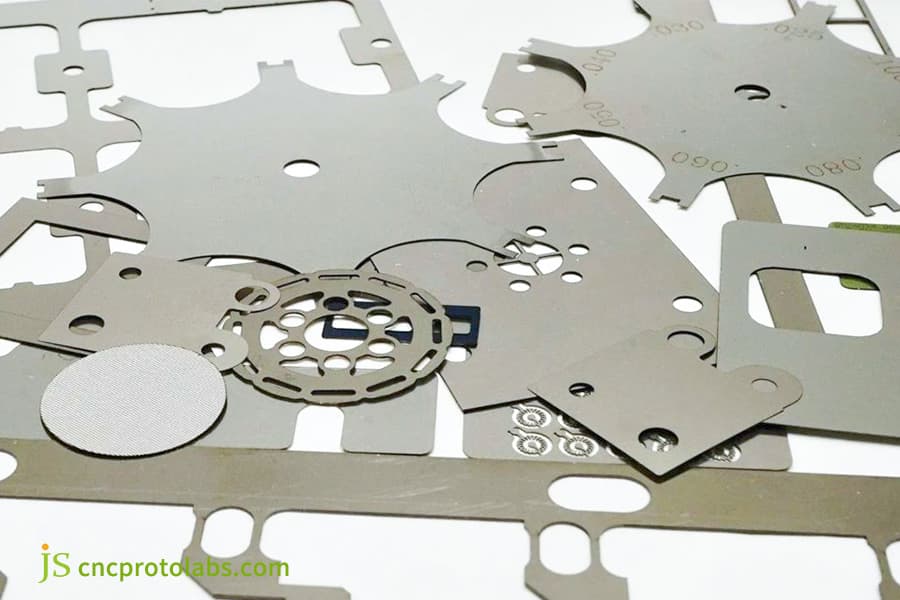
Figure 3: Precision laser cut metal parts showing strict tolerances and clean edges.
How to Minimize Sheet Metal Laser Cutting Cost Through DFM and Smart Nesting?
Sheet metal laser cutting cost can be directly reduced by common-edge cutting, micro-tab fixing, and nesting algorithm layout, lifting material utilization from 72% to above 88%.
Hard Geometric DFM Rules
Using DFM for laser cutting, the 80% extra costs of post-treatments can be reduced already at the design (drawing) stage. These are some major geometric rules that should not be compromised:
- Corner radii: R ≥ 0.5 × material thickness to prevent micro-cracks at sharp corners.
- Minimum hole diameter: ≥ 1.0 × material thickness to prevent hole ellipse shape because of the optical lensing due to thermal effects.
- Entry/exit position: Avoiding places near the assembly reference surfaces where the HAZ effect would interfere with the fit of the parts in the machine.
- Micro-tabs: keep small 0.2–0.5 mm tabs on tiny parts to avoid them from getting lost in the machine; snap off manually afterward.
Parameter Fine-tuning to Match Engineering Requirements
If the OEM laser cutting service review is conducted by the designers before the quotation (quoting), the unnecessary expenses on correcting design shortcomings during production (reworks) will be prevented. Based on our own hands-on involvement in the 2025 DFM optimization project, we carried out DFM optimization of an electric cabinet panel for a German machinery company:
- Original design: 72% material utilization, 12.4 kilometers total cutting path length per 100 pieces.
- After applying DFM: utilization increased to 87%, total cutting length dropped to 980 meters.
- Achieved: the purchase cost (raw material) was 21% less and the machining time 15% shorter, which together made up the savings of 18.5%.
Get a free DFM optimization proposal from JS Precision—send us your original drawings, and our engineers will return an optimized DXF within 12 hours, showing the exact cost reduction percentage.
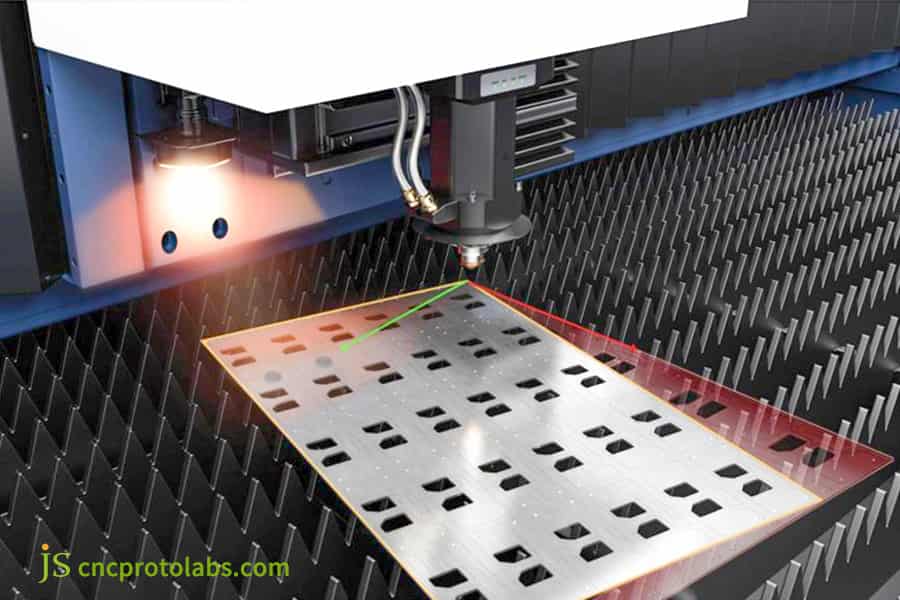
Figure 4: Smart nesting laser cutting process on metal sheet to minimize cost.
Why Choose Turnkey OEM Laser Cutting Service Over Standalone Cutting Shops?
Integrating the OEM laser cutting service removes about 80% process transit loss, because all the operations like cutting bending riveting, welding, and surface treatment become part of one quality system. By comparison, standalone cutting only represents 30%–40% of the total structural part cost.
Hidden Costs of Decentralized Sourcing
Hiring out a sheet metal laser cutting service can appear at first sight to be a money-saving operation with the cost per part; still, hidden transportation and repackaging costs very often eat into the saving:
- Tolerances in Tolerance Stack-up: when a work piece goes through several stages, the overall ±0.1 mm per stage error accumulates; at four, the maximum deviation can be ±0.5 mm.
- Repackaging Labour: the fact of taking the box apart every time it needs to be packed up means the cost of repackaging labor is €8–€15 per box.
- Logistics Multi-Stag:e the cost of transporting between vendors is about €0.8–€1.2 per kg at each stage.
- Quality Assurance: if there is any failure in the shared processes areas, suppliers hold one another responsible.
Tolerance Chain Compensation in Integrated Manufacturing
JS Precision's turnkey metal fabrication solution applies bending deduction and K-factor automatic compensation during the laser cutting stage
BD = 2 × (R + T) × tan(A/2) – K × T × A × π/180
Where R = inner radius, T = plate thickness, A = bending angle, K = K-factor (typically 0.3–0.5 for laser-cut parts).
- Compensation done live: downstream bending K-factor is considered when pre-compensating laser kerf width by 0.1–0.2 mm.
- Single quality Manager: all dimensions and quality checks from flat pattern production up to the finished product are JS Precision sresponsibility.
- Reducing delivery period: Elimination of extra warehousing steps helps the delivery from receiving a material to finished goods to be 28 days down to 12 days.
Contact our one-stop metal manufacturing experts at JS Precision, just send us your 3D STEP model, and we shall provide a detailed quote which includes laser cutting, bends rivets, welded joints and powder coat. Everything comes with one point of contact and schedule.
How to Calculate the True Landed Cost Comparison for China vs Europe Sourcing?
Landed cost comparison must encompass ex-works price, international freight, import duties (HS 7326.90 / 7219.90), and customs fees. When batch weight exceeds 150 kg or order value reaches €1,620, China's landed cost remains 32%–50% lower than European local suppliers.
Tariff and Customs Structure
A complete landed cost analysis, besides considering the ex-works unit price, should account for sea or air freight, duties, and customs clearance costs too. Per the EU TARIC database, for HS Code 7326, the MFN (Most-Favored-Nation) duty rate remains 2.7%. At the same time, products of HS 7219, i.e. Flat-rolled stainless steel, enjoy the advantage of 0% duties.(European Commission DG TAXUD, data as of July 1, 2026)
- Duty calculation: duty on a 10,000 order is 0–€270.
- VAT consideration: while EU VAT of 19%–25% applies, it is deductible to businesses.
- Customs brokerage: A fixed €85–€150 per shipment, regardless of cargo value.
- MTC certificate requirement: Since September 2023, for HS Chapter 73 the EU customs calls for a Material Test Certificate (MTC) to prove origin not of Russia - JS Precision assists in the provision of the full MTC documentation.
Landed Cost Break-Even Model
In the case of international freight sheet metal procurement, the break-even point will mainly hinge on the mode of transport chosen. Take for instance, from our detailed model 2025 costing, the purchase of 300 stainless steel sheet metal enclosures.
- Manufacturing in France: €28,400 including 8% margin, local logistics, 4-week lead time.
- JS Precision ex-works: €16,200.
- Plus sea freight (0.60/kg average 380 kg): 228.
- Plus EU duty (2.7% average): €437.
- Plus customs clearance and VAT deduction: €135 + deductible.
- Landed cost from China: €17,000. Total cost saving of 40.1%.
Case Study: JS Precision's High-Precision Laser Cutting for Medical SS316L Enclosures
China laser cutting service delivered by JS Precision achieved 42% cost reduction on 2,000 SS316L medical enclosures while maintaining ±0.03 mm assembly tolerance.
Client Pain Points
Traditional CO₂ laser cutting had been carried out with ordinary nitrogen gas on a European in-house machine on 2.5mm 316L mirror-finish stainless steel which resulted in three major problems:
- Residuals of edge dross and oxidation discoloration: The only way to get rid of these defects was the tedious method of sanding and electropolishing every item separately, which in Europe used to cost €12 per item.
- Heat-induced warpage: The extremely closely spaced vent holes were resulting in flatness variation of 0.8 mm.
- Production cost: due to these errors, the final total price of a unit was increased by €86.00, while at the same time a very significant scrap rate of 18.2% was being generated.
JS Precision Solution
Based on years of experience providing sheet metal laser cutting service, JS Precision implemented a special route for their latest project:
- A 20 kW fiber laser and 99.999% liquid nitrogen combined: the flying cut, a highly efficient method, that saved almost 44% of the cutting time to just 50 seconds compared to the previous 180 seconds, without forming any oxide deposits - the improvement is 40 seconds.
- Leapfrog pathing algorithm: micro-hole matrix planning consisted micro-holes were redistributed by leapfrog algorithm, that performed zonal alternating piercing, to localize thermal stress distribution - the result is controlling product flatness to be less than or equal to 0.15 mm.
- Automatic wide-belt deburring machine: micro-chamfering and brushing of both sides of the workpiece was achieved through one manufacturing process.
Failure Experience and Process Correction
In a run when first samples were being produced, leftover adhesive from the protective film melted because the piercing laser heated the place too much that the melted adhesive made mirror-like surface.
JS Precision engineering team quickly modified the Laser De-filming settings based on the standard protocol for troubleshooting. They placed a pre-vaporization band around each hole of 0.5mm at a feed rate of 10mm/sec which resulted in removing of burn marks and adhesive residue entirely. Although those changes delayed the time for the first sample approval by 36 hours, they are believed to have prevented scrapping of about 2,000 parts.
Final Results
- Unit cost: €86.00 → €49.88, reduced 42%.
- Cutting time: 180 sec → 42 sec, improved 76.7%.
- Flatness: 0.8 mm → 0.15 mm, improved 81.25%.
- Scrap rate: 18.2% → 1.1%, reduced 94%.
- Annual savings: €72,240.
You can send us drawings with JS Precision, and our experienced engineers team will provide you a complete DFM analysis and the quote of the prototype within 12 hours, including flight cutting path simulation and jump puncture strategy.
FAQs
Q1: What is the standard pricing metric used for sheet metal laser cutting services?
Lasercutting charge is figured by cutting meters rate or pure machine hour rate, include material thickness grade number of piercings, CAD conversion time, and assist gas consumption. A large quantity production together with nesting optimization results in a lower per-unit cost.
Q2: Why does 99.999% high-purity nitrogen cutting cost more than compressed air cutting?
Nitrogen with a high purity of 99.999% is an inert gas that keeps the melting metal away from oxidation and results in clear, metal-free edges suitable for welding and further processing. Cutting with compressed air is more cost-effective though it results in a faint edge oxidation.
Q3: How does fiber laser cutting lower overall part costs compared to CO2 laser technology?
Fiber lasers attain a 35–45% electro-optical efficiency which makes them over 3 times more efficient than CO lasers. For a thin-to-medium 1–6 mm gauges feed speeds are about 2–3 times faster, saving considerable amount of energy and machine time costs.
Q4: What is the typical production and shipping turnaround time from JS Precision?
JS Precision produces and ships within 24–48 hours for prototype samples made out of standard materials (304/316 stainless steel, 6061 aluminum, SPCC carbon steel). Delivery via DHL/FedEx air freight allows European and American clients to receive their packages within 3–5 days.
Q5: How can engineering designers optimize CAD files to reduce laser cutting quotes directly?
While generating the 2D DXF files, remove overlapping lines, apply common-edge for cutting and keep the internal fillet radii at least the material thickness to cut down the number of piercings and limit heat-related deformation effects. DFM optimization of this sort can bring a saving of 15%–25%.
Q6: What cutting tolerances can be maintained across different sheet metal thicknesses?
Sheet metal thickness (1–4 mm) processed using fiber laser cutting can consistently meet linear tolerances between ±0.02 mm to ±0.05 mm. Plate thickness of 6–12 mm will only achieve tolerances around ±0.08 mm to ±0.15 mm due to the limited heat-affected zone and the limitation in dross width.
Q7: How are sheet metal parts protected against corrosion and scratches during ocean transit?
Laser protective film is kept on the parts or alternatively they are protected by covering them with rust-preventive oil, sandwiching the parts between foam sheets, sealing them inside vacuum moisture-proof bags that contain desiccant, and finally, the whole packaging is being placed in fumigation free wooden crates.
Q8: What technical documentation is required to receive an accurate laser cutting quotation?
The clients should supply 1:1 scale vector 2D drawings (DXF/DWG) including critical tolerances and also a 3D model (STEP), material grade thickness surface finish requirements, and order quantity specified. You can upload your drawings to get an instant quotation, the more details, the better the price.
Summary
The price difference between Chinese and European laser cutting is determined through hourly machine rates, availability of high-purity assist gases, level of nesting utilization, and tariffs. For industrial sheet metal parts with batch size over 200 pieces or total weight over 150 kg, benefiting from China's high-power fiber laser equipment and full-process supporting, with the maintaining of ±0.02 mm accuracy tolerance, can lower the European/U.S. Buyers' total ownership cost by 35%–55%.
Send us your DXF/DWG/STEP drawings to the JS Precision smart engineering and quoting system asap. Our engineers will provide a detailed DFM feasibility assessment, nesting utilization analysis, and a competitive tiered quotation within 12 hours, enabling rapid prototyping and mass custom production.

Disclaimer
The contents of this page are for informational purposes only. For JS Precision Services, there are no representations or warranties, express or implied, as to the accuracy, completeness, or validity of the information. It is the buyer's responsibility to identify specific technical requirements and request a formal parts quotation. Please contact us for more information.
Resource