English



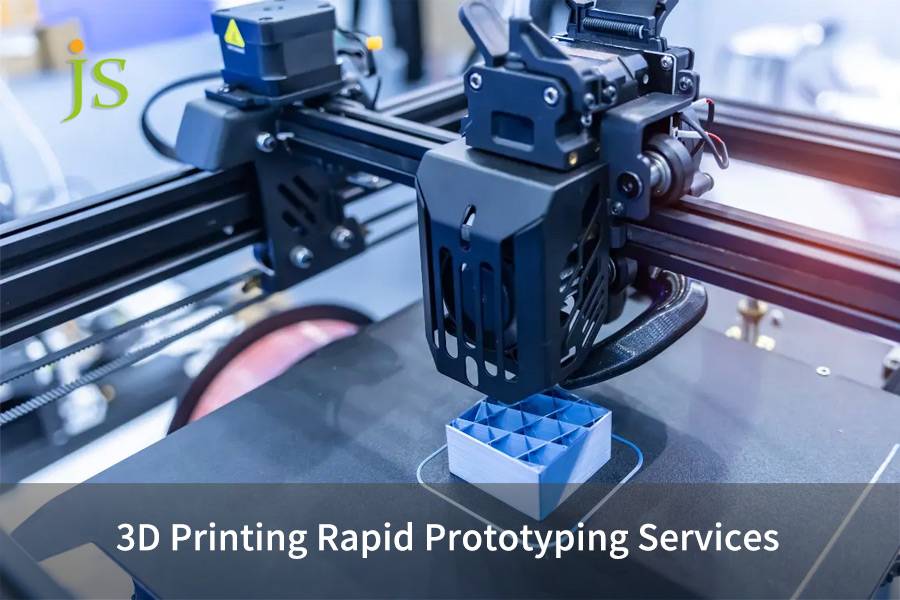

3D printing rapid prototyping services are changing the way that products get developed. Product development teams in various industries from consumer electronics to automotive parts face a major challenge:
Traditional mold-making processes require 4-8 weeks to complete and every single design change costs them tens of thousands of dollars which makes design teams proceed with extreme caution and experimental methods.
Your team has not yet produced its first prototype while competitors have already completed three product iterations.
The situation worsens because outsourced prototypes fail to create complex structures which results in assembly testing discovering interference after the critical testing phase has ended. 3D printing rapid prototyping services provide the best resolution to all existing issues.
Quick Overview of Core Answers
| Core Dimensions | Key Answers | Value for You |
| Process Essence | Additive manufacturing Besides helping to save the cost of physical molds, this method layers materials one on top the other. It is possible to get a prototype in 24-48 hours. | Compressing the product development cycle from months to weeks to accelerate time to market. |
| Technology Selection | FDM is suitable for large sized concepts, SLA is suitable for high precision appearances, and SLS is suitable for complex functional components. | Match the process to the prototype's intended use, avoiding paying for excessive performance. |
| Material Systems | From ABS resin to fiberglass reinforced nylon, from transparent photosensitive resin to metal powder. | Appearance verification and functional testing are both achievable, with material properties approaching those of mass produced parts. |
| Cost Inflection Point | Small batch ( <1000 pieces) 3D printing costs only 10-30% of injection molding, eliminating the need for mold investment. | Zero mold cost trial and error, zero additional expenses for design iteration. |
Key Takeaways
- R&D cycle reduced by more than half:
3D printing reduces prototype iterations which usually take weeks to only days. Actually, in a practical example, three iterations that took 21 days were reduced to 3 days.
- Obvious cost tipping point:
For productions less than 1000 pieces, molds are required with injection molding, which take 4-8 weeks for mold making, whereas 3D printing can be done in 3-7 days. Besides, small batch costs are only about 10-30% of the traditional methods.
- Unparalleled design freedom:
Constraints like draft angle limitations disappear when making complex structures like snap-fits hinges internal channels.
- Materials properties nearly the same as mass production:
A variety of materials including engineering-grade nylon PA12, carbon fiber reinforcement, flame-retardant ULTEM are able to meet different functional test requirements.
Why Trust This Guide? JS Precision's Precise 3D Rapid Prototyping Experience
JS Precision is specialized in 3D printing rapid prototyping and has been working in this field for more than 10 years.
Through a wide range of service provisions, JS Precision has carried out more than 2,000 prototype development projects for over 20 major industries including automotive medical consumer electronics, aerospace, and home appliances, etc.
Besides, we have cooperated with a number of world-famous Tier 1 automotive suppliers and consumer electronics technology companies, and as a result, automotive projects took up 42% of our total project volume while medical projects had a success rate of 99.5%.
Our engineering team is equipped with 8+ years of experience in additive manufacturing engineering, and the lead members have significant industry accreditations.
We do not just offer printing services but also provide clients with a full set of expert solutions that include design optimization, process selection, material matching, and post testing. On average, we are able to reduce the development costs of our clients by 15%-20% per project.
JS Precision is well-furnished with more than 20 industrial quality 3D printers of various technologies FDM SLA SLS, and metal. The sizes and specifications of these printing equipment are quite diverse.
For instance, we can print parts as large as 600×600×400mmmm, and we strictly monitor the critical dimensions to be within ±0.1mm, which is double the tolerance limit in the industry of ±0.2mm.
Besides, our machines are running efficiently for 98% of the year, thus guaranteeing on-time delivery. We also comply with ISO/ASTM 52900 standards.
All process parameters, cost data, and selection recommendations in this guide are derived from the summary of over a thousand actual projects implemented by JS Precision. After repeated verification, they have strong practicality and reference value.
Recently, we have aided an automotive electronics company in slashing their component development costs by 96%. A medical device manufacturer has witnessed their time for prototype turnover shrink from 14 weeks to 4 weeks thanks to our product development services.
Also, we have a consumer electronics brand on our list of clients that we helped trim down the lead time of the new product prototype testing stage by 60%.
These situations from the industry confirm that we can perfectly hit the nail on the head in terms of solving the top product development issues like inherent long lead times, high costs, and production constraints.
If you are struggling with the efficiency and cost of product prototype development, contact JS Precision engineers now for a dedicated 3D rapid prototyping pre development consultation and let our professional team diagnose your project.
What Is 3D Printing Additive Manufacturing Rapid Prototyping And Why Do You Need It?
The product development process requires rapid prototyping as its essential component. The combination of 3D printing and additive manufacturing enables rapid prototyping to transform traditional manufacturing methods into a vital technique for contemporary product development.
From Subtraction to Addition: A Change in Manufacturing Logic
CNC subtractive manufacturing methods, which European scientists developed to create products through material removal, face two main issues: they waste too much material and they need three-dimensional objects to meet operational requirements.
3D printing additive manufacturing rapid prototyping uses its layer-by-layer deposition method to create complex 3D models in one step, which helps to eliminate production delays.
The Essence of Rapid Prototyping: Low-Cost Trial and Error
The initial product development phase requires companies to test design concepts with cost-effective methods which enable them to avoid critical errors during the mold manufacturing process. The fundamental value of 3D printing additive manufacturing rapid prototyping is established through this particular application.
JS Precision offers engineering-level DFM analysis for prototype development by combining all the benefits from its complete 3D printing rapid prototyping service chain.
To more intuitively present the core data differences of 3D printing rapid prototyping in different scenarios, the following is a comparison table of key parameters for prototype development across multiple industries:
| Application Industry | Optimal Process | Standard Precision | Delivery Cycle | Material Cost (/piece) | Yield Rate |
| Consumer Electronics | SLA | ±0.05mm | 24-36h | $80-150 | 98.5% |
| Automotive Parts | SLS | ±0.1mm | 36-48h | $120-220 | 97.8% |
| Medical Devices | Metal Printing | ±0.08mm | 48-72h | $350-600 | 99.2% |
| Aerospace | SLS/Metal Printing | ±0.06mm | 72-96h | $500-800 | 99.0% |
| Home Appliances | FDM/SLA | ±0.15mm | 24-48h | $60-120 | 98.0% |
Want to know if 3D printing additive manufacturing rapid prototyping is a good fit for your product development project? JS Precision offers free project feasibility analysis to quickly determine the match between technology and cost.
How Does 3d Printing And Rapid Prototyping Shorten Your Product Development Cycle?
The slow delivery and iterative process of prototype development functions as the primary constraint which limits product development efficiency. The development speed of products experiences fundamental improvements through 3D printing and rapid prototyping which enable faster development times.
Concurrent Engineering:24-48 Hour Rapid Delivery
Traditional prototype outsourcing requires 2-3 weeks for delivery, while professional 3D printing and rapid prototyping service providers can deliver within 24-48 hours, supporting design teams to test multiple solutions in parallel.
Instant Feedback and Iteration
The teams use 3D printing and rapid prototyping to create physical prototypes which they test and use to identify problems which they fix through immediate printing. The process creates multiple iterations which take months to complete but now can finish within days.
Accelerated Cross-Departmental Collaboration
Departments use 3D printed physical prototypes for their communication needs which eliminates the need for blueprints and visual imagination. The organization experiences enhanced decision-making processes because 3D printing and rapid prototyping deliver value through their ability to create more understandable communication methods.
Which Technology Is Best For 3d Rapid Prototyping? (FDM, SLA, Or SLS?)
The three main methods used in three-dimensional rapid prototyping work process operate through FDM, SLA, and SLS. The selection of an appropriate method serves as a vital factor that determines the success of 3D rapid prototyping operations.
FDM (Fused Deposition Modeling): The first choice for large scale concept models
The FDM process achieves an accuracy rate of ±0.2mm while producing layer thicknesses between 0.1 and 0.3mm which make it appropriate for printing large scale concept models and tooling fixtures, and it provides the most economical material expenses while enabling fast production of sizable components.
SLA (Stereo lithography): The king of high precision appearance parts
SLA process accuracy reaches ±0.05mm while its layer thickness extends to 0.025mm with a surface roughness level of Ra<1.6μm and polished transparent resin achieves 92% light transmittance thus establishing it as the most suitable option for producing high-precision appearance parts.
SLS Laser Sintering: A Powerful Tool for Complex Functional Components
SLS technology requires no support structure, enabling the molding of complex internal structures. The system supports development of functional components by using PA12 nylon materials which have tensile strength values ranging from 48 MPa to 85 MPa that fulfill functional testing standards.
JS Precision recommends optimal 3D rapid prototyping processes according to the prototype's intended use which includes SLA for appearance verification, SLS for functional testing, and FDM for large-scale concepts that follow ASTM F2792 standards.
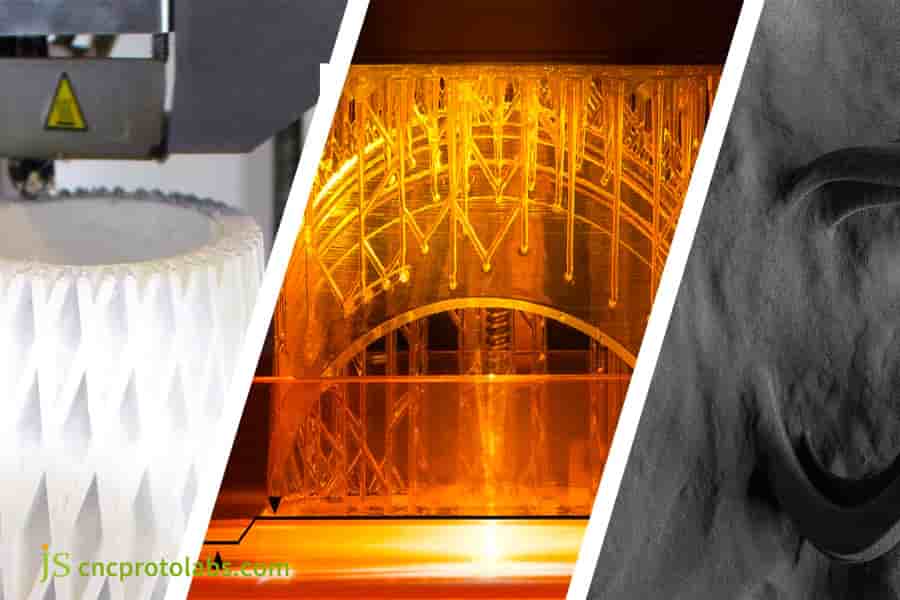
Figure 1: A 3D printer using Fused Deposition Modeling (FDM) technology is actively building a part with a lattice structure layer by layer on its build platform.
What Materials Are Suitable For Prototyping Products?
The requirements for prototyping products are divided into appearance verification and functional testing. JS Precision has a comprehensive material library to match various prototype needs, which enables their prototypes to achieve performance similar to that of actual production equipment.
Appearance Prototype Material System
- High Transparency Resin: The material demonstrates 92% light transmittance which enables it to replicate the optical properties of PC and PMMA components. This material serves as a transparent product appearance testing tool.
- ABS-like White Resin: The material enables painting and electroplating applications while its surface texture matches the appearance of commercial production components. The material functions properly with all types of shell-based products.
- PP-like Flexible Resin: The material demonstrates a Shore A hardness range of 50 to 90 A which enables it to mimic the soft rubber texture. The material functions properly as a flexible component for buttons and grips.
Engineering Prototype Material System
- PA12 Nylon: The material demonstrates a tensile strength of 48MPa while its good toughness makes it suitable for designing structural elements like buckles and hinges.
- Glass Fiber Reinforced Nylon: The material demonstrates a tensile strength of 85MPa while its high rigidity makes it suitable for testing structural load-bearing components.
- Flame Retardant ULTEM 1010: The material achieves a UL94 V-0 rating which enables it to withstand high-temperature flame retardant scenarios at 215℃ heat distortion.
Metal 3D Printing Materials
- 316L Stainless Steel: The material has a tensile strength of 640MPa which makes it suitable for medical devices and industrial parts due to its corrosion-resistant properties.
- AlSi10Mg Aluminum Alloy: The material has a high specific strength and good thermal conductivity which makes it suitable for components that require both heat dissipation and lightweight design.
- TC4 Titanium Alloy: The material shows good biocompatibility while its high strength makes it suitable for both medical implants and aerospace applications.
| Prototype Type | Recommended Material | Core Performance | Applicable Scenarios |
| Transparent Appearance Parts | High Transparency Photosensitive Resin | Light transmittance 92%, Ra<1.6μm | Optical parts, transparent shells |
| Rigid Appearance Parts | ABS-like White Resin | Electroplating and screen printing available, high surface smoothness | Home appliance shells, consumer electronics bodies |
| Flexible Parts | PP-like Flexible Resin | Shore 50-90A, good resilience | Buttons, seals, grips |
| Structural Functional Parts | Glass Fiber Reinforced Nylon | Tensile strength 85MPa, flexural modulus 3800MPa | Load-bearing brackets, mechanical structural parts |
| High Temperature Flame Retardant Parts | ULTEM 1010 | UL94 V-0, heat distortion 215℃ | Automotive engine compartments, aerospace components |
| Metal Functional Components | 316L Stainless Steel | Tensile strength 640MPa, corrosion resistant | Medical devices, industrial precision components |
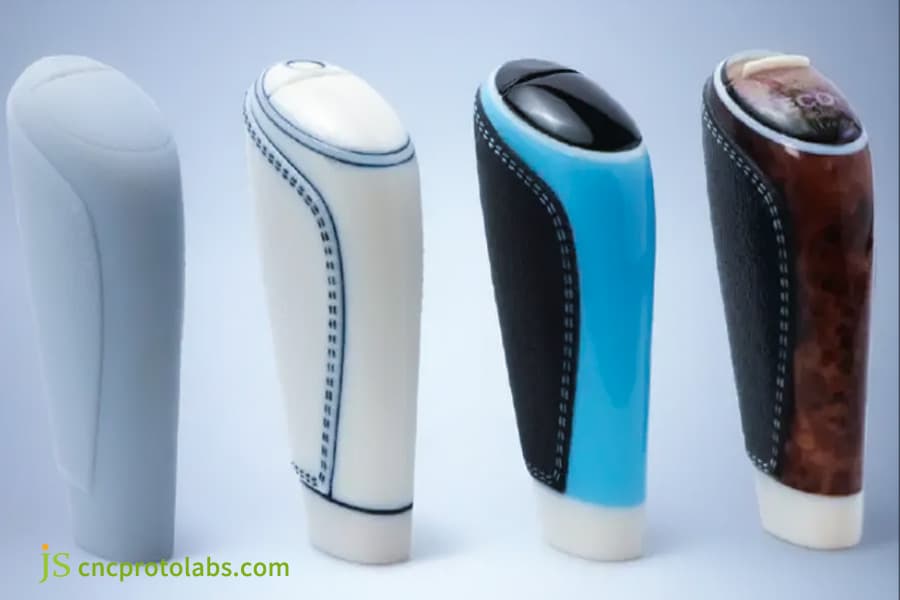
Figure 2: A white, smooth-finish car central control knob prototype, standing upright against a neutral background.
What Is The Typical Workflow For 3D Printing Rapid Prototyping?
The standard operating procedure serves as the foundation which determines the success of 3D printing rapid prototyping. JS Precision creates a complete workflow system which guarantees both timely prototype delivery and maintaining prototype quality standards.
Step 1: Data Repair and Optimization
Engineers check the model's wall thickness, overhang angle, and STL format. The minimum wall thickness requirement for FDM printing is ≥1mm and for SLA printing it is ≥0.1mm. Support structures need to be added when overhang angles exceed 45 degrees to prevent printing errors.
Step 2: Slicing Parameter Optimization
The prototype needs specific layer thickness settings which range from 0.05 to 0.3mm and infill density settings which range from 10 to 100%. Users must choose appropriate supports which maintain the required level of accuracy while they work to achieve their operational goals.
Step 3: Printing and Monitoring
The team operates industrial-grade printing equipment while they track printing progress to ensure each layer meets quality standards and prevents printing errors.
Step 4: Post processing is Key
Standardized post processing procedures which include support removal, sanding and polishing, cleaning and curing, and painting and coloring, create high quality prototypes.
Having learned about the standard workflow of 3D printing rapid prototyping, and want to bring your project to fruition? Upload your CAD drawings to JS Precision to get a free drawing optimization and DFM analysis report.
How Does Rapid Tooling Bridge The Gap Between Prototype And Mass Production?
Rapid tooling enables organizations to shift from prototype testing to small scale production because it functions as the main connection point between 3D printed prototypes and full industrial production.
What is Rapid Tooling?
Rapid tooling or rapid mold making uses 3D printing to make mold inserts and master molds which allow companies to produce small-scale trials without using costly steel molds.
The Value of Small Batch Trial Production
| Comparison Items | Traditional Steel Molds | Rapid Tooling | Savings |
| Mold Cost | Tens of thousands to hundreds of thousands of US dollars | Thousands to tens of thousands of US dollars | Savings: 80-90% |
| Development Cycle | 4-8 weeks | 1-2 weeks | Shortened by 50%+ |
| Applicable Batch Size | Over 10,000 pieces | 50-500 pieces | Economically feasible for small batches |
| Mold Modification Difficulty | High, high modification cost | Low, quick adjustment | Modification cycle shortened by 70% |
Performance Verification: Using Final Mass Production Materials
Rapid tooling techniques allow the utilization of mass production materials such as PP and ABS, which can not only accurately mirror the final performance and visual appearance of the product but also serve as a highly precise source of data reference for mass production.
JS Precision's One Stop Service
JS Precision offers complete coverage from 3D printing of prototypes and rapid tooling to small batch injection molding, enabling a seamless transition from the prototype stage to mass production.
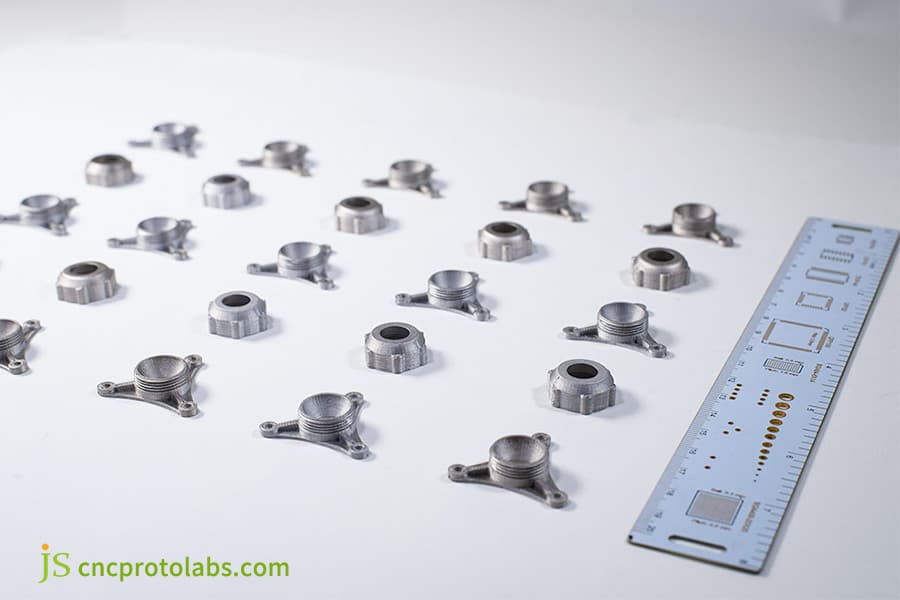
Figure 3: An assortment of small, metallic gray connectors, likely created using SLA 3D printing for rapid tooling applications, arranged alongside a precision ruler for dimensional verification.
JS Precision Case Study: Automotive Electronics Companies Save $860,000 In Development Costs With 3D Printing And Rapid Prototyping
Challenge
The automotive Tier 1 supplier which has global recognition needed to develop a new car center console knob which required five ergonomic tests and one vehicle test sample batch to be completed within three months.
The total cost of the traditional method included five CNC machining sessions which cost $12,000 each and injection mold development which cost $180,000.
The CNC machining process was unable to create the internal translucent texture structure which resulted in challenges for both appearance assessment and functional testing.
Solution
JS Precision developed a custom solution through their organization which integrated 3D printing technology with rapid prototyping and rapid tooling methods. The solution required two distinct steps to complete:
1. Prototype Verification:
High transparency resin knobs were printed using SLA technology, with layer thickness precisely controlled at 0.05mm.
The surface reached a roughness level of Ra1.2μm after three gradient polishing processes while the light transmittance achieved 91% which perfectly matched the light transmission effect and texture details of mass produced parts.
The researchers completed five rounds of ergonomic verification testing which resulted in all testing errors remaining within the range of ±0.03mm.
2. Small Batch Trial Production:
We team created a high precision silicone mold after successfully completing functional testing which used our optimized SLA part as the master mold. The mold tolerance was determined to be ±0.08mm.
The manufacturing process produced 50 sets of PC/ABS vehicle-mounted sample prototyping products which required only 12 minutes to create each individual part while achieving a 99.8% success rate.
Results
- The total project cost was reduced to $38,000 which saved $860,000 compared to the traditional solution while achieving a 96% cost reduction.
- The development cycle was shortened from 14 weeks to 4 weeks, and the client's PPAP review was passed two months ahead of schedule.
- Physical testing showed three design problems which included a light knob damping feel and uneven character backlighting, and the testing results enabled the team to make necessary mold changes which protected the production process frompotential defects.
- The team achieved first-time success in mass production because they used rapid mold verification data to predict material shrinkage which directly informed their steel mold design process.
This case fully demonstrates the practical value of 3D printing rapid prototyping services. If you also want to reduce costs and accelerate your product development, contact JS Precision immediately for a customized project solution.
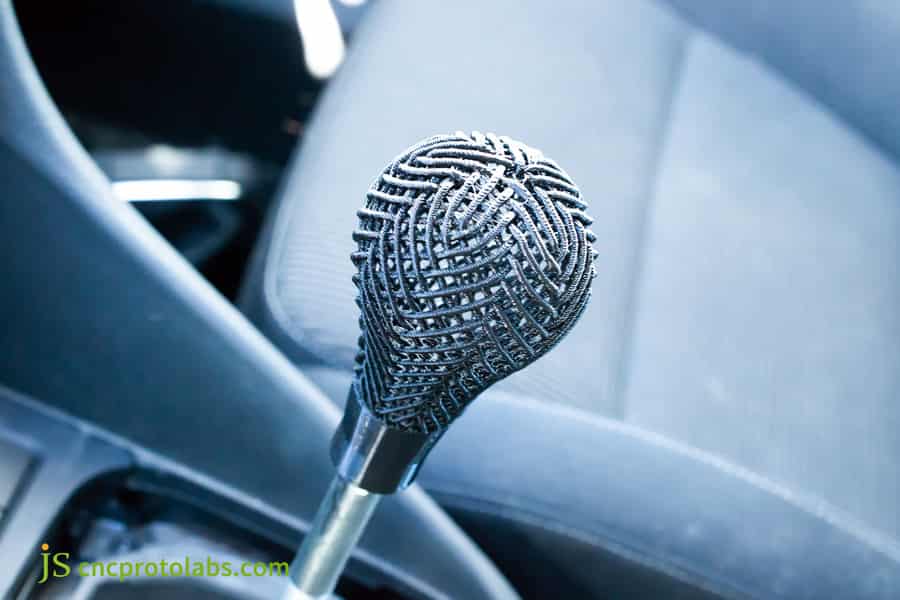
Figure 4: A close-up view of a car central control knob prototype with an intricate lattice design, manufactured using Stereolithography (SLA) 3D printing from photosensitive resin.
How To Choose a Reliable 3D Printing Rapid Prototyping Services Partner?
A product development team needs to select a trustworthy 3D printing rapid prototyping services provider who will deliver quality prototypes and maintain project progress. JS Precision summarizes four core selection criteria to help you avoid pitfalls.
Equipment Capabilities
Professional service providers must possess a complete set of industrial-grade printing equipment. JS Precision operates more than 20 FDM and SLA machines which enable printing of large objects that reach dimensions of 600×600×400mm.
Engineering Review Capabilities
High quality service providers proactively review models. The DFM report from JS Precision shows clients three to five possible problems which help them reduce development risks from the beginning.
Quality Control System
The establishment of comprehensive quality control procedures holds vital importance. The company JS Precision delivers CMM inspection reports which document the functional components' dimensional measurements and their precise control of critical dimensional tolerances which extend to ±0.1mm limits.
IP Protection Capabilities
The level of IP protection which a service provider offers demonstrates their professional expertise. We company safeguards client intellectual property through encrypted data storage and network separation between its internal and external systems and the option to establish a dedicated nondisclosure agreement.
FAQs
Q1: What is the minimum order quantity for 3D printing rapid prototyping?
The minimum order quantity for 3D printed rapid prototyping is 1 piece. JS Precision provides complete support through all stages from proof of concept until small batch pilot production while adjusting to various order sizes.
Q2:How long does it take to print a prototype?
The time required for printing depends on how complex and large the item is. Basic components receive delivery within one day while complex components need a period of two to three days for delivery. The requirements of the process enable the creation of advance estimates.
Q3: What is the accuracy of the 3D printed prototype?
The different processes show various accuracy performances. SLA achieves ±0.05mm, SLS ±0.1mm, and FDM ±0.2mm, all meeting most assembly verification requirements.
Q4:Can the prototype materials withstand functional testing?
The prototype materials can withstand functional testing. Engineering grade PA12 displays a tensile strength of 48MPa while its glass fiber reinforced variants achieve an 85MPa strength level which makes them suitable for multiple structural evaluations.
Q5: For my project, which is better 3D printing or CNC machining?
3D printing is a great option for complex shapes with intricacies and snap-fit features, whereas CNC machining is the go-to method for simple metal parts requiring high precision. JS Precision is capable of offering hybrid process optimization advices.
Q6: Do you make 3D printed prototypes in transparent materials?
Of course! We have the ability to make transparent prototypes. Our SLA high transparency resin samples have a light transmittance level of 92% after polishing, simulating the same visual effects as optical components like PC and PMMA.
Q7: What is your process for measuring 3D printed parts to ensure accuracy?
To make sure of the dimensional accuracy of the 3D printed parts, JS Precision will use a Coordinate Measuring Machine (CMM) to perform an inspection on the prototype and share the inspection report with you. Besides, dimensional key data being traceable, accuracy is not compromised.
Q8: How long does it take to receive a sample from the moment I provide you with the drawing?
The complete process goes through five steps: uploading CAD drawings, DFM review, confirming the quotation, post-printing processing, quality inspection and delivery. The status of the whole process can be checked on-line.
Summary
3D rapid prototyping services are a core tool for reshaping product development, enabling zero-mold iteration, day-to-day delivery, cost reduction, and efficiency improvement. JS Precision, with its professional capabilities, delivers high quality prototypes and development certainty to its clients.
Whether you need creative validation, functional prototypes, or are looking to transition to small batch trial production, you can choose JS Precision to upload your drawings, obtain a DFM report and quote, and seize the market opportunity.

Disclaimer
The contents of this page are for informational purposes only.JS Precision Services,there are no representations or warranties, express or implied, as to the accuracy, completeness or validity of the information. It should not be inferred that a third-party supplier or manufacturer will provide performance parameters, geometric tolerances, specific design characteristics, material quality and type or workmanship through the JS Precision Network. It's the buyer's responsibility Require parts quotation Identify specific requirements for these sections.Please contact us for more information.
JS Precision Team
JS Precision is an industry-leading company, focus on custom manufacturing solutions. We have over 20 years of experience with over 5,000 customers, and we focus on high precisionCNC machining,Sheet metal manufacturing,3D printing,Injection molding,Metal stamping,and other one-stop manufacturing services.
Our factory is equipped with over 100 state-of-the-art 5-axis machining centers, ISO 9001:2015 certified. We provide fast, efficient and high-quality manufacturing solutions to customers in more than 150 countries around the world. Whether it is small volume production or large-scale customization, we can meet your needs with the fastest delivery within 24 hours. Choose JS Precision this means selection efficiency, quality and professionalism.
To learn more, visit our website:www.cncprotolabs.com
Resource