English




3D printing rapid prototyping robotics is a major factor driving changes in the way robots are designed. The extra weight that is not needed wastes power and torque.
Besides, if the design is not properly checked, it could end up costing millions of dollars to fix the molds when the product is mass produced. The engineers have to make compromises to some extent, such as between light weight and solid structure or between quick delivery and thorough examination.
This post will explore the main technical approaches of 3D printing rapid prototyping robotics. At the same time, a scientific prototyping method can be a vehicle for the discussion of how it is possible to reduce the weight by more than 30%, while functional verification remains true and data are dependable.
Quick Overview of Core Answers
| Core Dimensions | Key Solutions | Value Brought to You |
| Lightweight Achievement Path | Topology optimization + lattice structure + CFRP/PEKK materials, reducing weight by 30-50% while maintaining stiffness. | Reduces motor load and energy consumption, improving robot dynamic performance. |
| Functional Verification Strategy | SLS nylon for mechanical performance testing, SLA-like ABS for assembly testing, CNC metal parts for load-bearing testing. | Early detection of design defects avoids mold opening losses. |
| Precision and Speed Trade-off | PolyJet/Micro SLA achieves 16μm layer thickness, multi-nozzle FDM adapts to large-size structures. | 24-hour iteration cycle precisely matches the precision requirements of different components. |
| Hybrid Manufacturing Strategy | 3D printing complex shells + CNC machining of metal inserts, reducing overall cost by 20%. | Balances lightweight requirements with the strength and wear resistance of key interfaces. |
Key Takeaways
- Starting with lightweighting for cost reduction: For example, a 30 % decrease in the weight of a robotic arm can be translated into downsizing power motors for direct usage which in turn can lead to a system cost reduction of 15-25%.
- Functional verification requires' real materials': SLS nylon (PA12) can have a tensile strength as high as 48MPa which is near to that of injection, molded parts and therefore, it is the top material for functional testing.
- Optimal solution of mixed strategy: 3D printing complex cavities + CNC machining of key interfaces is the best way to achieve high speed, precision, and cost, effectiveness at the same time.
- Outsourcing prototyping: Save millions of investment in industrial grade equipment, and adopt a pay as you go model to reduce development costs for small and medium-sized enterprises by 35-50%.
Why Trust This Guide? Practical Experience In Rapid Prototyping With JS Precision
JS Precision has been heavily investing in 3D printing rapid prototyping robotics over a decade. We have provided 200+ robotics companies a full process solution for rapid prototyping from concept design to functional verification.
Our prototyping services include, but are not limited to industrial collaborative robots, medical surgical robots, and AGV logistics robots. We have designed and manufactured more than 10,000 prototypes, thus accumulating very rich firsthand experience.
Our team consists of senior DFM analysis engineers, structural optimization engineers, and precision manufacturing engineers who have all been involved in robot prototype development for more than 5 years. They can pinpoint design process defects and performance risks with great precision.
JS Precision has in house industrial level SLS/MJF 3D printing equipment, a five axis CNC machining center, and state of the art testing equipment (such as CMM coordinate measuring machine, tensile testing machine, etc.).
Following ISO 13485 standards very closely, we can provide rapid one stop prototyping manufacturing for parts of micro level precision to large structural components. Before they are released, all prototypes are thoroughly performance tested and undergo dimensional inspection to ensure accuracy and data usability.
For a medtech startup focused on a knee joint module for medical robotics, We addressed the primary issues of lightweighting and precision verification.
With the use of topology optimization and rapid prototyping with SLS nylon, we managed to do seven design iterations in two weeks only, with a 32% weight reduction and the same level of stiffness for surgical use in each case, thus allowing the client to complete their clinical trials successfully.
Additionally, we offered prototype manufacturing outsourcing services for two logistics robots companies, thereby not only cutting the original 6 months prototype development cycle in half (to 3 months) but also lowering total costs by 35%.
Choose JS Precision to obtain a customized 3D printing rapid prototyping robotics solution, allowing professional capabilities to accelerate your robot development and transform it into product competitiveness.
How To Achieve a Seamless Transition From Concept To Functional Validation Through Prototype Manufacturing Services?
Prototype manufacturing plays a vital role in linking robot concept design to functional testing. Outsourcing to professional service providers can not only speed up the work but also limit the risk exposure.
JS Precision merges 3D printing, rapid prototyping, robotics along with engineering skills to offer comprehensive prototype manufacturing solutions.
Complete Service Workflow
- DFM Analysis and Process Recommendation: Engineers not only assess the design of the parts but also the precision and budget factors to suggest the best combinations of 3D printing, rapid prototyping, robotics processes.
- Rapid Prototyping: 3D printing can be ready within 24-48 hrs, CNC process within 3-5 days to match fast iterations needs.
- Functional Testing Support: Help in preparing test plans, analyzing data, and delivering a foundation for design modifications.
- Small Batch Production: Post prototype validation, there will be no break in the flow while small batch production (50-500 pieces) is going on, thereby enabling the prototype to production changeover easily.
Risk Mitigation Benefits
Experienced service providers have the capability to pinpoint design risks such as inadequate wall thickness and assembly interferences beforehand, thus not only preventing subsequent wastage of resources (cost and time) but also lessening R&D losses.
Case Study: An AGV Company Outsources Prototype Manufacturing
A logistics robot startup was in urgent need of completing their prototype production and exhibiting the prototype within 3 months. Establishing their own prototype production line would have cost them $300,000 and have a cycle of 6 months, which is very different from the exhibition requirement.
Therefore, the firm outsourced the entire prototype manufacturing course to JS Precision including body structure (CNC), sensor bracket (SLS), and control box (SLA) fabrication.
JS Precision took care of the creation of the process, manufacturing, and testing. Eventually, the project development cycle was halved, the total cost was down by 35%, the prototype was exhibited on time, and the company raised its seed round.
Outsourcing prototype manufacturing can help SMEs save on equipment investment and focus on their core business. Download JS Precision's prototype manufacturing service white paper now to learn more about the entire process and cost optimization strategies for robot prototype manufacturing.
How To Achieve Lightweight Design For Robotics Using 3D Printing Rapid Prototyping?
Lightweighting is an essential aspect of robot development. 3D printing offers rapid prototyping solutions for robotics, and its geometric freedom and adaptability to material use can greatly decrease weight without sacrificing stiffness. JS Precision uses scientific lightweighting through three main approaches.
Topology Optimization
By means of finite element analysis (FEA), topology optimization eliminates the material present in low stress areas of parts, leaving only the key load carrying framework.
It is estimated that collaborative robot arms can be lightened by up to 35% in this way, with only minimum reduction in stiffness, that will still completely satisfy the operational requirements.
Lattice Structure and Bionic Design
3D printing technologies, enabling one to take advantage of the interiors of parts, can fill them with lattice structures such as honeycomb that can efficiently take the place of solid structures which deliver significant weight savings.
For instance, a drone robotic arm with a titanium alloy lattice design has seen a 42% weight reduction, and the mechanical properties are in line with ASTM F2924 standards, which is a big improvement in endurance.
Selection of Lightweight High Performance Materials
Materials with high performance and low weight can be selected to further improve the weight saving effect:
- Carbon fiber reinforced composites are very good for the long arm structures.
- PEKK/PEEK are the best choice for the high temperature joints.
- PA12 GF/CF represents a good balance of lightweight and rigidity, hence the preferred choice for small to medium batch of prototypes.
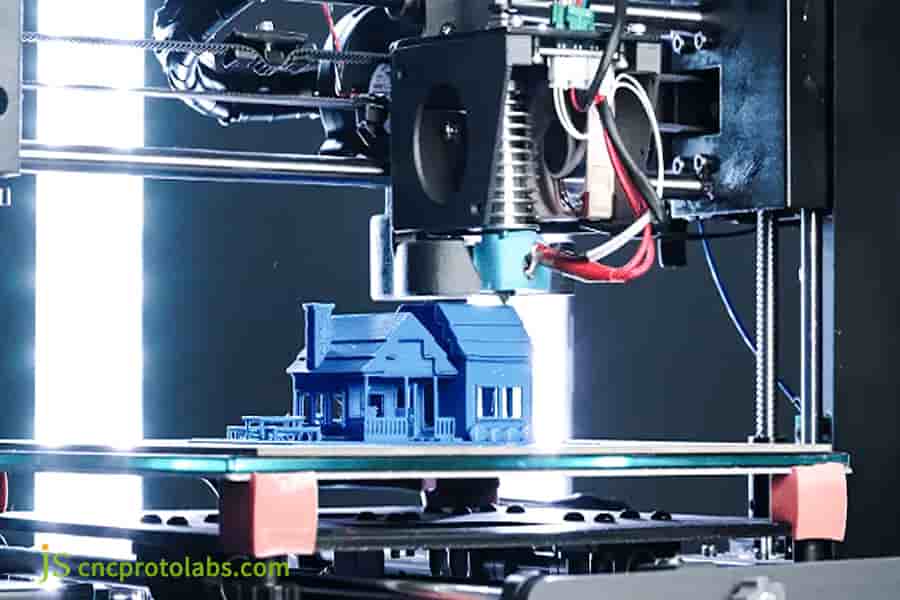
Figure 1: A 3D printer is actively creating a blue-colored, house-like model of a robotic component, highlighting the precision of the additive manufacturing process.
How Do Rapid Prototyping Parts Meet The Performance Requirements Of Robots In Functional Validation?
The performance of rapid prototyping parts directly determines the reliability of validation data. JS Precision ensures that these parts meet the functional validation requirements of robots through process matching and post-processing optimization, providing a reliable basis for design optimization.
Key Mechanical Performance Indicators and Process Matching
| Process Type | Tensile Strength | Impact Toughness | Fatigue Life | Anisotropy |
| SLS PA12 | 48MPa (close to injection-molded ABS) | 12kJ/m² | Withstands 100,000 cycles | Vertical strength is 50% of horizontal strength |
| MJF PA12 | 50MPa | 15kJ/m² | Withstands 120,000 cycles | Vertical strength is 60% of horizontal strength |
| FDM PETG | 35MPa | 8kJ/m² | Withstands 50,000 cycles | Vertical strength is 45% of horizontal strength |
| SLS TPU | 18MPa | Impact rebound rate >60% | Withstands 200,000 cycles | Relatively weak anisotropy |
Depending on the type of the part and its mechanical properties, the engineers will propose the best manufacturing process and help reduce the anisotropy through a change of the printing direction to ensure that the prototype performance is stable.
Post Processing Technology Enhances Prototype Performance
Multiple post-processing techniques can improve prototype performance:
- Chemical smoothing can diminish the surface roughness.
- Metal plating can greatly increase wear resistance.
- Heat treatment can raise the heat distortion temperature of PEEK parts.
Case Study: Robot Gripper Prototype Validation
A flexible gripper on a 3C electronics assembly line was required to perform 5000 opening and closing operations in 8 hours of continuous operation.
The original injection molding solution included a 6 week mold development cycle costing $80 000 but since the design had not been validated, there was a risk of failure.
The client Decision JS Precision's SLS nylon (PA12) to produce rapid prototyping parts and carried out 5000 accelerated tests to simulate the working conditions. At the 3800th cycle, cracks resulting from stress concentration at the root were observed. Our design team increased the fillet radius accordingly.
The final optimized injection molded part successfully passed validation on the first attempt, saving the client more than $50,000 in mold modification costs.
Rapid prototyping parts can mitigate R&D risks in advance. Upload your robot part drawings, and let JS Precision create qualified prototypes and complete precise validation for you.
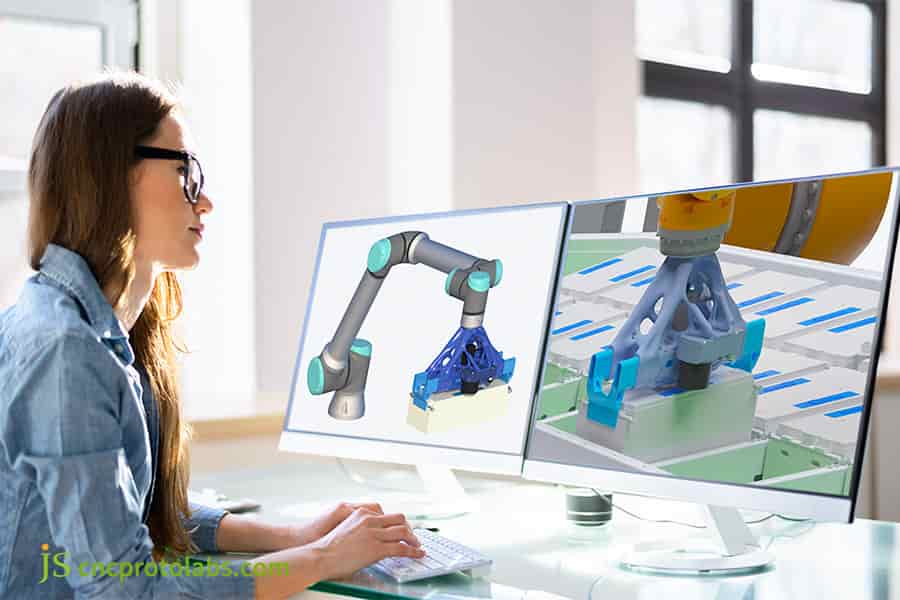
Figure 2: A designer works at a dual-monitor computer station, with detailed 3D models of a robotic arm and its gripper interacting with objects displayed on the screens.
Can Rapid 3D Prototyping Accelerate Development Cycles While Maintaining Precision?
The key benefit of rapid 3D prototyping is that it allows for fast repeat cycles. JS Precision, by carefully choosing the methods of production and accurately controlling each step, implements iterations every 24 hours without compromising precision standards of various robot parts, greatly reducing development time.
Choosing Between Accuracy and Efficiency
Different manufacturing techniques at certain levels can fulfill the requirement of both accuracy and efficiency:
- PolyJet and Micro SLA are primarily used for making very accurate parts.
- Multi nozzle FDM is highly suitable for making large scale structural parts.
- Industrial grade MJF offers a good balance between speed and the level of details, hence it is the first choice for structural parts.
Benefits of Maintaining Contact With Reality
A traditional machining change normally takes 2-3 weeks however rapid 3D prototyping can achieve "design-print-test" loop closure in about 24 hours. As an instance, a robot joint team did 5 upgrades in one week and uncovered the top solution for both stiffness and weight.
Case Study: Rapid Iteration of Robot Joints
A knee joint module of an exoskeleton robot had to be significantly lightened without any drop in strength. Regular CNC machining is time consuming with one revision taking up to 10 days, leading to a huge blow in project schedule.
The customer chooses JS Precision's rapid 3D prototyping service and uses SLS nylon for rapid prototyping. With engineers coming up with a new version every day and cooperating the client in the bench testing, the team managed to finish the full cycle from V1.0 to V5.0 within 5 working days only.
Besides this, the final product was as much as 28% lighter than the first one, at the same time, the joint stiffness was raised by 15%, and the whole development cycle was cut by 60%.
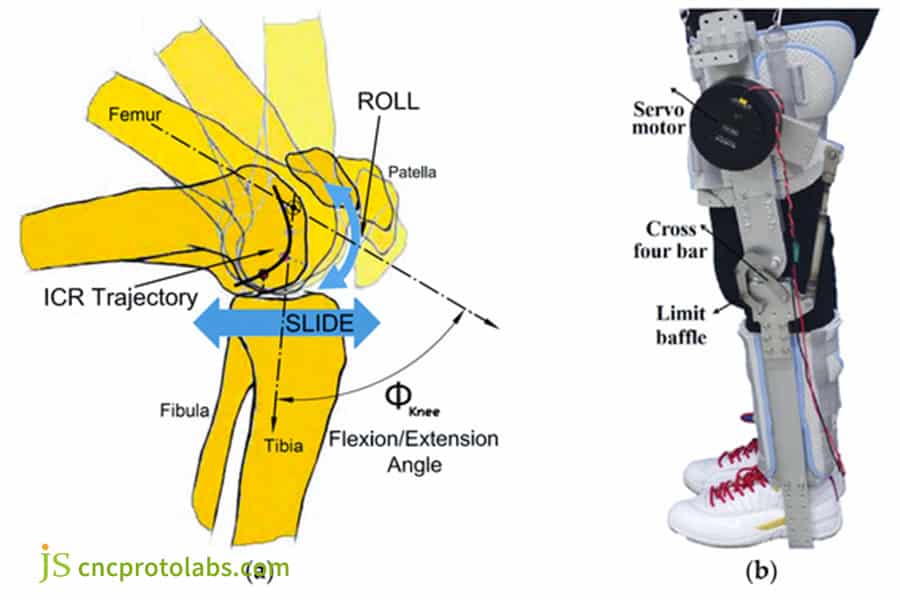
Figure 3: A two-part diagram comparing the biological anatomy of a human knee joint (left) with the mechanical design of a robotic knee module (right), used for prototyping and functional verification.
How Does High Precision Prototyping Ensure Reliable Validation Of Robot Joints And Sensors?
The accuracy with which robot joints and sensors interact jointly dictate their capabilities. High precision prototyping can accurately restore the precision of mass-produced parts. Through exact handling and sophisticated means, JS Precision is capable of offering very trustworthy validation services.
What Precise Control Is For
Precision control must be very focused on the following three major points:
- The clearance between the bearing housing and the shaft needs to be kept within 0.01-0.03mm.
- The flatness of the IMU mounting surface must be <0.02mm.
- The coaxiality of the input and output shafts of the joint reducer should be kept at <0.03mm.
Technologies to Bring the Idea to Life
Depending on the type of technology used, high precision prototypes can be realized by:
- Micron level 3D printing for the micro sensor housing.
- Five axis CNC precision machining for getting the complex curved surfaces right.
- The use of hybrid processes for joint components being the most preferred solution.
Case Study: Prototype Verification of a Robot Joint Reducer
A collaborative robot joint had to check the fitting accuracy between the harmonic reducer and the motor flange. The input shaft had to be coaxial <0.02mm and the output runout <0.03mm very precise requirements.
For the housing made of 6061 aluminum alloy, JS Precision decided to use CNC machining. The dimensional accuracy of the part was determined using a CMM full size inspection, which is a combination of measures that together confirm the key shape to meet the IT7 tolerance grade (±0.015mm).
At the first attempt, the final prototype was successfully put together and went through 200 hours of torque test quite well. The test data can be used directly for making the mold.
High precision prototyping lays the foundation for mass production. Get the JS Precision precision test report template for free and accurately control the verification standards for robot precision components.
When To Choose Rapid Prototyping CNC Machining Over 3D Printing For Robot Components?
Although rapid prototyping CNC and 3D printing are two of the main methods used for robot prototyping, their qualities vary quite a lot. JS Precision factually lays out the pros and cons of each thus the customer can make a well informed decision.
Besides this, it also opens up the possibility of their joint use, since the strengths of one method complement the weaknesses of the other.
CNC's Absolute Advantage Situations
CNC production sets the standard in three particular situations: production of metal parts, parts that need to be extremely precise, and parts carrying loads of various kinds, where strength and fatigue performance are considerably better.
Cost and Batch Size Decisions
Batch size and price will be the primary factors in deciding which process to use:
- 3D printing is generally the best choice for small batches (< 10 pieces).
- The most efficient option for medium batches (10-100 pieces) is a combination of both.
- CNC is the most cost effective choice for large batches (> 100 pieces).
Selection Guidelines
| Component Type | Recommended Process | Core Considerations |
| Load-bearing Structures, Transmission Components | Rapid Prototyping CNC | Strength and fatigue life prioritized |
| Complex Internal Cavities, Lightweight Structures | 3D Printing | Irreplaceable geometrical freedom |
| Sensor Housings, Exterior Parts | 3D Printing + Post-processing | Balance speed and surface quality |
| Metal Inserts, Precision Shafts | Rapid Prototyping CNC | Accuracy and material properties determine |
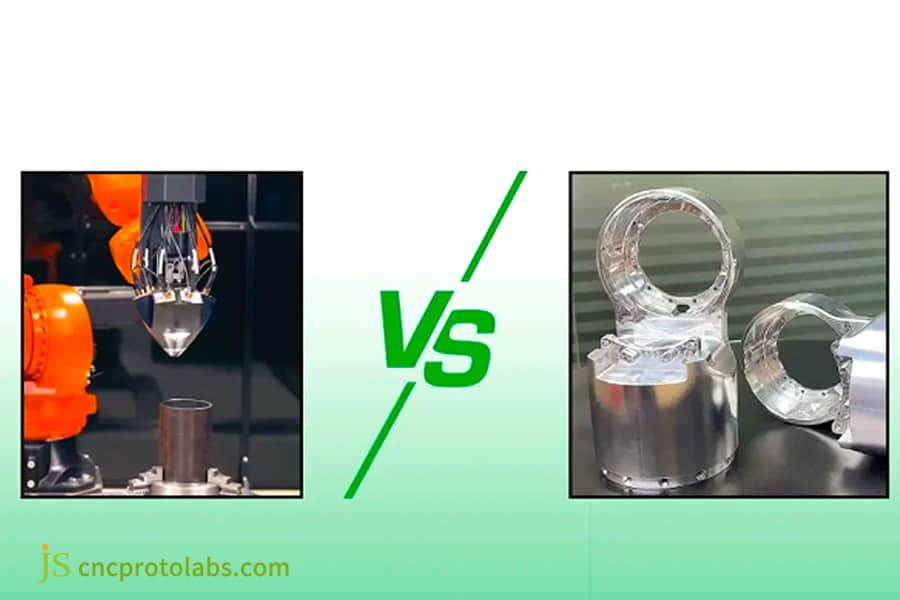
Figure 4: Several high-precision, metallic components of a robot gripper prototype are displayed on a metal surface for verification.
Why Is The Hybrid Strategy Of Rapid Prototyping CNC And 3D Printing Ideal For Lightweight Validation In Robotics?
The lightweight advantage of 3D printing rapid prototyping combined with the precision and strength advantages of CNC is the optimal solution for robot lightweight verification, which can achieve a weight reduction of 30-50% while ensuring interface accuracy and wear resistance.
Complementary Technological Integration
- 3D printing technology can be employed to produce structures with intricate internal cavities and lattice structures, which can lead to a 30-50% reduction in weight and also shorten the cycle time.
- Rapid prototyping CNC is used to maintain the accuracy and wear resistance of the main components.
The two partner each other and help the effectiveness of one another.
Typical Hybrid Application Case
To develop an AGV drive wheel module, JS Precision rolled out a hybrid solution of "3D printed shell + CNC metal inserts" that resulted in a 35% reduction of weight and a 22% reduction of cost, with delivery done within 10 working days, fully satisfying customer requirements.
One Stop Hybrid Manufacturing Process
JS Precision offers a full in house hybrid process planning, at the same time 3D printing and CNC machining can be running, complete precision assembly and functional testing, and deliver prototype parts ready for direct installation.
How Does 3D Printing Prototype Cost Impact The Budget Of Robotics Projects?
In fact, 3D printing prototype cost is the central aspect of the robot research and development budget.
JS Precision via its professional cost optimization approaches not only can effectively manage cost and raise the efficiency of R & D funds, but can also guarantee prototype performance.
Deeply Analyze the Cost Breakdown
The 3D printing prototype cost is mostly made up of four parts: material costs, equipment depreciation, labor post processing, and design optimization. The percentage of each part is fixed and the sections can be optimized individually.
Material costs are typically 30-50%, equipment depreciation and post processing labor are each 20-30%, and design optimization is 10-20%. The prices of different materials, vary significantly, for instance, PA12 is much cheaper than PEKK.
Five Ways to Cut Costs
Support tweaking, hollow design for material saving, four piece printed batch for cost spreading, and finally standard parts reuse and material substitution for further cost reduction.
Case Study: Cost Optimization of a Robot Shell Prototype
The shell prototype of a certain industrial robot enterprise was originally designed as a fully solid structure, using PEKK material, and the single 3D printing prototype cost reached $850.
JS Precision engineers, after conducting DFM analysis, managed to improve the design to a thin walled hollow structure with reinforcing ribs while replacing the material with PA12-CF.
The ending unit cost came to just $490, which is a decrease of 42%. In addition, it was found out that the stiffness of the piece was 10% higher than that of the original design by the testing, which was a complete fulfillment of the functional testing requirements.
Prototype investment is the "insurance" for mass production. Upload your robot component drawings, and JS Precision will calculate the 3D printing prototype cost for you for free and provide professional cost optimization suggestions.
FAQs
Q1: What is the strength of 3D printed robot structural parts?
The tensile strength of SLS nylon (PA12) structural parts is around 48MPa, which is strong enough for medium load applications, for very heavy duty parts, CNC machined aluminum alloy or stainless steel would be a better choice.
Q2: How long does it usually take to deliver prototype production materials?
Generally 3D printing takes 24-48 hours, CNC machining 3-5 days, and prototype complex assembly 1-2 weeks. JS Precision also have a rapid 24 hour turn around service.
Q3: How much weight can lightweight design generally trim?
By combining topology optimization and lattice structure design, weight can be cut by 30-50% in most cases, however, the exact figure depends on the initial design of the part and its actual working conditions.
Q4: To what precision can CNC machining be expected?
The typical tolerance for CNC machining at JS Precision is ±0. 01mm, and for very precise features, it is ±0. 005mm, which is in line with IT6 IT7 level high precision standards.
Q5: To what extent is anisotropy present in 3D printed parts?
3D printed parts exhibit some degree of anisotropy, with the vertical strength being only about 50-70% of the horizontal strength. This can be mitigated by changing the print orientation or selecting the MJF process.
Q6: What process should I choose for small batch production (around 100 pieces)?
If you desire a small batch of around 100 pieces only, come up with a hybrid approach or rapid prototyping + injection molding. JS Precision, a leading prototyping manufacturer in China, has performed this cost comparison of two processes and they want to share it with you.
Q7: How to estimate prototype manufacturing costs?
JS Precision is here to assist you in rapid and easy estimation of prototype manufacturing costs. You need to consider materials, part volume, and post processing complexity.JS Precision supports uploading drawings, which will allow you to get quotes instantly.
Q8: How to choose between metal 3D printing and CNC machining?
To achieve complex internal structures, you should use metal 3D printing, however, if you want simple geometric high precision parts, CNC machining is more economical, in the case of complicated metal parts, you can select depending on delivery time.
Summary
3D printing rapid prototyping robotics is the core engine of robot R&D. A scientific prototyping strategy canhelp engineers to avoid detours and design decisions with data support.
When developing robots, a professional prototyping partner is the first step. JS Precision is able to produce high precision prototypes and can also, based on the experience of the practice, give professional advice to you on design, cost and timeline.
Take action now! Upload your drawings and get free DFM analysis. Let JS Precision be your reliable partner from concept to mass production!

Disclaimer
The contents of this page are for informational purposes only.JS Precision Services,there are no representations or warranties, express or implied, as to the accuracy, completeness or validity of the information. It should not be inferred that a third-party supplier or manufacturer will provide performance parameters, geometric tolerances, specific design characteristics, material quality and type or workmanship through the JS Precision Network. It's the buyer's responsibility Require parts quotation Identify specific requirements for these sections.Please contact us for more information.
JS Precision Team
JS Precision is an industry-leading company, focus on custom manufacturing solutions. We have over 20 years of experience with over 5,000 customers, and we focus on high precisionCNC machining,Sheet metal manufacturing,3D printing,Injection molding,Metal stamping,and other one-stop manufacturing services.
Our factory is equipped with over 100 state-of-the-art 5-axis machining centers, ISO 9001:2015 certified. We provide fast, efficient and high-quality manufacturing solutions to customers in more than 150 countries around the world. Whether it is small volume production or large-scale customization, we can meet your needs with the fastest delivery within 24 hours. Choose JS Precision this means selection efficiency, quality and professionalism.
To learn more, visit our website:www.cncprotolabs.com
Resource