English



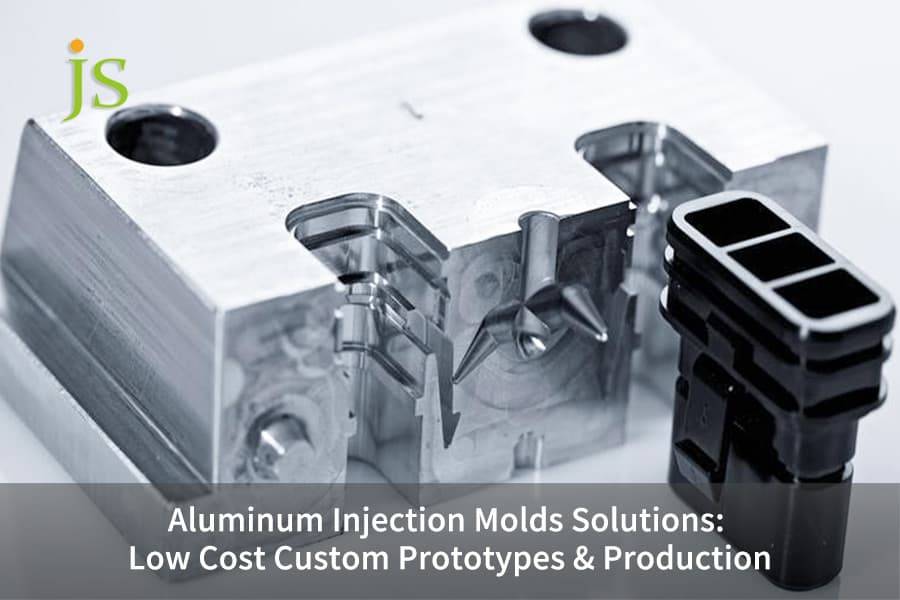

Aluminum injection molds have truly revolutionized the way companies can tackle the challenges of developing new products.Are new product development issues holding you back?
You may be considering steel molds, but the fear of the typical 6-8 weeks delivery time and the hefty price tag that runs to tens of thousands of dollars might be deterring you. Maybe you are thinking of prototypes, however, parts made this way do not allow for assembly testing and safety certification.
With product lifecycles getting shorter and iterations happening faster, reliance on traditional mold investment strategies is a recipe for failure.
And can the answer be a method capable of directly producing injection molded parts that are market ready for validation but at only a small fraction of the cost and time associated with steel molds?
Injection molding tooling is the most significant issue, and aluminum injection molds have the potential to be the answer.
Core Answer Overview
| Core Dimensions | Aluminum Mold Solution Performance | Traditional Steel Mold Solution Performance |
| Delivery Cycle | 2-3 weeks (fast processing speed, no heat treatment required). | 6-8 weeks (longer processing cycle, heat treatment required). |
| Upfront Cost | 30%-50% of steel mold (lower material and processing costs). | High baseline. |
| Part Quality | Uniform cooling, minimal warpage. | Stable performance. |
| Total Cost of Ownership | Suitable for production below 50,000 units, lower unit cost. | Suitable for mass production above 100,000 units. |
| Iteration Risk | Low mold repair costs, flexible mold modification. | High mold repair costs, long cycle. |
Key Conclusions:
- Matching requirements dictates the right solution: Aluminum moldings best fit projects with an yearly output volume of less than 50,000 units and which require fast design changes.
- Reduced overall expenditure: When factoring the "unit averaged cost" based on the life of a mold, aluminum molds tend to be more cost effective.
- Quality is not compromised: Thanks to their higher thermal conductivity, aluminum molds not only meet the production of injection molding parts perfectly, but also fulfill the safety standards.
- Prevention of risk: Prototype aluminum moldings for limited small batch productions serve well for market checking as well as design refinement prior to making steel molds.
Why Choose Aluminum Injection Molds? JS Precision's Low Cost Solution
When businesses encounter hurdles in new product development, aluminum injection molds may serve as a dependable injection molding tooling option for premium customers to execute their plans efficiently.
To get low cost, rapid delivery mold solutions, JS Precision with 15 years of aluminum injection mold making experience is mature and right(left) support - our services extended to 20 countries and 500 clients (including startups and Fortune 500 companies), thus we can learn successful experiences from different industries and avoid common pitfalls in new product development.
ISO 20457:2018 specifies that high quality aluminum injection molds can very accurately meet the precision requirements of small to medium batch production, allowing companies to avoid losses caused by defective parts and rework due to lack of mold precision.
Industry statistics reveal that for projects with an annual output of less than 50,000 units, aluminum injection molds can cut the total project cost by an average of 40%-60% compared to steel molds. This implies that companies can dedicate a larger budget to product development and marketing, thereby reducing the financial strain.
An electronics startup in America has successfully launched a new sensor product by using the aluminum injection molds from JS Precision, which helped them bring down their mold investment from $30,000 to $9,000 and the delivery cycle from 8 weeks to 2 weeks, thus securing a competitive position in the market.
In fact, one of the main reasons many companies go for this solution is its effectiveness.
We have a highly skilled team that offers tailored solutions that take your company's product features into account. So, each set of aluminum injection molds will be made to fulfill your quality and timing requirements to the letter. And, you won't have to worry about compatibility issues of molds that will cost you time and money.
In other words, choosing JS Precision is practically the same as choosing a trustworthy partner in your new product development who will be capable of correctly addressing your main issues and generating real business value.
If you would like to know if aluminum injection molds are suitable for your project, please contact our engineers for a free one-on-one consultation and professional project assessment.
How Do Aluminum Injection Molds Deliver Both Low Cost And Fast Turnaround?
The high efficiency and low cost of aluminum injection molds basically come from various factors, mainly its excellent machinability, a simplified process chain, material cost advantages, and shorter delivery cycles.
These factors together lead to reducing overall project costs, thus making them the favored injection molding tooling option for companies that have rapid product iteration speeds.
3-5 Times Faster Cutting Speed
Aluminum is a lot softer than steel, so it's possible to have very high cutting speeds over 1500 inches per minute and 3-5 times faster than steel molds. Also, there is a more significant point that it doesn't require the weeks of heat treatment that a steel mold usually needs, so, the trial molding can be done immediately after the processing.
In fact, the mold delivery cycle time is shortened from 6-8 weeks of steel molds to 2-3 weeks, enabling companies to start production and market validation much earlier.
In other words, it compares to ordering fast food in a restaurant, you simply don't wait for complicated kitchen preparation processes. Your order is served quickly, and therefore, you have a faster "finished product" and a competitive edge in the market.
Material Costs Reduced by 50%-70%
The price gap between premium P20 mold steel and top tier aerospace 7075 aluminum alloy is quite large. On average, the material cost for aluminum injection molds amounts to a mere 30%-50% compared to steel molds.
This benefit effectively enables businesses to offer more affordable products and also set aside more money for developing and marketing their products.
| Mold Material | Cutting Speed (inches/minute) | Material Cost as a Percentage of Steel Mold | Heat Treatment Time | Delivery Cycle | Applicable Batch Size |
| 7075 Aluminum Alloy | 1500-2000 | 30%-50% | None | 2-3 weeks | Under 50,000 pieces |
| P20 Mold Steel | 300-500 | 100% | 2-3 weeks | 6-8 weeks | Over 100,000 pieces |
| Alumold-350 Aluminum Alloy | 1200-1800 | 40%-60% | None | 2-3 weeks | Under 50,000 pieces |
| H13 Mold Steel | 200-400 | 120%-150% | 3-4 weeks | 8-10 weeks | Over 200,000 pieces |
What Makes a Reliable Injection Mold Part From An Aluminum Tool?
The quality of the injection mold part does not get worse, in fact, because of aluminum's better thermal conductivity, the plastic inside the mold cavity cools more evenly, leading to dimensionally stable and visually appealing injection molded parts.
Aluminum molds for injection molding are now a favorite option for companies that want to combine speed and quality.
4 Times Thermal Conductivity, More Even Cooling
The thermal conductivity of aluminum is about 237 W/mK, which is four times that of steel. 7075 aluminum alloy according to ASTM B209-21 standards has even more stable thermal conductivity, which can lead to a reduction of mold cooling time by 30%-50%.
Thus, the parts shrink more uniformly, warpage and residual stress are significantly lessened, and the injection mold parts' yield rate is improved.
In layman's terms, it is similar to evenly spreading ice cubes over hot food- it cools fast and uniformly, prevents a certain area from getting too hot and changing shape, and ensures that each piece is both good looking and precisely measured.
Mold Flow Analysis Ensures First Time Success
Dependable aluminum molds for injection molding require accurate mold flow analysis.
Moldflow, for example, can forecast points of weaknesses like weld lines and trapped air, improve the arrangement of the cooling water channels, and verify that the injection molded component made from the sample mold fulfills the size and performance specifications, thus eliminating the need for multiple mold modifications.
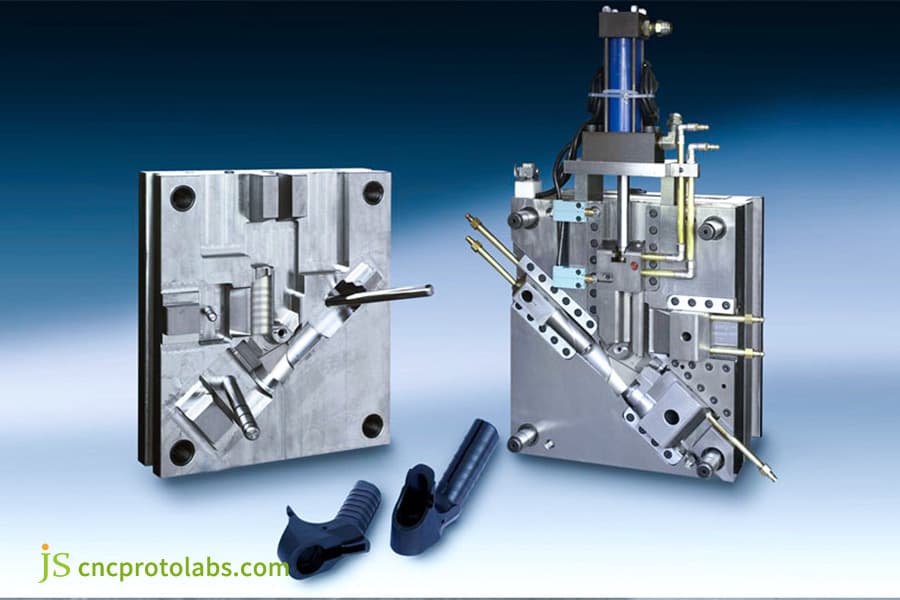
Figure 1: Two detailed aluminum mold halves with cooling channels alongside two black plastic prototype parts on a gradient background.
Why Are Prototype Injection Molds The Key To De-Risking Your Product Launch?
Prototype injection molds serve as a means to close the gap between prototypes and steel molds for mass production.
They use equipment and processes of mass production grade to produce parts which can be used directly for market testing, thus bridging the "process gap" and lowering the risk of new product launches.
Manufacturing plastic parts for production using prototypes is an important risk management step for businesses.
Eliminating Process Gaps, Directly Using Mass Production Grade Injection Molding Machines and Process Parameters
On one hand, traditional prototypes cannot mimic the real injection molding process, on the other hand, prototype injection molds can be put on mass production injection molding machines and go through the same parameters.
This is the surest way of having aluminum mold parts and steel mold parts of the future that have the same mechanical properties and dimensional accuracy.
Parts Can Be Directly Used for Certification and Sales
Consignments made using prototype injection molds are legitimate injection molded parts, that can be used for whole machine assembly testing UL or CE safety certification, etc.
When the first stage verification is passed, these parts can be used as initial sales inventory to market entry with "zero inventory" and taking advantage of market opportunities.
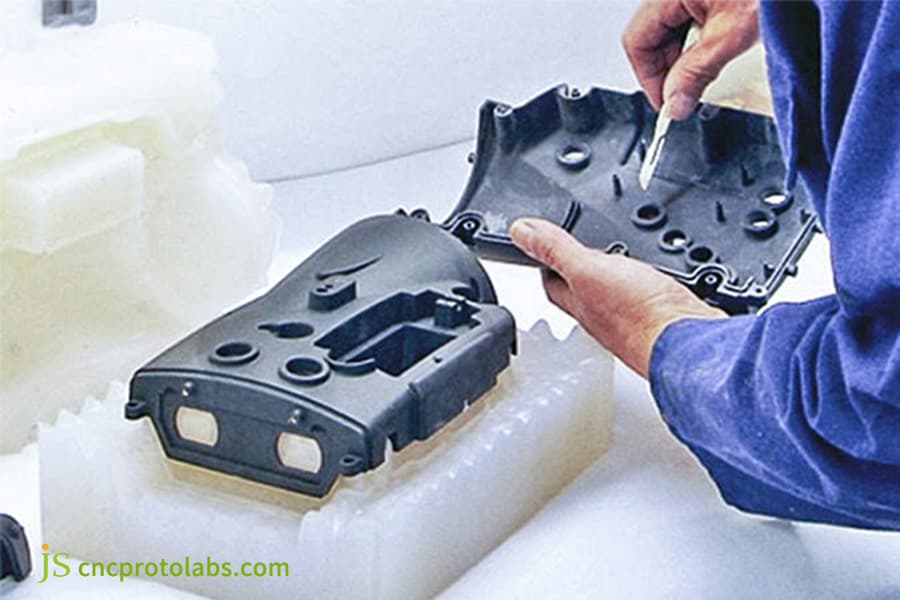
Figure 2: A pair of gloved hands closely examining a complex dark grey injection-molded component.
How Does Injection Molding Tooling In Aluminum Compare To Steel On Total Cost?
By assessing the per-part amortized cost, it is clear that in manufacturing projects having similar life cycles, aluminum injection molds are significantly cheaper than steel molds.
Besides the fact that they have a very low initial capital outlay, mold alterations entail negligible costs thus making the total cost of production to be continually lower no matter the scenario of production level.
In the long run, switching to aluminum injection molding can be a financially attractive option for enterprises looking to improve cost efficiency.
| Production Batch (pieces) | Total Investment in Aluminum Molds (USD) | Total Investment in Steel Molds (USD) | Unit Cost of Aluminum Molds (USD) | Unit Cost of Steel Molds (USD) | Cost Savings Percentage |
| 10,000 | 2,000 | 8,000 | 0.2 | 0.8 | 75% |
| 30,000 | 2,000 | 8,000 | 0.067 | 0.267 | 60% |
| 50,000 | 3,000 | 8,000 | 0.06 | 0.16 | 62.5% |
| 100,000 | 5,000 | 8,000 | 0.05 | 0.08 | 37.5% |
| 200,000 | 8,000 | 8,000 | 0.04 | 0.04 | 0% |
60% Reduction in Amortized Cost per Unit
One steel mold that lasts 100,000 units cost $8,000 while an aluminum mold that lasts 20,000 units is priced at $2,000. With only 30,000 units life of product, the price of aluminum mold side is $0.067 while that of steel mold is $0.267.
This way, there will be 60% less amount of cost per aluminum mold. The advantages for aluminum in this area get even bigger when considering modifying of molds.
Mold Repair Costs Only 1/5 of Steel Molds
It is difficult to finalize product design in one go, and the easy processing characteristics of aluminum materials make the cost and time of repairing aluminum injection molds only 1/5 of steel molds, helping enterprises to complete multiple design optimizations at low cost and reduce financial pressure.
Enter your production batch size, and we will calculate the amortized cost per unit of injection molding tooling for you free of charge, providing a clear view of cost savings and helping you make a more economical choice.
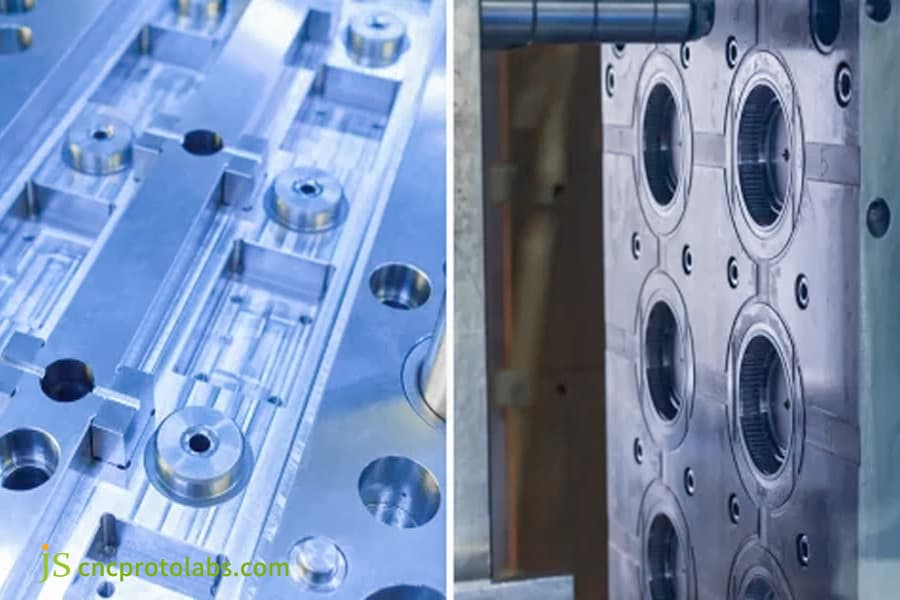
Figure 3: Detailed close-up views of the flat and side profiles of a silver aluminum mold tool, showcasing numerous precisely machined holes and cavities.
What Are The Practical Limits Of Aluminum Molds For Injection Molding?
We articulate precisely what the aluminum molds' shortcomings are:
When the yearly production runs beyond 50,000 units, the engineering plastics which are injected are those having more than 30% of glass fiber, or thin wall molding necessitates a super high injection pressure, the life expectancy of aluminum molds for injection molding will be greatly reduced.
Clearly marking boudaries of these helps firms choose the best.
Three Cases When Molds Lifespan Is Drop Drastically
High production level, high content of glass fiber and high pressure are the three situations that aluminum mold life time dwindle significantly:
While injection molding engineering plastics with more than 30% glass fiber, the wear on the mold cavity by glass fiber is 5-8 times that of ordinary plastics, annual demand exceeding 50,000 units or thin wall molding pressure >1500 bar will lead to an aluminum mold life of less than 10,000 cycles, which is a loss of cost effectivness.
Aluminum Molds Limits Production
The aluminum molds of injection molding can excellently perform the task requirements outside of the above conditions.
In about 90% of the cases, aluminum molds identify prototype verification, small batch trial production, and even applications like consumer goods and automotive parts that do not require high glass fiber reinforcement, outperforming steel molds in every aspect overall.
How To Optimize Manufacturing Plastic Parts With Aluminum Molds For Cost Efficiency?
Multi cavity sharing and mold base standardization are two of the most effective ways to optimize the cost of manufacturing plastic parts starting from the design stage.
By taking advantage of the flexibility that aluminum injection molds offer, single cavity molds can be tested and then converted to multi cavity molds with the help of standard mold bases that are reused to get maximum cost benefits.
Expanding to Multi Cavity Molds After Single Cavity Validation
Provision for multi cavity configuration should be kept in the mold design mold. Initially, a single cavity core is machined for trial molding and validation purposes.
Once it has been established that the design, materials, and processes are all right, the less restrictive nature of aluminum injection molds makes it possible to quickly modify the single cavity mold to 2-cavity or 4-cavity molds, thus saving both time and costs of development.
This is the simple analogy, like one tries on samples clothes before ordering the bulk ones. This completely avoids the large initial investments and the wastage of "ill fitting" items thus saving a lot of time and costs.
Standard Mold Base Reuse
Standard mold bases are usually chosen for mass production.
Later, if there is a requirement to develop similar parts, only new cores and cavities are required to be machined and installed on the existing mold base which results in reduction of injection molding tooling expenditure by 40%-60% and also the total mold changeover time is cut down by more than half.
Do you have specific product drawings? Submit your requirements, and we will customize an optimized aluminum mold solution for manufacturing plastic parts to maximize cost reduction and improve production efficiency.
What Should You Look For In a Plastic Prototype Manufacturing Partner?
When selecting a plastic prototype manufacturing partner, focus on three core capabilities: pre-processing mold flow analysis to predict problems, a mature injection molding process database, and one stop service from mold to injection molding to avoid shirking responsibility and ensure smooth project progress.
Mold Flow Analysis and Defect Prediction Capabilities
Top notch plastic prototype manufacturing partners should be equipped with professional mold flow analysis capabilities, which use software to predict risks in the injection molding phase.
Besides that, through optimization of gates and venting systems prior to mold processing, problem points like weld lines are addressed to make sure the trial molding goes with a high success rate.
Injection Molding Process Database Accumulation
To be a dependable partner, one needs a database of process parameters that include the most common plastics like ABS and PC.
Having thoroughly analyzed the rheological properties of a given material, one can accurately set injection parameters to make sure that the production of the injection mold part is consistent and stable, without leaving things to manual experience.
One Stop Mold and Injection Molding Service
Give preference to one stop service providers when it comes to mold design, processing, and injection molding.
In case of quality issues such as burrs, or dimensional deviations, one wouldn't have to contact different factories, a single service provider would be able to directly take responsibility for the injection mold part and be able to quickly pinpoint and solve the problem.
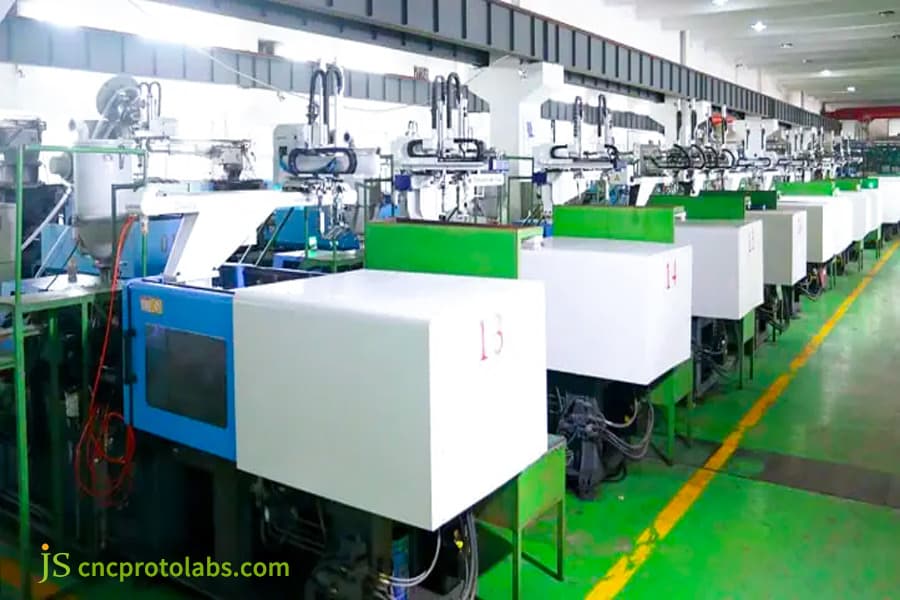
Figure 4: A long factory assembly line with multiple large, numbered machines in a clean, well-organized industrial facility.
JS Precision Case Study: Industrial Sensor Aluminum Mold Solution, Saving $22500 And Shortening 7 Weeks
This case study vividly illustrates how aluminum injection molds are superior in terms of cost efficiency and risk control. It also shows JS Precision's injection molding tooling expertise, which can be a practical guide for similar projects.
Challenges
A smart wearable startup based in the US intends to introduce a smart bracelet that is expected to sell 20,000 units in its first year. Steel molds usually cost $25,000 with a 10-week delivery cycle.
Due to limited funding, two design revisions, and high precision and appearance requirements of the PC+ABS material, prototypes could not be made. Besides the startup wanting to get market share urgently, the high price and long lead time of steel molds are the major constraints for them.
Solutions
1. Recommended Core Solution:
JS Precision recommends using aluminum injection molds, and the best metal for mold making is 7075-T6 aerospace grade aluminum alloy. It is a very hard metal while also having excellent thermal conductivity. So using this metal will give you a very good balance between mold durability and part molding quality.
2. Design Phase Optimization:
During the mold design stage, our engineers relied on Moldflow software for mold flow analysis to perfectly optimize the gate location and at the same time prevent the weld line problems in advance to make sure the injection mold part complies with the appearance and quality standards.
3. Single Cavity Validation and Trial Molding:
The approach was a single cavity validation, making a single cavity mold first for trial molding, manufacturing 300 parts for safety testing and media evaluation, fully validating the design rationality, materials, and processes.
4. Rapid Mold Modification and Expansion:
Once it has been verified that all indices were in compliance with the requirements, taking advantage of the easy modification of the aluminum injection molds, the mold was extended from a single cavity to a two cavity one in two weeks, thus finally entering the stage of formal small batch production.
5. Comprehensive Process Support:
We offered expert process guidance. We were in full control of the production process so as to ensure the stability and consistency of part production.
Final Results
- Concerning the cost, the total investment for the aluminum injection molds solution was $7,000 which was only 28% of the steel mold cost, resulting in a direct saving of $18,000.
- When it comes to cycle time, it took a total of 5 weeks from the finalization of design to the delivery of the first batch of 2,000 parts, which means the launch was 8 weeks ahead of schedule.
- Concerning quality, the mold life was as long as 25,000 cycles, the dimension accuracy of injection mold parts was 0.05mm, all safety certifications were passed, and the client has been cooperating with JS Precision on a long term basis.
Want to replicate this success? Tell us your project details to get a customized aluminum injection molds quote. We'll help you quickly launch your project, save costs, and seize market opportunities.
FAQs
Q1: Can aluminum molds produce transparent injection molded parts?
Aluminum molds are definitely capable of reaching the surface finish at the level of SPI-A2 standard. That means transparent PC or acrylic parts produced with aluminum molds can be compliant with the standards not only in their appearance but also in their quality.
Q2: Are aluminum molds prone to wear during use?
When glass fiber is absolutely not used or its content is very low, aluminum molds might be able to perform for 20,000-50,000 pieces. Surface coating treatments have the capability of making the mold more resistant to wear, prolonging the usage period, and lowering the operating expenses.
Q3: If a major product design change is needed, how many mold repairs can an aluminum mold withstand?
Aluminum has good toughness and can usually withstand 2-3 large mold repairs. The cost and time of mold repairs are only 1/5 of steel molds, reducing the pressure of iteration costs.
Q4: What are the differences between using aluminum molds for prototyping and 3D printed parts?
Parts made with 3D printing cannot represent the mechanical properties of injection molding. Also, parts produced with aluminum molds are injection molded, which means they have the strength of mass produced parts, and therefore, these parts can be directly used for assembly and safety certification.
Q5: Can aluminum molds produce threaded parts?
Of course. Aluminum molds may be equipped with intricate mechanisms like sliders and angled ejectors so that internal and external threadings can be simply made without any other processing steps.
Q6: What is the biggest injection molded part that aluminum molds can produce?
It is subject to the injection molding machine and mold size. By and large, it can produce sizable parts from a button size to 1 meter, thus fulfilling the production requirements of most industries.
Q7: How much time is required from the design to receiving the first batch of parts?
Basic items can be shipped within a week. Typical projects in mold processing and parts delivered in small quantities usually take 2-3 weeks to allow for market validation.
Q8: Can JS Precision supply additional finishing work for injection molded parts?
Definitely. JS Precision, as an integrated factory, offers a full range of post processing services for the parts such as painting, screen printing, and laser engraving to satisfy the variety of requirements.
Summary
Aluminum injection molds provide a practical way to bring your ideas to the market while cost, speed and quality are balanced. They can also be great solutions for the problems of new product development including high costs, long cycles and high iteration risks.
Immediate action: Contact us and let us know the details of your project. JS Precision will offer you a professional project assessment enabling you to figure out the feasibility of aluminum molds and at the same time, helping you bring your product to the market faster and more cost effectively.

Disclaimer
The contents of this page are for informational purposes only.JS Precision Services,there are no representations or warranties, express or implied, as to the accuracy, completeness or validity of the information. It should not be inferred that a third-party supplier or manufacturer will provide performance parameters, geometric tolerances, specific design characteristics, material quality and type or workmanship through the JS Precision Network. It's the buyer's responsibility Require parts quotation Identify specific requirements for these sections.Please contact us for more information.
JS Precision Team
JS Precision is an industry-leading company, focus on custom manufacturing solutions. We have over 20 years of experience with over 5,000 customers, and we focus on high precisionCNC machining,Sheet metal manufacturing,3D printing,Injection molding,Metal stamping,and other one-stop manufacturing services.
Our factory is equipped with over 100 state-of-the-art 5-axis machining centers, ISO 9001:2015 certified. We provide fast, efficient and high-quality manufacturing solutions to customers in more than 150 countries around the world. Whether it is small volume production or large-scale customization, we can meet your needs with the fastest delivery within 24 hours. Choose JS Precision this means selection efficiency, quality and professionalism.
To learn more, visit our website:www.cncprotolabs.com
Resource