English




Rapid prototyping medical devices is one of the main methods medical technology companies use to bypass R&D bottlenecks. Although a market launch of 3-7 years is the typical time frame, any prototype failure during this time will result in losing the market window.
Engineers pursue "fast failure, fast iteration" while ensuring that every design change meets the stringent requirements of ISO 10993 or FDA.
This article will compare rapid prototyping technologies for medical devices, evaluate the costs, and assist you in choosing high-precision prototyping services providers who can help you quickly and cheaply verify product safety.
Quick Overview of Core Answers
| Core Dimensions | Key Answers | Value for You |
| Technology Selection Path | 3D printing is a great method for making a proof of concept (cheap with fast turnaround), CNC is used to create a model that is closest to the final version (material testing/performance), and replica molding is used for small batch clinical trials. | Avoid using the wrong technology at the wrong stage, saving 3-4 weeks of iteration time. |
| CNC Core Value | Precision in CNC plastic prototype parts can be maintained within ±0.01mm tolerance, and these parts also demonstrate excellent performance characteristics of PEEK/titanium alloys, etc. | Ensures reliable functional testing and passes medical device registration review on the first attempt. |
| Cost Control Strategy | Use a cheap 3D printing process to "settle the position, " and then, for final confirmation, use CNC machining prototyping will decrease the total costs by 30%. | Optimize R&D budget allocation, spending money on the most crucial aspects of final verification. |
| Certification Partner Selection | Must hold ISO 13485 certification, have cleanroom facilities and batch traceability. Chinese suppliers offer 15-40% lower costs and faster delivery times. | Find high-precision prototyping services partners with both compliance qualifications and supply chain efficiency. |
Key Takeaways
- Technological Inflection Point: 3D printing can be used for morphological checks, but only CNC can do the functional checks, especially for sterile or stress benefitting parts.
- Cost Truth: Materials(e.g. PEEK) and post-processing(e.g. aseptic packaging) are major contributors to hidden costs- cumulatively, they account for over 40% of the unit price.
- Compliance Red Line: ISO 13485 is a non negotiable minimum standard, medical supply chains only accept suppliers who have this certification.
- Geographical Advantage: Manufacturers of rapid prototyping services in China (especially the Pearl River Delta) can supply globally within 7-12 days while their prices are 30% lower than those of the European and American markets.
Why Trust This Guide? JS Precision's Experience In Rapid Prototyping Medical Devices
JS Precision has been a key player in rapid prototyping of medical devices for more than 20 years. We have helped 300+ med-tech companies worldwide with categories ranging from surgical robots, implantable devices to diagnostic equipment.
We have done 1000+ medical prototype development projects, out of which 80% assisted clients in prototype verification phase for FDA or CE certification.
We are a one-stop solution provider - from 3D printing to 5 axis CNC machining. Our production line facilities are certified with ISO 13485:2016, and we have Class 100,000 cleanrooms.
This is how we maintained ISO 13485 compliance not only for production but also for the entire lifecycle management of medical devices from material processing to aseptic packaging.
One time, we reduced a lead time for 15 PEEK testing components for a US diagnostic equipment company from 10 days to 4 days, while still maintaining a stable accuracy of ±0.015mm and ultimately enabling the client to perform clinical testing ahead of time by two weeks.
During one of the real-world projects, we rid of the precision problems of PEEK prototype processing for a European orthopedic implant startup by bringing down the tolerance from ±0.05mm to ±0.01mm. This improved the accuracy of the client's animal testing data by 90%, ultimately leading to a successful Series A funding round.
We use smart tech for medical materials. Our tools work well with titanium, PEEK, and medical silicone. Performance stays strong thanks to these settings. That’s why top hospitals trust us. Plus, results are solid and consistent. Seems like a smart pick for quality care.
Choosing a trustworthy partner is a prerequisite for successful medical device rapid prototyping. JS Precision's practical experience can help you avoid 90% of the pitfalls in prototype development. Contact our engineers now to receive a free, customized medical device prototype development solution, minimizing detours in your R&D.
What Is The Best Medical Device Rapid Prototyping Technology For Your Project Stage?
Different R&D stages have significantly different prototype requirements. The medical device rapid prototyping core skill requires the selection of appropriate rapid prototyping technology which leads to twice the increase of R&D productivity.
The three main technologies offer specific benefits and drawbacks which apply to particular situations. The evaluation of fast prototyping should be done together with the evaluation of the current development stage:
3D Printing (SLA/SLS/PolyJet)
This technology serves its purpose during the initial research and development process by enabling the creation of concept models and surgical guides.
- Advantages: No mold cost, with an accuracy of ±0.05mm, it can achieve fast prototyping iteration (parts can be produced within 24 hours) and quickly verify product form.
- Limitations: The material properties of the product provide lower strength than those found in injection molded components which makes it unfit for testing functional loads and certain resins do not fulfill biocompatibility standards.
CNC Machining
CNC machining prototyping serves as the primary use case for this technology which enables the creation of functional prototypes and testing of high-performance material components.
- Advantages: The system maintains material isotropy while achieving tolerances of ±0.01mm and medical grade surface treatment which fulfills both sterilization and stress testing standards.
- Limitations: The processing costs increase when working with complex internal structures and the time needed to finish each item exceeds the duration required for 3D printing.
Vacuum Casting
Vacuum casting works well for early trial tests and animal studies with small groups of 10 to 20 pieces.
- Advantages: Its cheaper than full molds and mimics real medical materials. It gives fast, small-scale parts to test.
- Limitations: Its choice of material is narrow. It doesn’t work for long term implants. Accuracy isn’t as tight as with CNC.
ISO 10993-1 provides a clear classification of biocompatibility for medical materials, which is an important basis for technology selection. Want to know which technology is right for your project? Click to view our medical device rapid prototyping technology selection case studies to accurately match your R&D needs.
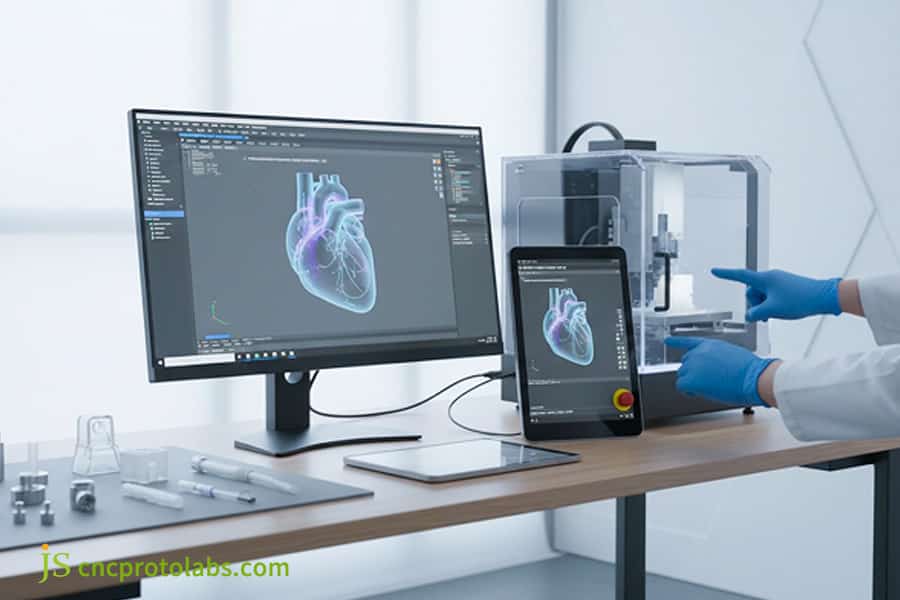
Figure 1: A 3D printer is actively creating a detailed heart-shaped prototype for medical device development, with design software visible on a nearby screen.
When Should You Use a CNC Plastic Prototype In Medical Device Development?
The functional verification stage of prototype development requires CNC plastic prototype which serve as essential testing tools. The process capability of CNC machining prototyping directly determines the verifiability of the verification.
The following two scenarios require the use of CNC plastic prototypes:
Uncompromising Material Performance
- Pain Point Scenarios: surgical instrument handles and diagnostic device housings and implant tools need performance standards which manufacturers must meet.
- Value Proposition: CNC plastic prototypes preserve material properties through subtractive manufacturing processes which create identical mechanical characteristics that match mass produced components. Fatigue testing data for materials like PEEK relies on CNC machined parts.
Surface Treatment and Biocompatibility
- Post-processing: Polishing and other processes achieve a surface roughness of Ra below 0.4μm which meets ISO 10993-5 cytotoxicity testing requirements.
- Cleanliness: CNC machining prototyping can be assembled in a clean room to avoid particle contamination and meet sterile requirements.
How Much Does Rapid Prototyping Medical Devices Really Cost?
The expense of fast prototyping services for medical device creation depends on various factors. The expense of high-precision prototyping services remains higher than standard costs yet their accuracy prevents future compliance work.
The organization needs to maintain precise cost management because it serves as the primary financial element.
Pricing Drivers
- Technology Selection: SLA resin parts cost approximately $500 each while metal CNC and PEEK machining expenses range from $3,000 to $8,000 for each item.
- Material Premium: Medical-grade titanium rods and PEEK materials cost 3-5 times more than regular plastics because they need batch certification which makes up 20% of their total expense.
Hidden Costs of Post-Processing and Documentation
- Certification Surcharges: The expense of compliance documentation creates a hidden cost that ranges between 8% to 12% of total expenses.
- Surface Finishing: Medical grade appearance requirements increase post processing costs by 15-20%.
Total Cost of Ownership Optimization Strategies
- Optimization Strategy: The organization can achieve 30% reduction in total research and development expenses through rapid iteration process which starts with SLA 3D printing and ends with high-precision prototyping services.
Medical Device Rapid Prototyping Cost Reference Table
| Prototype Type | Prototype Type | Material | Unit Price (USD/piece) | Minimum Order Quantity |
| Conceptual Appearance Part | SLA 3D Printing | Medical Resin | 450-600 | 1 |
| Simple Functional Part | CNC Machining | Medical ABS | 800-1200 | 1 |
| High-Performance Functional Part | CNC Machining | PEEK | 3000-4000 | 1 |
| Metal Functional Part | CNC Machining | Titanium Alloy TC4 | 5000-8000 | 1 |
| Small Batch Clinical Parts | Vacuum Molding | Medical Silicone | 600-800 | 10 |
After understanding the cost structure, you need to accurately calculate your project costs. Contact JS Precision now, provide product drawings, and get a free detailed quote for rapid prototyping medical devices.

What’s The Lead Time Difference In Medical Device Rapid Prototyping Technologies?
The different delivery cycles in a significant way between various technologies play an important role in planning and scheduling medical device rapid prototyping. CNC machining prototyping, in particular, allows you to have better control over your lead time as outlined below:
- SLA 3D Printing: Normal delivery in 1-3 business days,fast delivery within 24 hours,ideal for urgent proof-of-concept.
- CNC Plastic Prototype: Delivering plastic parts in3-5 business days,fast delivery within 48 hours for simple shapes.
- Metal CNC Machining Prototyping: Delivering standard 5-7 business days,with fast delivery available can be 3-4 days, lead time depends on materials machining complexity.
- Vacuum Molding: Delivering standard 7-10 business days, allows rapid production after mold is finished,ideal for small batch clinical testing.
Note: Lead times above do not include time for post-processing. If you want to have medical-grade surface treatment or aseptic packaging, an extra 1-2 working days are required.
Can Fast Prototyping Produce Multiple Design Iterations In a Week?
The answer is yes. The design team can use SLA 3D printing fast prototyping technologies to finish three to four appearance and assembly tests within a five-day work period. The medical device industry benefits from rapid prototyping which enables companies to develop their products through multiple design cycles.
A more efficient mixing strategy is: begining with 3D printing shape verification which occurs on Monday and continues with design changes based on Monday's test results which take place on Wednesday and concludes with CNC machining testing of essential stress areas which happens on Friday.
This hybrid system combines fast prototyping speed with complete component verification authenticity which makes it ideal for projects that need to be developed quickly.
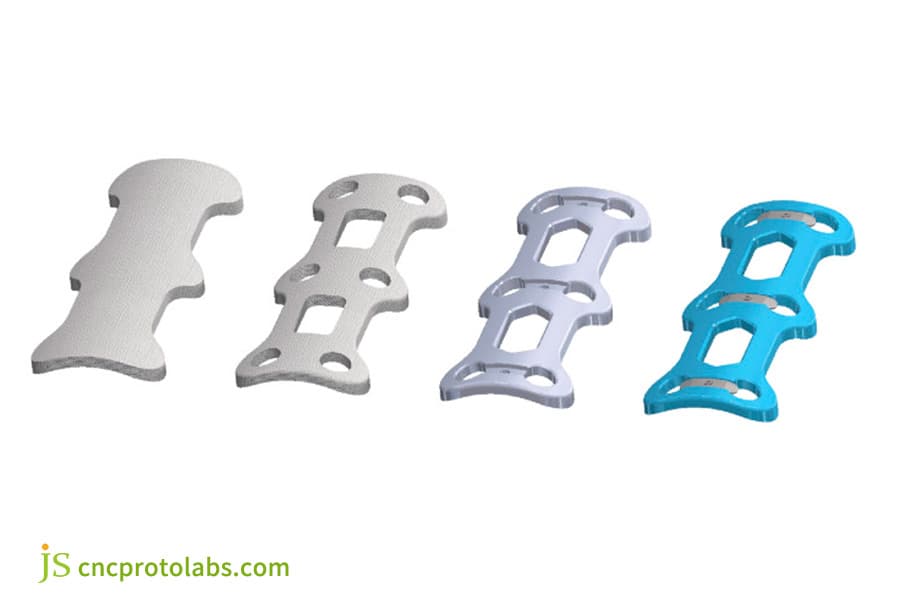
Figure 2: A series of four distinctly shaped, precision-machined plastic prototypes arranged in a row, demonstrating rapid design iteration capabilities.
What’s The Accuracy And Repeatability Of Rapid Prototyping Medical Devices For Implants?
Implant prototypes have extremely high requirements for accuracy and repeatability. The testing validity of medical device prototype testing depends on which manufacturing process the team selects for rapid prototyping.
High-precision prototyping services are the only way to achieve this:
- Accuracy Level: Implant prototype tolerances must reach IT6-IT7 level (±0.01mm - ±0.025mm) to match human anatomy.
- Process Selection: Only 5 axis CNC or metal 3D printing (requiring precision) from high-precision prototyping services can achieve this accuracy.
- Repeatability: The repeat positioning accuracy of CNC machined parts in the same batch is ≤ 0.01mm, ensuring consistency of animal experimental data.
Medical Implant Prototype Accuracy and Process Adaptation Table
| Implant Type | Tolerance Requirements | Recommended Process | Repeatability | Surface Roughness Requirements |
| Orthopedic Bone Plate | ±0.015mm | 5 axis CNC Machining | ±0.008mm | Ra≤0.3μm |
| Dental Implant | ±0.01mm | 5 axis CNC Machining | ±0.01mm | Ra≤0.2μm |
| Spinal Fusion Device | ±0.02mm | Metal 3D Printing + CNC Finishing | ±0.01mm | Ra≤0.4μm |
| Craniofacial Implant | ±0.025mm | 5 axis CNC Machining | ±0.01mm | Ra≤0.3μm |
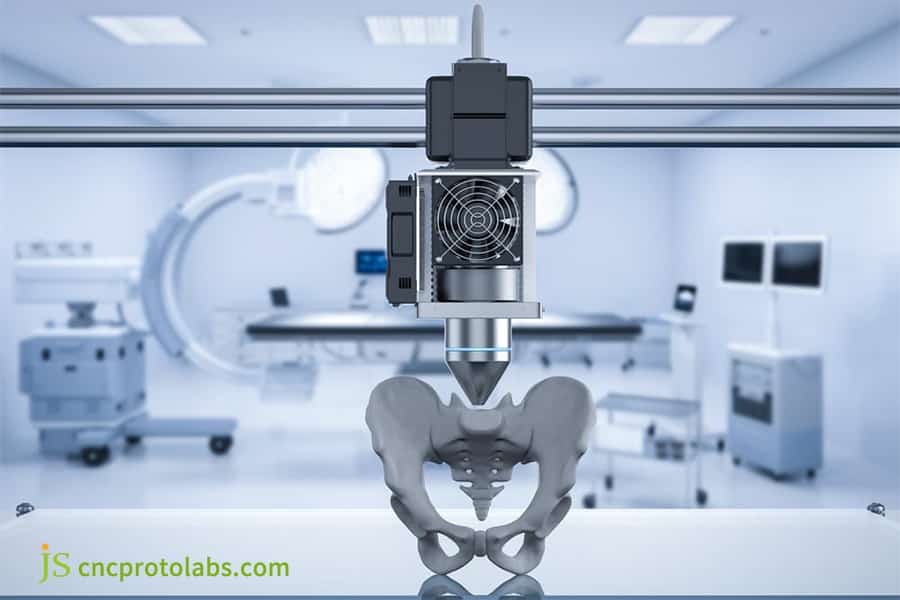
Figure 3: A 3D printer fabricates a detailed, bone-like pelvic implant structure layer by layer in a controlled environment.
How To Design For 5 Axis CNC Machining Prototyping Of Orthopedic Guides?
The design of orthopedic guides directly determines 5 axis CNC machining prototyping results for efficiency and accuracy. The design process determines which CNC plastic prototype materials should be selected by engineers.
The core principles are as follows:
Design Guidelines
Engineers must not create designs that include deep cavities which have wall thickness below 1.5mm. The process of machining deformation should be minimized through optimization of toolpath accessibility which helps prevent tool interference.
Material Selection
Surgeons commonly prefer PEEK and PC materials which perform well in surgical environments. The 5 axis linkage system enables operators to perform single-clamp machining, which results in a 30% reduction of CNC plastic prototype delivery times.
Positioning Features
Pre-reserved bone tissue positioning slots, with accuracy controlled within ±0.02mm, facilitating subsequent clinical validation.
How To Select a Certified Partner For High-Precision Prototyping Services?
The success of medical device rapid prototyping needs you to choose a partner who provides high-precision prototyping services. Organizations require all three elements because they represent essential business needs.
The core selection dimensions are as follows:
Qualification Review:
ISO 13485 is the minimum requirement, not ISO 9001.
- System Certification: ISO 13485 is the minimum requirement for entering the medical supply chain, and its requirements are far higher than ISO 9001.
- Process Control: A Class 100,000 or higher cleanroom is required to ensure the sterility of the prototype.
Traceability and Geographical Manufacturing Advantages
- Documentation Capabilities: Material batch numbers and compliant test reports are required, these are crucial for FDA or NMPA registration.
- Geographical Comparison: European and American suppliers excel in compliance collaboration, suppliers in the Pearl River Delta region of China (such as JS Precision) offer 15-40% lower costs and 7-12 day global door-to-door delivery.
Selecting compliant partners requires professional judgment. JS Precision has compiled a "High-Precision Prototyping Partner Screening Checklist for Medical Devices." Download this white paper now to easily screen for qualified high-precision prototyping services partners.
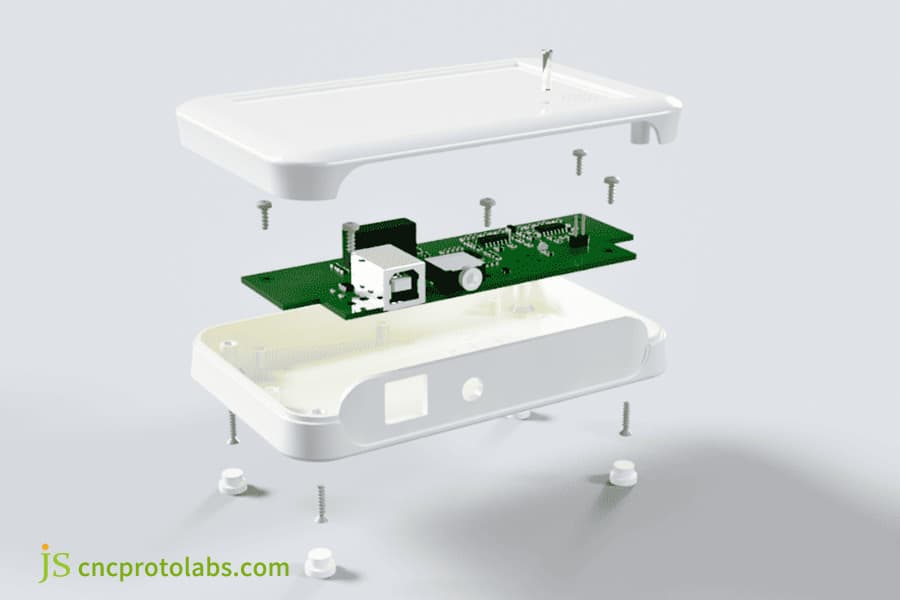
Figure 4: An exploded assembly view showing the internal components of a white medical device casing, including a green circuit board and various small parts.
JS Precision Case Study: Cost Reduction Of Orthopedic Guidebook Project By American Surgical Robot Company By 28%!
Challenge
A surgical robotics startup in Silicon Valley needed to obtain 20 PEEK orthopedic surgical guides within 6 weeks for critical animal experiments.
US-based supplier provided an expensive quote of $18,000 which required an 8-week delivery period to fulfill their order but they could not deliver to the data collection deadline which existed before their funding was approved.
The guide plate design is complex, including multiple 0.8mm cooling channels and complex bone contact surfaces, with extremely high requirements for accuracy (± 0.02mm) and biocompatibility. Conventional CNC machining prototyping processes are difficult to achieve.
Solution
JS Precision developed a customized solution through its CNC plastic prototype machining expertise:
1. DFM Optimization: The guide plate draft angle was modified from 0.5° to 1° which eliminated tool interference hazards during five-axis machining operations. The machining process for the thin-walled support structure was improved through structure optimization.
2. Process Upgrade: The company used imported PEEK-CA30 bar stock as the material to perform 5 axis CNC machining which allowed all complex surface machining to be completed in one setup without needing secondary clamping which would have resulted in precision loss.
3. Enhanced Inspection: The system generates complete reports which include 100% of full-size measurements through coordinate measuring machines (CMM) while every shipment includes batch certificates that prove material compliance with ISO 10993 standards.
4. Delivery Guarantee: The final cleaning process together with individual aseptic packaging occurs within a Class 100,000 cleanroom which satisfies all requirements for animal testing aseptic conditions.
Results
JS Precision finished delivering all 20 guide plates in a short time, only 17 work days, at a total price of $12,800. Animal testing was passed by the client at the 1st try, and the client also managed to complete Series B financing.
While the original solution was still existing, procurement costs were cut by 28%, and the delivery cycle was by more than 50% shortened at the very same time, supply chain advantages of fast prototyping were fully demonstrated through these results.
This case is just one of JS Precision's many successful practices. Your medical device prototyping project can also achieve cost reduction and speed improvement. Submit your product drawings now, and let JS Precision customize a CNC machining prototyping solution for you.
FAQs
Q1: Which is cheaper for medical device prototyping: 3D printing or CNC?
3D printing single exterior parts is cheaper, however, for metal or PEEK functional parts, CNC machining prototyping is necessary, and it's the only option that meets performance requirements.
Q2: What is ISO 13485? Why is it important?
ISO 13485 is a quality management standard specific to the medical device industry. It's the minimum requirement for suppliers to enter the medical supply chain, without this certification, compliance verification is impossible.
Q3: What should be considered when machining PEEK prototypes?
PEEK has a high melting point and is easily deformed during machining, requiring specialized tools and parameters, resulting in high material costs. It's essential to choose an experienced CNC plastic prototype service provider.
Q4: Can prototypes achieve the surface finish required for medical registration?
Yes. Through CNC precision machining and professional polishing, high-precision prototyping services can achieve a mirror finish with Ra below 0.4m, meeting medical registration requirements.
Q5: How long is the delivery time and logistics when sourcing medical prototypes from China?
Reputable fast prototyping service providers typically complete production and global door-to-door delivery within 7-12 days, including customs clearance, which is far more efficient than other options.
Q6: I need to conduct animal experiments, can you provide material biocompatibility reports?
Yes. JS Precision provides batch certificates for raw materials which meet ISO 10993 and USP Class VI standards through their shipment process to fulfill animal testing requirements.
Q7: Can you make a very complex intracranial surgical tool?
Yes. JS Precision uses 5 axis CNC machining to create prototypes which can produce complex free-form surfaces and internal flow channels that meet precise specifications for intracranial surgical equipment.
Q8: What process is best for small batches (10-20 pieces) of clinical test pieces?
Our team recommends vacuum molding because it costs less than CNC while delivering faster results and it can create multiple medical material simulations which work for our 10-20 clinical test piece requirements.
Q9: Can titanium alloy (TC4) prototype parts undergo surface coloring treatment?
Yes. JS Precision offers anodizing and micro-arc oxidation and additional treatments which fulfill aesthetic and medical product labeling needs while preserving biocompatibility.
Q10: How can I get an accurate quote for medical device rapid prototyping?
To receive a free, customized quote, share your product drawings and project requirements with a certified provider like JS Precision. Costs depend on the chosen technology (3D printing, CNC machining, or vacuum casting), material selection, part complexity, required surface finish, and delivery timeline.
Summary
The research and development process together with funding acquisition speed depends on three factors which include technology selection and cost control and partner selection. The selection of an ISO 13485 certified high-precision prototyping services partner helps organizations to reduce their operational threats.
JS Precision has two decades of field experience and complete rapid prototyping services which enable medical device companies to create device prototypes while maintaining compliance and minimizing costs and time requirements.
Contact JS Precision now, send your design drawings, and receive free DFM analysis and quotes to help your medical technology products reach the market faster.

Disclaimer
The contents of this page are for informational purposes only.JS Precision Services,there are no representations or warranties, express or implied, as to the accuracy, completeness or validity of the information. It should not be inferred that a third-party supplier or manufacturer will provide performance parameters, geometric tolerances, specific design characteristics, material quality and type or workmanship through the JS Precision Network. It's the buyer's responsibility Require parts quotation Identify specific requirements for these sections.Please contact us for more information.
JS Precision Team
JS Precision is an industry-leading company, focus on custom manufacturing solutions. We have over 20 years of experience with over 5,000 customers, and we focus on high precisionCNC machining,Sheet metal manufacturing,3D printing,Injection molding,Metal stamping,and other one-stop manufacturing services.
Our factory is equipped with over 100 state-of-the-art 5-axis machining centers, ISO 9001:2015 certified. We provide fast, efficient and high-quality manufacturing solutions to customers in more than 150 countries around the world. Whether it is small volume production or large-scale customization, we can meet your needs with the fastest delivery within 24 hours. Choose JS Precision this means selection efficiency, quality and professionalism.
To learn more, visit our website:www.cncprotolabs.com
Resource