English



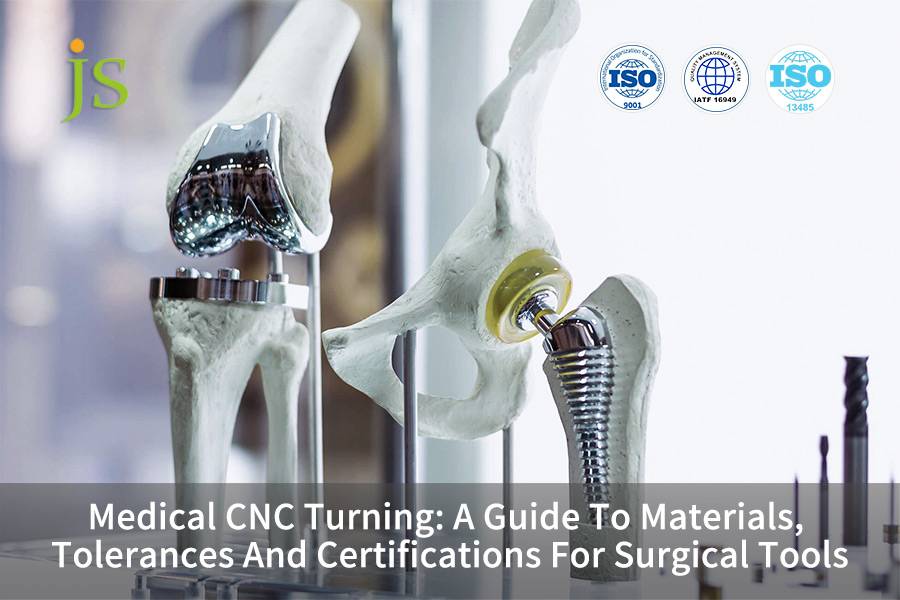

Medical CNC turning forms the backbone of medical devices' precision manufacturing. One of the main challenges in medical device manufacturing is the delivery stability of the products that must meet demanding micron-level tolerances, regulatory requirements, and batch consistency.
The FDA indicates that about 8% of medical device recalls are due to manufacturing defects, among which uncontrolled precision machining is the leading cause.
This article will serve a deep-dive review of ways in which professional medical CNC machining services guarantee that all medical machined components pass the toughest tests.
Being a partner from China whose operations and experiences are totally aligned with the medical grade CNC turning fabricator scene, JS Precision, too, will discuss how, as a company, we have been able to assist worldwide clients in getting over these primary difficulties in medical device manufacturing.
Key Answers Overview
| Key Questions | Key Answers | Value Brought to You |
| High precision and biocompatibility of surgical tools | The main thing is to find a qualified CNC medical grade turning fabricator who can control materials, tolerances (5μm), and adherence to the ISO 13485 certification system from the source. | Knowing the full picture of compliant and trusted medical device production lowers regulatory risks. |
| When it is necessary to seek precision medical machining services? | If your design comprises complex shapes, hard to cut materials (like titanium alloys), or needs traceable batch consistency. | Set up key project milestones to help you avoid R&D failures due to a lack of process experience. |
| Choose a reliable medical manufacturing partner | Dont limit yourself to simple procurement inquiries, thoroughly evaluate their cleanroom production capabilities, process control software, and experience in testing medical machined components. | Look for a long-term strategic partner who is able to share both regulatory and technical risks. |
Why Trust This Guide? JS Precision's Expertise In Precision Medical CNC Turning
CNC turning has always been the mainstay of JS Precision, and we have been doing this for 15 years now.
We make medical grade CNC turning fabricator our specialty, partnering with medical companies in more than 30 countries worldwide through medical CNC machining services to provide them with more than 1000 types of medical machined components which have been used in all categories of devices including orthopedics, dentistry, and minimally invasive surgery.
The yield rate for titanium alloy implants has been unwaveringly high, above 99.7%, for a long time.
We have a team of over 20 senior process engineers, all of whom have hands-on experience with ISO 13485 and FDA 21 CFR Part 820 systems, thus enabling us to offer our clients a complete package from DFM design optimization to mass production.
Concerning industry compliance, we have been a firm follower of the design control requirements of FDA 21 CFR 820.30, by which we have been establishing a completely thorough Design History File (DHF) for each product to allow batch traceability from raw materials through to the finished products.
We assisted a famous European dental instrument company in solving the problem of dimensional inconsistency in titanium alloy abutment machining. This led to an increase in the CPK value from 0.9 to 1.6 and a complete resolution of the high product recall rate.
Furthermore, we have contributed to a US-based minimally invasive surgical instrument manufacturer's overcoming of mass production bottlenecks in titanium alloy bone drills. Our help made it possible for their products to be available in the European market three months earlier than planned.
Being one of the few medical grade CNC turning fabricator in China who are certified by ISO 13485, have FDA registration, and CNAS accreditation all at the same time, our precision medical machining services have been trusted and confirmed by top tier global medical companies.
If you are struggling with precision machining, compliant production, or cost control for medical devices, contact JS Precision's engineering team immediately. Submit your part drawings, and we will provide you with a free process review and customized machining solution within 24 hours.
What Exactly Is Medical CNC Turning And Why Does It Matter For Surgical Tools?
CNC turning is principal process for the accurate shaping of medical device components such as shafts and discs. Medical CNC turning is essentially different from normal precision machining, the quality of its machining is, in fact, a direct measure of the safety and reliability of surgical instruments.
Defining Medical-Grade Machining
Medical CNC turning executed under ISO 13485 quality system standards is characterized by total control over the selection of materials, the methods used, the work environment, and the recording of batch details. Even the tiniest burrs and scratches under the microscope can become sources of biocontamination.
Major Application Areas
Besides orthopedics, the areas of application include dentistry and instruments for minimally invasive surgery, these being the medical devices that are directly in contact with the human body, hence, they have performance and biocompatibility requirements at the micron scale.
How Precision and Safety are Interrelated
Any inaccuracy in the dimensions too much can be a surgical hazard. To prove it by examples at hand, flaws in the cutting edge of a bone drill can cause fractures of the bone very easily, and deviations in the threading of the implant are the reason for the lack of fixation stability.
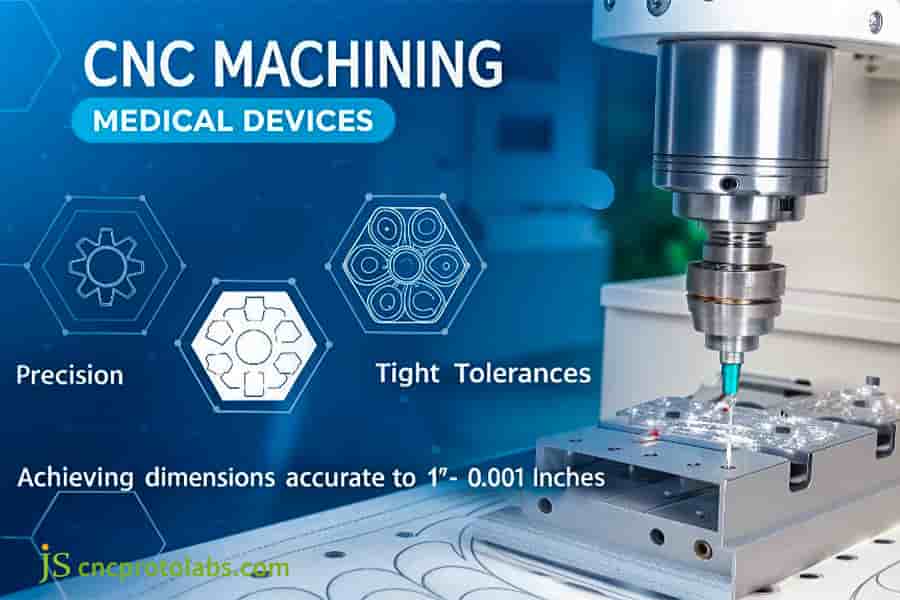
Figure 1: A CNC machine precisely turning a metal medical component, with on-screen graphics emphasizing “Tight Tolerances” and achieving accuracy to 0.001 inches.
Which Materials Are Best Suited For Medical Grade CNC Turning?
Materials are fundamental to medical grade CNC turning. Different medical materials vary significantly in their machinability and biocompatibility. JS Precision can provide precise material selection and processing solutions.
1.Comparison of Properties of 316LVM, Ti6Al4V, and MP35N
| Material Type | Tensile Strength (MPa) | Yield Strength (MPa) | Biocompatibility | Machining Characteristics | Applicable Scenarios |
| 316LVM | 480-620 | 170-310 | Excellent | Good machinability, no work hardening | General surgical instruments, basic implants |
| Ti6Al4V | 860-950 | 795-880 | Excellent | Poor thermal conductivity, prone to work hardening, rapid tool wear | Orthopedic implants, MRI-compatible tools |
| MP35N | 1200-1500 | 900-1100 | Excellent | High cutting resistance, extremely rapid tool wear | Cardiovascular stents, long-term implants |
2.Machining Considerations for PEEK and Ultem:
The former is generally used for medical implants, whereas the latter is used for components of the instrument structure. Both of them are susceptible to heat deformation and burr formation during machining, hence, the necessity for professional medical CNC machining services.
3.Material Impact on Cost:
It takes titanium alloy tools only one-third of the time to wear out compared with stainless steel, and cobalt, chromium, molybdenum is one-fifth. Experts can keep the costs down and at the same time make sure the quality is good through parameter optimization.
What Are The Key Design Rules For Medical Machined Components?
Proper design can help reduce the difficulty of machining medical devices. JS Precision offers design guidelines for medical machined components from a practitioner's point of view to help keep the cost under control.
1.Wall thickness and Deep Hole Drilling: Design ideas to prevent deformation of thin walled parts
- It is recommended that the minimum wall thickness of thin walled parts be ≥0.5mm. Titanium alloy and PEEK materials should be suitably thickened.
- Deep holes with an aspect ratio >10 should be designed in segments or process holes should be pre reserved so as to reduce tool deflection.
- Round the corners so as to avoid sharp transitions, reduce stress concentration, and make the machining easier.
2.How to plan the cutting edge for a better cutting performance?
Surgical scalpel cutting edge design must be suitable for the object to be cut: bone drill apex angle 118°-135°, blade cutting edge 15°-20°. Back angle and cutting edge that are designed appropriately can also help reduce cutting friction.
3.How to lower the machining difficulty of medical devices through Design for Manufacturing (DFM)?
DFM can help to reduce the costs without compromising on the functionality, for example, by adding relief grooves and making the corner radii uniform. JS Precision technicians are ready to provide DFM optimization assistance.
Want to make your medical machined components more suitable for machining processes? Submit your design files to JS Precision to receive a free professional DFM optimization report, significantly reducing the difficulty and cost of medical device machining.
What Level Of Accuracy Does Precision Medical Machining Demand?
Precision medical machining is the centerpiece of medical CNC machining services' competitiveness. Medical devices have significantly raised precision standards than the ordinary parts, and even the manufacturing process needs to be compliant with the ISO 13485:2016 standard.
1.Precision Variation from ±50µm to ±5µm:
The tolerance of regular industrial parts is roughly ±50µm. Precision medical machining of medical machined components mainly delivers ±5µm levels of precision, whereas extremely critical components may demand even more stringent tolerances and, therefore, high precision CNC machinery.
2.How is a surface roughness Ra < 0.2µm achieved?
A Ra < 0.2μm can reduce bacterial adhesion and friction. In medical CNC turning, it is done through parameter optimization, the use of superhard cutting tools, and the post-polishing process.
3.Measurement and Verification: CMM and Optical Measuring Instruments:
Experienced medical grade CNC turning fabricator require high end testing equipment. CMMs measure samples' dimensions, and optical profilometers measure roughness to make sure that the product's precision is in line with the standards.
Want to know if your product can meet the micron level precision requirements of precision medical machining? Contact JS Precision. We will provide you with free precision testing and feasibility analysis to ensure your product meets the stringent precision standards for medical devices.
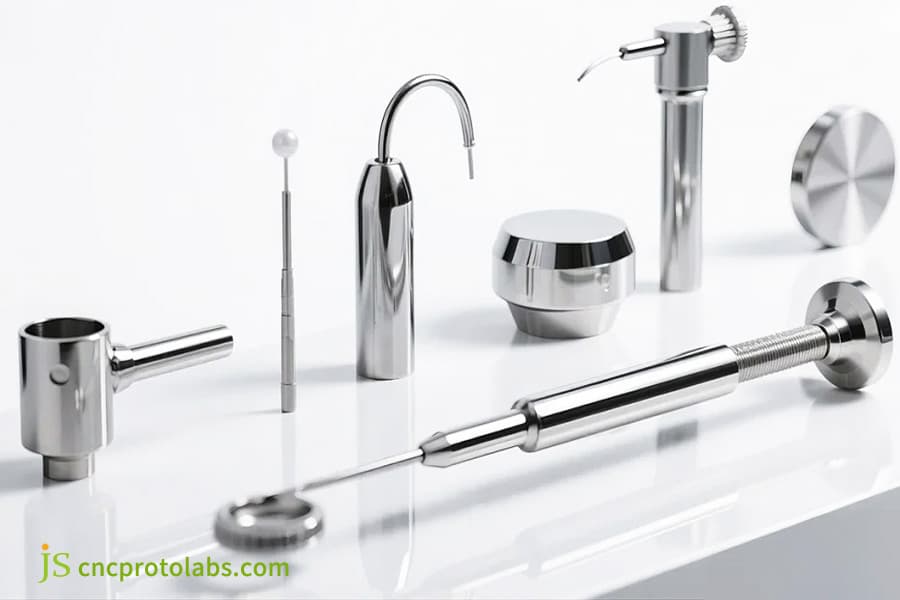
Figure 2: An assortment of finely finished, metallic medical components, showcasing the diverse and precise shapes achievable through advanced machining.
How Does Medical CNC Turning Ensure Biocompatibility Of Implants?
Since biocompatibility is essential for implantable devices, any medical CNC turning process step can have an impact on implant safety.
- Surface Integrity Requirements: Microcracks created during processing can cause stress corrosion, and burrs can result in inflammation. It is necessary to use optimized processes and specialized cutting tools to produce a crack-free and burr-free surface.
- Cleanroom Processing Requirements: Implant processing must take place in a cleanroom. JS Precision operates an ISO Class 7 cleanroom to prevent contamination.
- Post-Processing Guarantee Measures: Stainless steel passivation and titanium alloy anodizing are carried out. Implants are cleaned, and aseptically packaged, thus ensuring implantation standards are met.
What Are The Main Challenges In Micro-Component Medical Device Machining?
Miniaturization trend of medical devices is significant, it has drastically increased the difficulty level of machining micro-component medical devices. JS Precision has developed mature precision medical machining technology and solutions.
The essential challenge in the micro-machining of medical device components is the control of the main parameters like dimensions, spindle speed, and tolerances. The machining parameters can differ quite a lot according to the specs of the micro-component.
Below is a table of core machining parameter data measured by JS Precision:
| Micro-component Type | Diameter Range (mm) | Length-to-Diameter Ratio | Spindle Speed (rpm) | Cutting Speed (m/min) | Dimensional Tolerance (±µm) |
| Minimally Invasive Puncture Needle Core | 0.2-0.5 | 20:1-30:1 | 35000-45000 | 80-100 | 1.5-2.5 |
| Dental Micro-Abutment | 0.5-1.2 | 10:1-15:1 | 25000-35000 | 60-80 | 2-3 |
| Cardiovascular Micro-Shaft | 0.3-0.8 | 15:1-25:1 | 30000-40000 | 70-90 | 1.8-2.8 |
| Endoscopic Micro-Forceps Shaft | 0.4-1.0 | 12:1-20:1 | 28000-38000 | 65-85 | 2-3.2 |
| Miniature Surgical Scissors Shaft | 0.6-1.5 | 8:1-12:1 | 22000-32000 | 55-75 | 2.5-3.5 |
Miniaturization Limits: Machining Precision Shafts with Diameters Less Than 0.5mm
Medical machined components with diameters less than 0.5mm and length-to-diameter ratios greater than 20 have such poor rigidity that they easily cause tool deviations. JS Precision employs a Swiss-type lathe and a high speed electric spindle for precise machining.
Burry Control: Failure Risks Visible Only Under a Microscope
Burries on micro components are roughly only 10-20µm, which can easily lead to failure risks. JS Precision uses dedicated technology to totally remove micro-burrs.
High Speed and Micro-Feed: A Test of Machine Tool Dynamics
Micro-component medical CNC turning places extremely high demands on machine tool dynamics. JS Precision, which is ready with imported equipment, can satisfy the requirements of high speed, high response, and high thermal stability.
Want to overcome the technical challenges of micro-component medical device machining? View JS Precision's micro-component machining case studies to understand how we solve the machining challenges of precision micro-parts. You can also directly submit your micro-component requirements to obtain customized machining solutions.
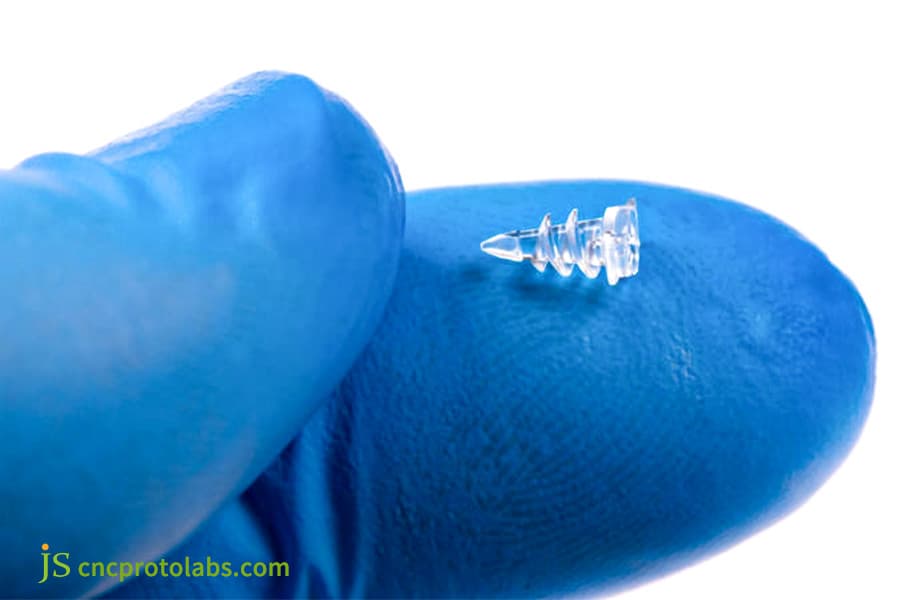
Figure 3: A gloved hand carefully holds a minute, transparent screw-like medical component, illustrating the extreme precision required in micro-manufacturing.
How To Evaluate The Cost-Effectiveness Of Medical CNC Machining Services?
Evaluating medical grade CNC machining services requires considering the overall cost, and a professional medical grade CNC turning fabricator can help customers achieve full lifecycle cost optimization.
1.Unit Price vs. Overall Cost Comparison:
Lower priced suppliers usually have higher defect rates, which can easily cause production stoppages. It is necessary to reach a compromise between unit price and quality.
2.Economies of Scale:
The cost is dependent on the scale. Costs are higher at the prototype stage, small batches experience 30%-40% reductions, and large batches experience over 60% reductions. Experts offering professional services are capable of making the change easier.
3.Risks of Low-Price Quotations:
The low prices may hide poor quality tools, the testing being only simplified, etc., and these are some of the things that may easily lead to product recalls. A service provider who is in compliance is a safer choice.
How Can I Find a Reliable Medical Grade CNC Turning Fabricator For Mass Production?
Choosing a dependable medical grade CNC turning fabricator is of great importance. It is a matter of assessment on different aspects, such as qualifications, technology, and soft power. JS Precision is a reliable compliant partner in China.
- Certification Checklist: ISO 13485, FDA, 21 CFR Part 820
It is a must to check if a service provider has ISO 13485 and an FDA listing when deciding for one. JS Precision is certified for all and can therefore offer full documentation support.
- Technical strength: Five Axis CNC Machining Services, Swiss-Type Lathes, and Automated Production Lines
The calling card of medical CNC machining services is their equipment. JS Precision has 20+ highly advanced imported machines that can produce 5 million precision parts per year, sufficient for batch production requirements.
- Soft Power: Process Control, Traceability, and Engineering Support Capabilities
Professional service providers should possess strong soft powers. JS Precision keeps the quality consistent with SPC and achieves traceability by MES. The engineering team can always offer DFM support.
- JS Precision: Your compliant medical device manufacturing partner in China
JS Precision adheres to the benchmark of international standards, besides that, we have a cost saving advantage, our engineers are fluent in English, offering 24-hour feedback, delivery of samples within 2-3 weeks, and stable delivery times of batches.
JS Precision Case Study: Us Minimally Invasive Surgical Instrument Manufacturer Breaks Through Production Bottleneck Of Titanium Alloy Bone Drill
Challenge
A local manufacturer of minimally invasive surgical instruments in the US faced several challenges in the mass production of titanium alloy bone drills (2.5mm diameter, 15:1 length-to-diameter ratio):
The tools wore out too quickly, 8% of the products were defective, and delivery was delayed by 3 weeks. They were in great need of professional medical CNC machining services to help remove these bottlenecks.
JS Precision Solutions
1.Toolpath Optimization:
JS Precision engineering staff reviewed the initial production process and discovered that the cutting parameters were too safe. We improved heat distribution by using trochoidal milling paths and implemented micro-lubrication technology to help with the poor thermal conductivity of titanium alloys.
As a result, we were able to increase the tool life from 30 pieces/cutting edge to 95 pieces/cutting edge.
2.Process Chain Integration:
They separated roughing (rapid removal of the material) and finishing (achieving the dimensions and surface quality) phases. An automated deburring and vacuum cleaning line was set up after the precision medical machining process to ensure the surface integrity and cleanliness of every medical machined part conform to the standards.
3. End-to-End Traceability:
For every product a digital record was maintained capturing material furnace number, number of pieces machined with each tool, CMM inspection report (critical dimension CPK > 1.33), and cleaning parameter records thereby satisfying the traceability requirements of FDA 21 CFR Part 820.
Results
Optimization led to the bone drill's CPK value rising from 0.8 to 1.4, Ra was consistently kept at <0.2µm, the defect rate went down to less than 0.3%, the total cost of medical CNC machining services dropped by 35%, delivery time was fixed at 4 weeks, the customer's product was launched 3 months ahead of the schedule, and first-year sales breached $5 million.
Want to replicate this success and overcome your product mass production bottlenecks? Contact JS Precision immediately and explain your product machining pain points in detail. We will customize a dedicated precision medical machining solution for you.
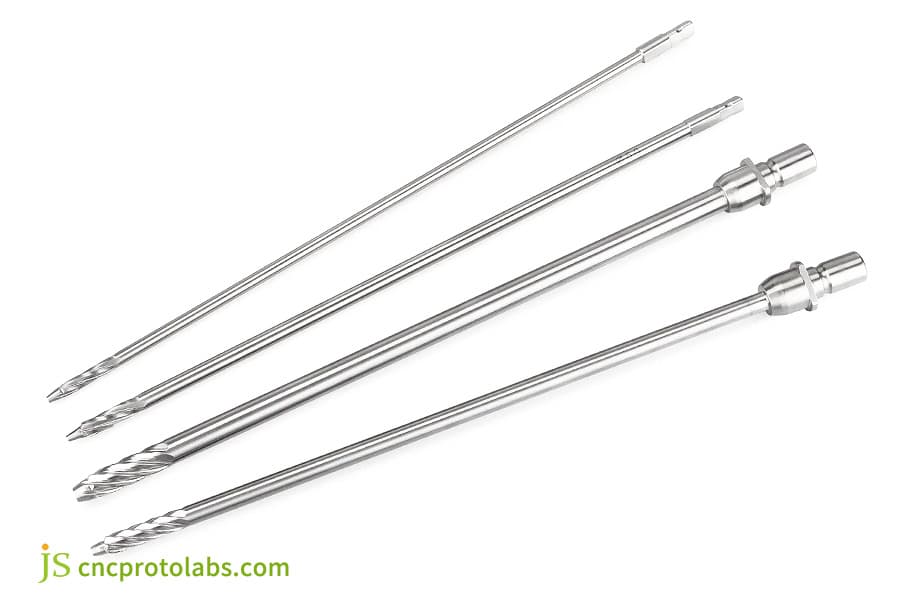
Figure 4: Four long, slender stainless steel rods with threaded ends, arranged with a measuring scale, demonstrating precision for medical applications.
FAQs
Q1: What tolerances are typically required for medical device machining?
Precision surgical instruments are a sub, category of precision medical machining. Generally, dimensional tolerances are kept within ±5µm to ±10µm, with some implants requiring an even finer tolerance.
Q2: How to ensure the biocompatibility of medical components?
Ensuring the biocompatibility of medical machined components involves several steps such as starting with the use of certified medical materials, controlling surface cracks, performing passivation treatment, and cleaning in a cleanroom environment.
Q3: What is the biggest challenge in medical CNC machining?
One of the biggest challenges in medical CNC machining is the precision and surface quality control of micro-components with the diameter <0.5mm and the use of difficult-to-machine materials, which requires very high standards for equipment and processes.
Q4: Can you provide batch traceability reports?
Of course, JS Precision is willing to offer a full report on medical machined components which covers materials, machining, and testing for every batch, ensuring full compliance with FDA and ISO 13485 requirements.
Q5: Is machining titanium alloy more expensive than stainless steel?
Mostly, yes. Titanium alloys have poor machinability and the tool life is short, which makes their medical device machining 30%-50% more expensive than stainless steel. The increment can be lowered through process optimization.
Q6: What's the lead time from prototype production to mass production?
Normally simple medical machined component prototypes are ready within 2 weeks. 4-6 weeks are usually the production lead time for mass production of at least 1000 pieces, which depends on product complexity and testing requirements.
Q7: What are the surface treatment requirements for surgical instruments?
To reduce friction and the adhesion of bacteria, surgical instruments need to have a surface roughness of Ra < 0.2µm. Besides that, a passivation process is needed to improve corrosion resistance and biocompatibility of surgical instruments.
Q8: How to pick a reliable medical CNC supplier?
To pick a reliable medical CNC supplier, it is necessary to review their ISO 13485 certification, experience in materials processing, availability of testing equipment, and their capability to issue traceable documentation.
Summary
In the manufacturing of medical devices industry, doing things with precision is a must for patient safety, and following regulations is necessary to get your product exported. Medical CNC machining services play a crucial role in bridging the gap between design and large-scale production.
JS Precision is a professional medical grade CNC turning manufacturer that offers the most advanced precision medical machining technology and has a thorough knowledge of international regulations. We are capable to take over your technical and compliance risks, resulting in products that can pass the most challenging tests.
Contact JS Precision now, send us your schematics, and let's have our engineering team customize a machining solution for your product that will help your medical device enter the world market faster.

Disclaimer
The contents of this page are for informational purposes only.JS Precision Services,there are no representations or warranties, express or implied, as to the accuracy, completeness or validity of the information. It should not be inferred that a third-party supplier or manufacturer will provide performance parameters, geometric tolerances, specific design characteristics, material quality and type or workmanship through the JS Precision Network. It's the buyer's responsibility Require parts quotation Identify specific requirements for these sections.Please contact us for more information.
JS Precision Team
JS Precision is an industry-leading company, focus on custom manufacturing solutions. We have over 20 years of experience with over 5,000 customers, and we focus on high precisionCNC machining,Sheet metal manufacturing,3D printing,Injection molding,Metal stamping,and other one-stop manufacturing services.
Our factory is equipped with over 100 state-of-the-art 5-axis machining centers, ISO 9001:2015 certified. We provide fast, efficient and high-quality manufacturing solutions to customers in more than 150 countries around the world. Whether it is small volume production or large-scale customization, we can meet your needs with the fastest delivery within 24 hours. Choose JS Precision this means selection efficiency, quality and professionalism.
To learn more, visit our website:www.cncprotolabs.com
Resource