English



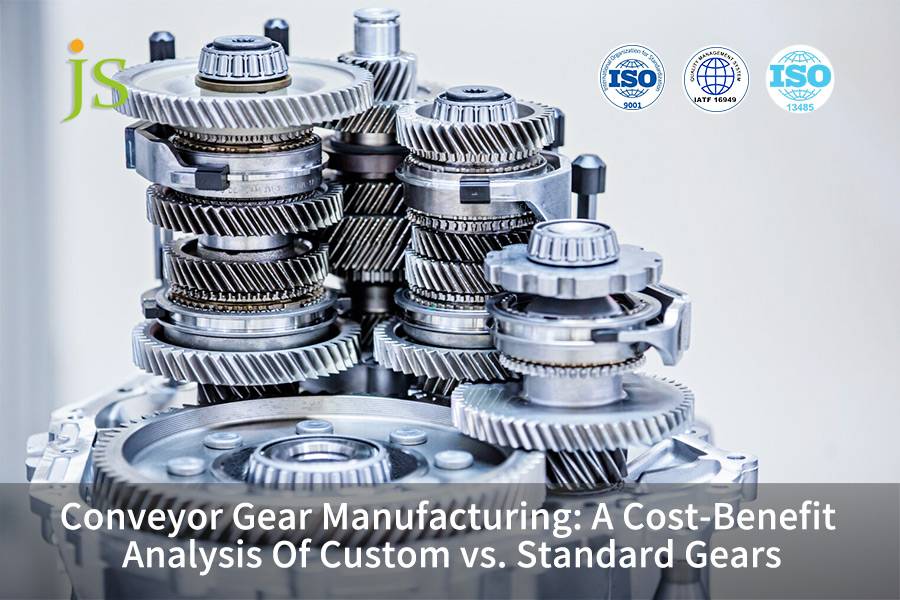

Conveyor gear manufacturing is a very important part of industrial conveyor systems, and the quality of their products is the major factor in the stable functioning of the conveyor line. If the conveyor line suddenly stops because of a gear failure, the loss of production due to downtime can be the equivalent of thousands of dollars per minute.
Standard gears are very inexpensive, and customized gears promise a perfect match, so most engineers have already had the dilemma whether to make a compromise just for this moment's budget or whether to invest for long-term reliability.
This guide will discuss gear manufacturing technology and, at the same time, reflect the actual needs of the industry with a view to disclosing the real costs of conveyor gear manufacturing.
Key Answers Overview
| Key Questions | Key Answers | Value for You |
| How to decide between standard and custom gears? | It is better to make a decision based on an overall evaluation of torque density, specific operating conditions, and total life cost (TCO) rather than looking at the purchase price only. | Avoid traps and get the optimal total cost of ownership for 3-5 years. |
| Why are custom gears so expensive? | The price tag is a reflection of the engineering collaboration, precision gear machining, and material certification, but it is capable of raising the transmission efficiency by 5%-15% and the life span of the component by 2-3 times. | Understand the makeup of the customization premium and evaluate the time of the return on investment. |
| How to locate a trustworthy customization partner? | One should review the partner's bevel gear machining capability, heat treatment process (the depth of the carburized layer 0.8-1.2mm), and their complete testing system. | By getting quantifiable criteria for the evaluation of suppliers, one is able to limit the quality risk. |
Key Findings
- Cost ≠Price: While the price of standard gears can be 30%-50% less, a single downtime loss can cancel out the price differences over several years.
- Operating Conditions Determine the Path: Standard components work well for light loads, normal temperatures, and continuous running, they need to be tailored when the situation involves heavy loads, dusty environments, high temperatures, and frequent start-stop cycles.
- Precision is a Hidden Variable: The level of machining precision of spiral gear has a direct impact on power transmission efficiency. ISO 5 can save the energy usage by 8%-12% in comparison with ISO 8.
- Small Batch Production is Not an Obstacle: Small batch gear manufacturing services make it possible to verify prototypes and replenish spare parts with an MOQ as low as 5 pieces.
Why Choose JS Precision To Customize Conveyor Gears?
The quality of conveyor gear manufacturing essentially depends on the combination of precision gear machining and tailored solutions. JS Precision has been heavily engaged in this area for several years and, through its core technology and practical cases, has become a reference point in the industry.
Besides, it has obtained ISO 6336 international standard certification for gear manufacturing, and its technical capability is recognized worldwide.
In gear machining, JS Precision uses top, tier machine tools from Gleason and Reisshaus, which allows them to perform high, precision machining of spiral gear and bevel gears. They keep the helix angle error within ±0.05°, whereas the tooth surface contact patch is over 90%, which is way beyond the industry average.
When it comes to conveyor gear production in heavy-duty applications like mining and cement plants, JS Precision's carburizing and quenching treatment is able to deliver the depth of the standard carburized layer of 0.8-1.2mm and the hardness of the tooth surface at HRC 58-62, thus prolonging the gear life by 2-3 times.
In practical use, JS Precision made a spiral bevel gear for a European cement company, which was a problem solver of frequent gear breakdowns in the high-temperature, dusty environment of the conveyor line. The machinery ran without any hitch for 18 months, and the downtime losses were reduced by over $100, 000 compared to the original standard gear solution.
For small batch gear manufacturing, JS Precision keeps flexible production with an MOQ of 5 pieces, and emergency spare parts are delivered in 2-3 weeks, four times faster than traditional manufacturers.
On the other hand, JS Precision has a professional engineering team that offers a one-stop service from DFM collaborative design to full-process testing, accurately optimizing gear structures and processes to meet the very different conveyor gear manufacturing needs under the varying operating conditions.
Want your conveyor system to adapt to specific operating conditions and achieve long-term, zero-failure operation? Submit your conveyor gear parameters and operating requirements now, and JS Precision engineers will provide you with a free customized solution design within 24 hours, as well as accurately calculate the total lifecycle cost.
What Are The Core Elements That Affect The Manufacturing Cost Of Conveyor Gear?
The main cost factors in the production of conveyor gears include the materials, heat treatment, and precision machining. The intricacy of the process of gear machining is the main factor for the cost and must be commensurate with the type of work and the performance characteristics.
1.Material costs:
QT500 ductile iron or 45# steel are typical materials for standard gears which are generally suitable for light load and room temperature, heavy load conditions require 20CrMnTi/8620 carburized steel whose price is 3 to 5 times higher, the use of 17-4PH stainless steel in corrosive environments is 6 to 8 times more expensive than regular steel.
2.Heat treatment costs:
Basic quenching and tempering treatment are cheap and suitable for low, load applications, the cost of carburizing and quenching is 40-60% higher but the tooth surface load capacity will be more than 3 times increased.
3.Precision grade cost:
Hobbing to ISO 6-8 is the cheapest option. ISO 4-5 requires the additional step of gear grinding, which will result in a unit cost increase of 80-120%.
In order to vividly present the cost difference of conveyor gear manufacturing under various processes and precision levels, below is a detailed data comparison table of various gear machining processes:
| Machining Process | Precision Grade | Unit Machining Cost (USD) | Machining Cycle (days/piece) | Scrap Rate (%) | Applicable Gear Type |
| Hobbing | ISO 6-8 | 80-120 | 1-2 | 2-3 | Ordinary spur gear, light-load spiral gear |
| Shaping | ISO 7-9 | 70-100 | 1.5-2.5 | 3-4 | Internal gear, small bevel gear |
| Precision Grinding | ISO 4-5 | 220-350 | 4-6 | 5-8 | Heavy-load spiral gear, precision bevel gear |
| 5-Axis Hard Cutting | ISO 5-6 | 180-280 | 3-5 | 4-6 | Medium-sized bevel gear, worm gear |
| Carburizing and Quenching + Grinding | ISO 4-5 | 300-450 | 7-10 | 6-9 | Heavy-load conveyor gear, high-load spiral gear |
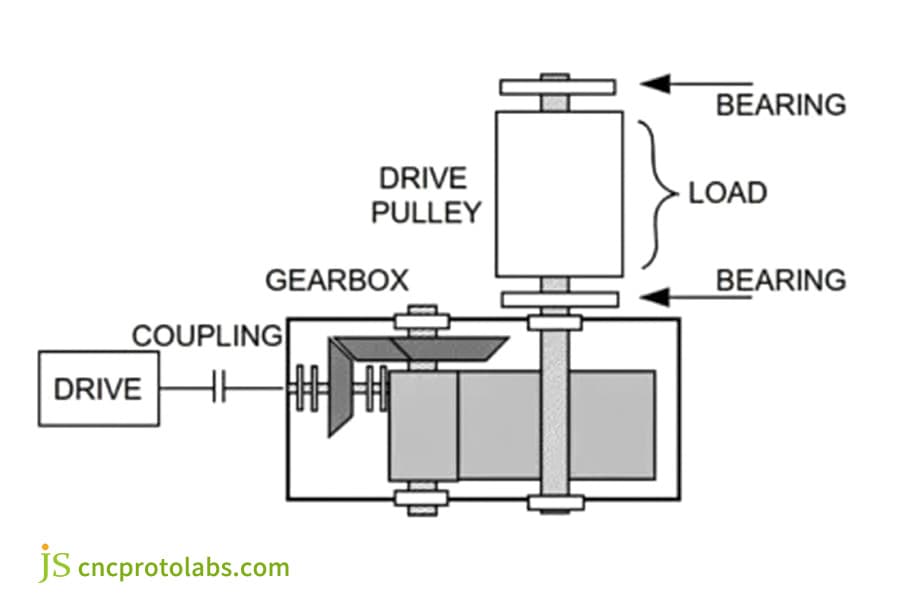
Figure 1: A detailed line diagram illustrating the key components (Drive, Coupling, Gearbox, Pulley) and their connections in a belt-driven conveyor gear system.
When Does Conveyor Gear Manufacturing Require Custom Solutions Over Standard Parts?
Regular standard gears only suit the basic conveying needs. However, custom gear manufacturing is the only way to carry out working conditions without a fault and with higher efficiency.
- Space limitations: Standard gear housings cannot be used in very small spaces or for 45 inclined conveyors. Customization can maximize the hub configuration and change the helix angle.
- Extreme working conditions: Standard gears with IP54 seals are easily penetrable by dust and ordinary steel is very easily corroded. Customization can supply IP65 seals, anti-corrosion paint, or the 17-4PH stainless steel can be used.
- Non-standard parameters: Non-standard speed ratios like 1:13.7 cannot be obtained with standard components. Customization can be done to the motor power curve thus resulting in the saving of electricity costs.
Belt Drive Gears Vs. Direct Drive: Is Customization The Key To Efficiency?
Belt drive gears are the heart of belt drives, their match is what makes the system work smoothly. Off-the-shelf parts don't fit well together, but a custom solution can effectively fix wear and slippage issues.
The Core Pain Points of The Belt
Standard belt drive gears feature an universal tooth profile which hardly meshes with dedicated belts, thus wear rate is increased, life is shortened, and tooth surface roughness Ra >1.6m makes them readily slip and consequently run at lower efficiency.
The Value of Customized Tooth Profile
JS Precision customizes and optimizes tooth profiles ensuring even load distribution on the belt drive gear tooth surface with a contact patch ratio of more than 85%, which greatly helps customers to save maintenance cost.
Assessing Downtime Costs
A custom set of belt drive gears will bump the initial price up by $800, however, they will be able to eliminate the losses of 8 hours downtime, thus the return on investment period will be a mere 3 weeks.
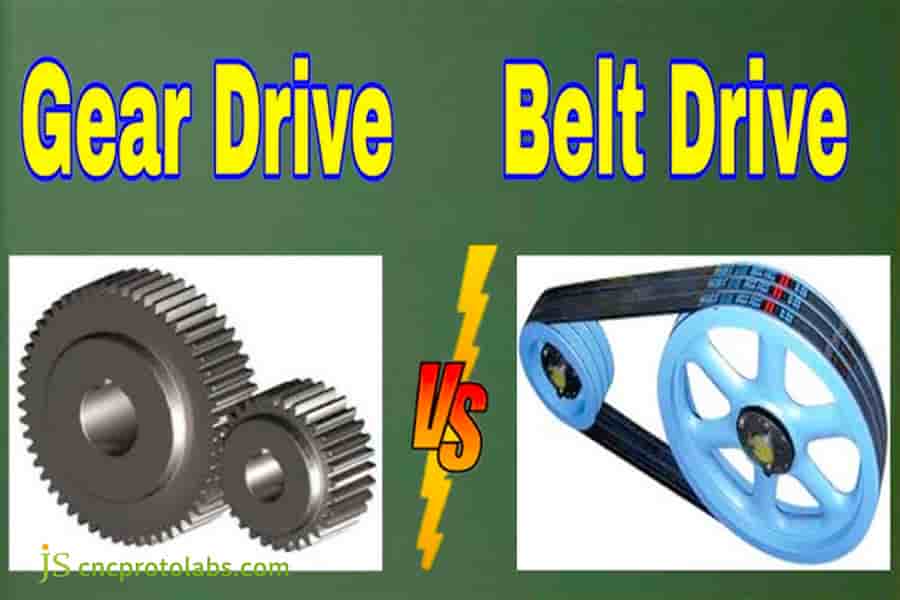
Figure 2: A side-by-side comparison graphic contrasting a Gear Drive system (featuring interlocking gears) with a Belt Drive system (featuring pulleys and a belt) for power transmission.
How Does Spiral Gear Machining Improve Performance In High-Load Conveyors?
Spiral gear is the core of high-load conveying, machining accuracy determines system stability. Professional spiral gear machining can improve performance and reduce failures.
Table of Suitable Scenarios for Different Helix Angles
| Helix Angle | Transmission Characteristics | Axial Force | Suitable Working Conditions |
| 15°-18° | High transmission efficiency, moderate stability | Small | Medium-load horizontal conveying, such as food packaging lines |
| 18°-25° | Smooth transmission, moderate efficiency | Medium | Heavy-load horizontal/slightly inclined conveying, such as building material conveying lines |
| 25°-30° | Extremely smooth transmission, low noise | Large | Ultra-heavy-load inclined conveying, such as mining ore conveying lines |
- Helix Angle Optimization: A commonly used range is 15°-25°. Increasing the angle leads to smoother transmission but at the same time results in a greater axial force. High-precision machining can keep the error within ±0.05°.
- Influence of Machining Accuracy: By reducing the tooth profile error less noise and vibration are generated. Gleason machines can produce more than 90% contact patch coverage on the tooth surface.
- Cost-Dilemma: Precision grinding adds up the costs, but brings about an almost 98% transmission efficiency, thus smaller motors can be used and electricity can be saved for a long time.
Want to customize high-precision spiral gear for your high-load conveyor system? Submit your load and speed requirements, and JS Precision will optimize the helix angle parameters for you free of charge and provide a spiral gear machining process plan.
Is Worm Gear Manufacturing Complexity Justified For Your Conveyor Application?
Worm gear manufacturing is complex and costly, but its self-locking and high reduction ratio characteristics are irreplaceable, the additional cost can be compensated for through long-term stable operation.
Worm Gear Material Pairing and Performance Table
| Worm Material | Worm Gear Material | Processing Cost | Wear Resistance | Service Life | Suitable Working Conditions |
| 45# Steel (Quenched and Tempered) | QT500 Ductile Iron | Low | General | 6-8 months | Light Load, Low Reduction Ratio Conveying |
| 20CrMnTi Carburized and Quenched | ZCuSn10P1 Tin Bronze | High | Excellent | 3-5 years | Heavy Load, High Reduction Ratio Lifting and Conveying |
| 17-4PH Stainless Steel | Tin Bronze (Nickel Plated) | Extremely High | Excellent | Over 5 years | Corrosive Environment Lifting and Conveying |
Safety Value of Self-Locking Function
Lifting conveyors should have an anti-reverse rotation feature. Worm gear manufacturing can provide mechanical self, locking, thus reducing the brake cost. Self-locking is reliable when the lead angle is <6°.
Scientific Material Pairing
Professional worm gears use 20CrMnTi carburized and quenched worms and ZCuSn10P1 tin bronze worm wheels. Although the price is higher, the wear resistance is greatly improved, thus the service life is extended.
Heat Dissipation and Failure
Standard worm gear sets are very likely to get overheated and suffer tooth surface failure if loaded excessively. A customized gear manufacturing is able to change tooth surface profiles and lubrication grooves so that heat is reduced.
How Does Precision Bevel Gear Machining Affect Long-Term Conveyor Reliability?
The precision of bevel gear machining determines the reliability of corner conveying. In heavy-duty scenarios, precision machining is the key to avoiding failures and reducing downtime losses.
One secret of tooth surface contact spots
Basically, an ordinary bevel gear machining will only give a small area of contact spots and that is a reason why pitting failure is so frequent. JS Precision's 5 axis hard machining is capable of producing contact spots with over 85% area, which means that the contact stress is reduced.
The importance of surface integrity
Gear grinding brings down tooth surface roughness and wear, on the other hand, precision machining keeps runout tolerances in check and thus, bearing life gets extended.
Vibration and product stability
Precision bevel gear machining is able to greatly reduce vibration levels, thereby allowing the operation to be very smooth. This not only makes it easy to handle, but also makes it suitable for conveying fragile items like glass and ceramics.
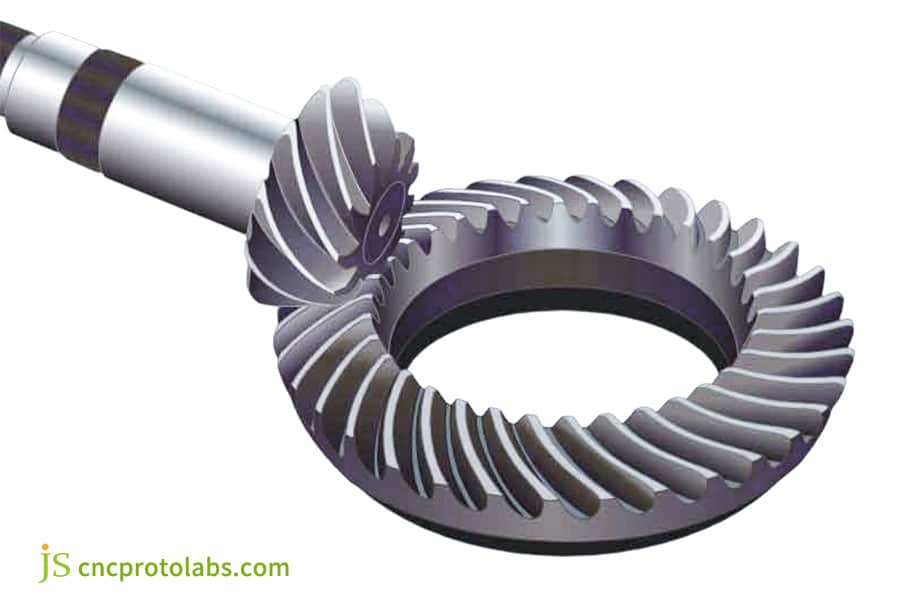
Figure 3: A detailed close-up of a helical (spiral) gear being meshed with another component, showcasing its precise teeth.
Can Small Batch Gear Manufacturing Solve Urgent Issues With Non-Standard Equipment?
Small batch gear manufacturing is an emergency spare parts and prototype verification solution for non-standard equipment. It helps to break the limitations of large-volume minimum order quantities and time-consuming matching problems.
- Small Batch Costs Reality: MOQ for small batch gear manufacturing can be as low as 5-20 pieces. Although the unit price is higher, the absence of mold helps to save on mold costs and avoid inventory lock, up.
- Delivery Cycle for Emergency Spare Parts: Small batch supply is very effective as the delivery can be done within 2-3 weeks, which is 4 times faster than the delivery of imported spare parts, thus, small batch is a good solution for urgent spare parts.
- A Shortcut to Prototype Verification: R&D risk is reduced by using small batch gears to test gear performance first, then, proceeding to large-scale production once the performance is confirmed.
How To Avoid The Selection Trap Of Custom Gear Manufacturing Suppliers?
The quality of custom gear manufacturing plays a big part in the strength of the supplier. If you choose the wrong supplier, you will increase your costs and risks. If you can master scientific evaluation standards, you will be able to avoid the most common mistakes.
- Equipment Capabilities: It is necessary for suppliers to have high-end machine tools like Gleason, be fitted with a gear measurement center, and be capable of issuing full-parameter testing reports.
- Quality System: Along with ISO 9001 that serves as the basic level, preference is given to IATF 16949 certification. SPC statistical analysis and random sampling of the key parameters are a must.
- Engineering Support: Expert suppliers wont provide you with vague promises but specific parameter solutions. You can verify their capabilities by professional questioning.
- JS Precision Advantages: The total costs are by 30%-40% lower compared to European and American suppliers. The response to the 3D drawings is given within 24 hours, and 3D drawings are provided with the solutions. Besides, our company has a good standing in the global clientele.
Looking for a reliable custom gear manufacturing supplier but unsure how to evaluate them? Request JS Precision's "Custom Gear Manufacturing Supplier Evaluation Checklist" and examine each item on the checklist to easily avoid selection pitfalls.
Case Study: JS Precision Saves 37% Of Costs And Shortens Delivery Time By 50%
Challenge
A US-based manufacturing material handling equipment company was buying spiral bevel gears (module 8, helix angle 25°, material 8620) for their new heavy-duty conveyor line.
The original European supplier was charging $4, 800 each for the conveyor gear manufacturing, with a 22-week lead time and a minimum order quantity (MOQ) of 20 pieces, which means a total investment of $96, 000. The customer has to handle two problems: new equipment launch delay and cash flow crisis at the same time.
JS Precision's Solution
1. DFM Collaborative Optimization:
JS Precision engineers suggested changing the root fillet radius from R0.8 to R1.2, thus reducing the root stress concentration factor by 28%. At the same time, the helix angle tolerance was relaxed from ±0.1° to ±0.15°.
Gear load tests confirmed that transmission accuracy was not compromised and that gear machining efficiency was elevated as well by 32%, thus the single-piece machining time was shortened by 1.5 hours.
2. Process Upgrade:
The use of a process chain of precision gear hobbing (cumulative pitch error 0.02mm) + carburizing and quenching (layer depth 1.2±0.1mm, tooth surface hardness HRC 58-62) + CNC gear grinding is not only possible to make the contact patch of the spiral bevel gear be more than 90%, and the tooth surface roughness Ra≤0.4μm, but also completely satisfy the torque of 1200Nm heavy-duty conveyor lines.
3.Flexible Production:
Facilitate the launch of production with an MOQ of 5 pieces, and place further orders as required. By comparison, the original supplier's minimum order quantity was 20 pieces.
Therefore, the customer's initial capital investment is lowered from $96, 000 to $15, 100, easing the financial constraint by 75%. Meanwhile, the capacity is 10% flexible to accommodate emergency order requirements.
Results
- Unit Cost: The unit cost is $3020, 37% less than European suppliers, thus the procurement cost of conveyor gear manufacturing is directly reduced.
- Delivery Cycle: The first batch of products was delivered in 8 weeks, which is 64% less than the original 22 weeks. Also, the subsequent batches were regularly delivered within 6 weeks, thus the customer was able to meet the new equipment launch schedule.
- Quality Performance: The noise level was only 68dB when the installation test was being conducted, which is a lower value than the customer's requirement of 72dB. The equipment was able to run for 12 months without any breakdowns, thus the performance of the equipment went far beyond the industry average.
Want to reduce costs and accelerate your conveyor gear manufacturing project while maintaining high quality? Submit your gear procurement requirements, and JS Precision will customize a dedicated DFM optimization solution for you, precisely controlling costs and delivery time.
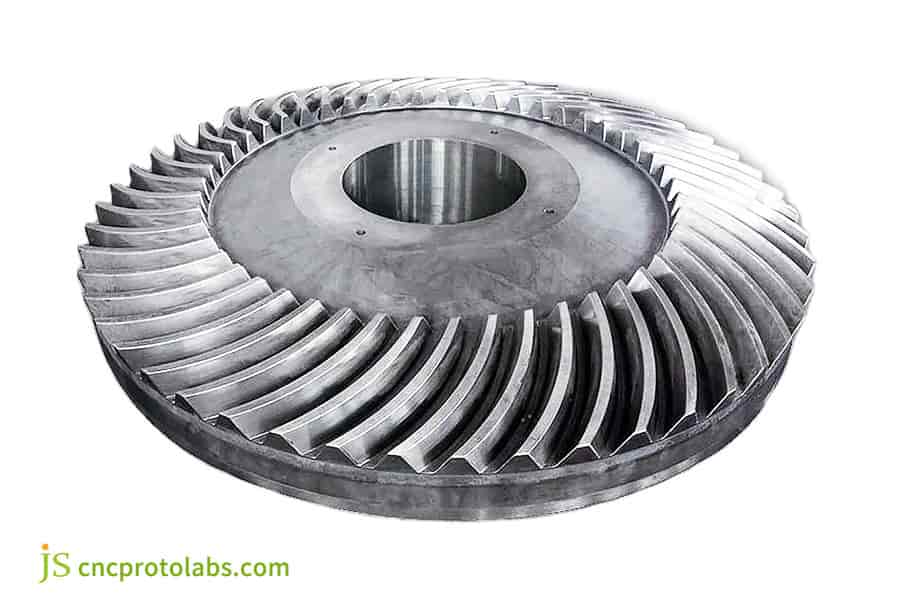
Figure 4: A single, large metallic bevel gear with precisely cut, angled teeth, isolated on a white background.
FAQs
Q1: How much does the price difference usually exist between standard gears and custom gears?
For small to medium batch custom gear manufacturing, products are 30%-60% more expensive than standard gears. Still, if you take into account the total lifecycle maintenance and downtime costs, custom gears are more cost-effective for most operating conditions.
Q2: In what situations must custom helical gears be used?
When the center distance and speed ratio of a conveyor system are non, standard parameters, or the working conditions are so demanding (high dust, strong corrosion, or ultra-high temperature), the standard spiral gear will not be able to meet the requirements and will have to be customized.
Q3: What is the maximum helix angle that can be machined for spiral gear?
JS Precision's spiral gear machining technology is able to consistently machine helix angles of up to 35°. A thorough assessment of the gear module and overall structure must be made to determine the specific machining solutions.
Q4: Is the self-locking function of worm gear manufacturing reliable?
Mechanical self-locking that is stable can be obtained if the worm gear lead angle is kept to 6° or less. Nevertheless, this feature is not advised to be used on its own to ensure the safety of critical conveying applications such as elevators and high-altitude lifting.
Q5: What materials are typically used to make conveyor gears?
For manufacturing conveyor gears that are only subjected to light loads, 45# steel or QT500 ductile iron are typically used, heavy load gears are generally made from 20CrMnTi/8620 carburized steel, and for corrosive environments, the choice is usually 17-4PH stainless steel.
Q6: How to check if the gear precision meets the standards?
The most accurate way is to ask for the GMC inspection report from the conveyor gear factory which will show if the specific deviation data of tooth profile, tooth direction, and tooth pitch comply with the standards.
Q7: How long does it take to go from drawings to samples?
It normally takes 2-3 weeks from drawings to samples for standard custom gear manufacturing. For complicated spiral or worm gears, the sample making time is approximately 4-5 weeks depending on the complexity of the process.
Q8: Are you able to manufacture stainless steel gears?
Yes. JS Precision frequently utilizes 17-4PH precipitation hardening stainless steel when making corrosion, resistant gears in conveyor gear manufacturing. The gears can be heat, treated to HRC 38-44.
Summary
There is not a single solution for the choice of conveyor gears that fits all situations. Standard gears have the benefit of being inexpensive, whereas custom gears are more appropriate for long-term operation and can address the problems of standard parts.
JS Precision, through its professional gear machining technology, has developed cost-effective gear solutions for conveyor systems in different industries.
Don't allow the selection of gears to be a point of risk in your conveyor project. Provide us with your conveyor specifications or drawings, and our engineering team will offer you a free technical analysis within 24 hours so that the conveyor line can work efficiently, stably, and with zero failures for a long time.

Disclaimer
The contents of this page are for informational purposes only.JS Precision Services,there are no representations or warranties, express or implied, as to the accuracy, completeness or validity of the information. It should not be inferred that a third-party supplier or manufacturer will provide performance parameters, geometric tolerances, specific design characteristics, material quality and type or workmanship through the JS Precision Network. It's the buyer's responsibility Require parts quotation Identify specific requirements for these sections.Please contact us for more information.
JS Precision Team
JS Precision is an industry-leading company, focus on custom manufacturing solutions. We have over 20 years of experience with over 5,000 customers, and we focus on high precisionCNC machining,Sheet metal manufacturing,3D printing,Injection molding,Metal stamping,and other one-stop manufacturing services.
Our factory is equipped with over 100 state-of-the-art 5-axis machining centers, ISO 9001:2015 certified. We provide fast, efficient and high-quality manufacturing solutions to customers in more than 150 countries around the world. Whether it is small volume production or large-scale customization, we can meet your needs with the fastest delivery within 24 hours. Choose JS Precision this means selection efficiency, quality and professionalism.
To learn more, visit our website:www.cncprotolabs.com
Resource