English



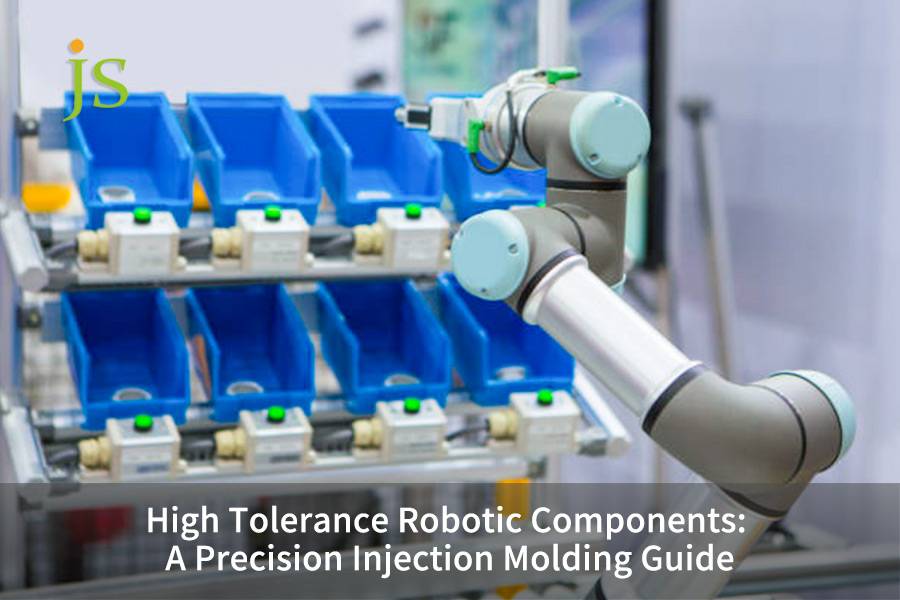

Precision injection molding is the core technology that breaks through the performance bottleneck of robot components. If there is a micrometer scale mistake in a robot, it may lead to the failure of the joint transmission or poor accuracy of the positioning.
Since factories using automation in a manner akin to human operators are moving to achieve both high precision and safety, tolerance stack up has become a major source of breaking points in the performance of the developer's products.
In addition to cutting down the costs of the assembly workers, through precision injection molding, firms can also increase the durability of their products.
It is said that this method can in a very reliable way keep the dimensional tolerances within 0.01 millimeter, thereby getting rid of about 90% of the physical dimensional variations and cutting down the secondary manufacturing costs by over 20%.
Core Content Overview
|
Core Dimension
|
Technical Solution (JS Precision Approach)
|
Key Delivery Indicators/Data
|
Customer's Core Benefits
|
|
Precision Bottleneck
|
Scientific Molding pressure closed-loop control
|
Dimensional tolerance is stably controlled within ±0.01mm.
|
Avoid joint positioning deviation and improve robot operation stability.
|
|
Structural Defects
|
Enhanced DFM: Rib thickness is controlled at around 60% of the main wall thickness.
|
Eliminate more than 95% of surface sink marks and warpage.
|
Reduce part scrap rate and lower production costs.
|
|
R&D Cycle
|
Aluminum Injection Molding
|
Deliver mass production-level prototype parts within 10-15 days.
|
Shorten R&D cycle and accelerate product launch speed.
|
|
Wear Resistance and Reliability
|
Process optimization of high-performance polymers (PEEK/PPA with carbon fiber).
|
Improve the fatigue strength of joint components by more than 30%.
|
Extend robot service life and reduce maintenance costs.
|
|
Quality Consistency
|
Industry 4.0 real-time pressure curve recording and coordinate measuring machine (CMM) inspection.
|
Achieve 100% batch traceability and zero-defect delivery.
|
Ensure mass production stability and improve customer reputation.
|
Key Takeaways
- Micrometer Level Control:
Microsecond level optimization via V-P switching points helps to eliminate nearly 90% of physical dimensional fluctuations. In fact, it means that robot joints can be positioned very accurately and their positioning does not stray much from the range set.
- Isotropic Advantage:
Injection molded prototype parts have the tensile strength in the Z direction 40% higher than 3D printed parts. Besides, they look more like functional verification parts.
- Leading ROI of Aluminum Molds:
For small volume production of less than 5,000 pieces, aluminum molds can save about 50% on mold costs, which is a very big reduction on the investment side of small volume production.
- Material Stability:
Along with raising the mold temperature to 120 degrees Celsius and above, it provides very effective prevention of dimensional drift of crystalline materials even under complex environments.
Why Choose JS Precision’s Precision Injection Molding? Experience In Robotic Component Manufacturing
If you are looking to make precision injection molding of robot parts, the main factor in your decision will be the risk reduction of the production and profits stability/protection. To fulfill such requirements you will need a well experienced and technically reliable partner with you.
If you opt for JS Precision you will be getting professional injecting molding support for robot parts focused on high precision work. The company has assisted over 50 robot manufacturers worldwide with customized solutions including industrial robots, collaborative robots, and other fields.
It follows to the letter the internationally recognized ISO 9001:2015 standard, which means physical features of your product batches are constantly verified according to high precision requirements, thus securing your quality standards.
Take, for example, a European collaborative robot manufacturer who is facing a problem quite similar to yours: low quality tolerances of the injection molded robot joints result in the robot not being able to do high precision positioning so the product launch schedule gets delayed.
If you let JS Precision know about your problem, it will look into it and offer a solution, i.e. it will improve your parts tolerances to 0.01 mm by tweaking the injection molding process via scientific injection molding and DFM design which will finally lead to your scrap rate being downescended from 18% to 0.5%, thereby saving you more than $30,000 of production costs per month and with time fewer losses.
Choosing JS Precision for you means a lot more than just the stable product quality and efficient delivery. It is a solution that enables you to find cost savings continuously and improve your competitiveness, which will ultimately result in your gaining an upper hand in robot component production.
If you are struggling with the precision and cost issues of robot components, contact JS Precision now for a free one-on-one consultation with an engineer to determine the most suitable precision injection molding solution for you.
Why Is Precision Injection Molding Critical For Next-Gen Robot Components?
Precision injection molding is one of the most effective means of attaining micron level accuracy. It significantly impacts the positioning accuracy and working life of high precision robots. In fact, it serves as a bridge between the design phase and mass production, making it a pivotal part of the process.
For example, based on the ANSI/ASME B46.1-2019, high precision components require an accuracy level of IT6 or IT7. Achieving such high precision can only be made possible by using specialized precision injection molding techniques.
This is one of the fundamental factors involved in manufacturing high quality parts.
Meeting the Micron Level Accuracy Requirements of Robot Joints
Collaborative robots are designed to have a repeatability accuracy of less than 0.05 mm, which is equivalent to injection molded parts with IT6 or IT7 level tolerances.
A discrepancy of 0.01 mm in the shaft or hole will lead to vibration of the end effect, resulting in robot joint operation abnormalities, and eventually affecting the overall robot performance.
The Influence of Cumulative Mechanical Tolerances on Positioning Accuracy
In a transmission chain made up of various robot components, the overall tolerance is determined by the RSS root mean square method. So, five parts, each having a tolerance of 0.03 mm, may yield an end effector deviation of over 0.1 mm, making the algorithm compensation task more challenging, if not impossible.
Simply put, it's similar to a game of dominoes, incredibly small inaccuracies in each component are added up, eventually leading the robot's end effector to fail in physically reaching the intended point with precision.
The same way a person walks, if each step is slightly off-center the final location will be significantly different.
Improve Component Accuracy to Optimize Assembly Costs and Product Lifespan
Using high precision robot components allows blind assembly, which is one of the main benefits of this process, minimizes repair work and results in a lowering of the secondary processing costs by up to 20%.
Moreover, the reduction in component wear not only results in a prolonged gearbox life of over 30% but is also one of the main benefits of this process.
Want to know how to avoid tolerance accumulation and reduce assembly costs? Download our free robot joints precision injection molding white paper for detailed technical guidance.
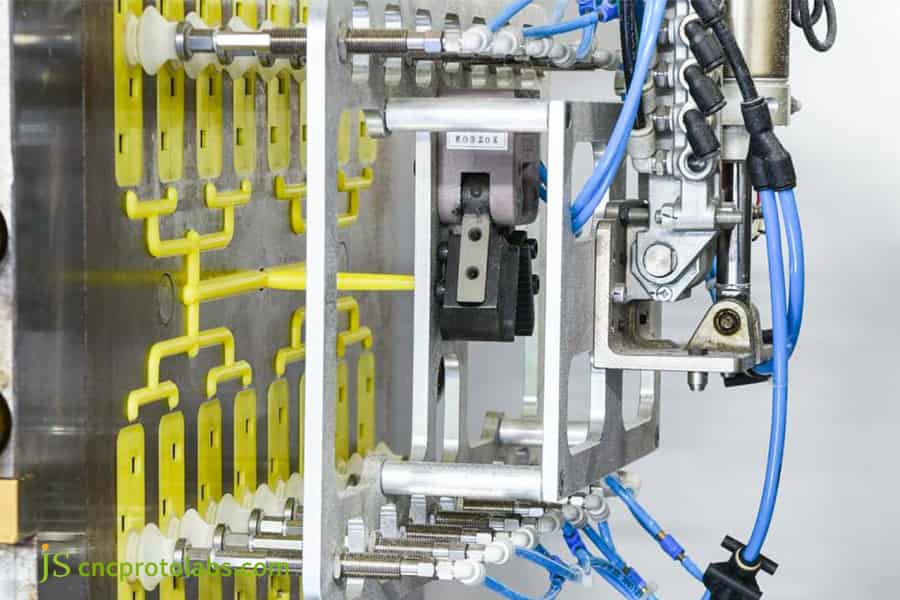
Figure 1: A metal injection mold with blue lines connected, shown alongside yellow plastic robot components, illustrating the tooling used in precision manufacturing.
What Are The Key Design For Injection Molding Strategies For Complex Robot Joints?
The main point of Design for Manufacturing (DFM) for robot joints is balancing the need for structural strength and dimensional stability.
Besides making sure that the parts are very precise and saving the manufacturing costs, the other main methods include adjusting wall thickness and reinforcing rib ratios to avoid shrinkage and warping, as well as designing correct draft angles to prevent demolding damage.
Adjustment of Rib and Wall Thickness Ratios to Control Shrinkage
Shrinkage of thick walled regions will deteriorate the accuracy of installing bearing housings. The major idea here is to limit the thickness of the rib's base to 50%-67% of the thickness of the adjacent wall.
This is also fundamental in designing injection molding for ordering structure, getting rid of shrinkage, and maintaining surface flatness.
Draft Angle Regulation for High Torque Transmission Gears
Transmission gears or splines that are intended for very precise mechanical operations need a draft angle to be regulated within the range of 0.5-1 degree. This, along with a mold surface polishing of the SPI-A1 grade to lower friction, makes demolding easier and lessens the chance of part damage.
Robot End Effectors Use of Embedded Inserts via Injection Molding
JS Precision uses an automatic feeding system to make sure the metal threaded insert and substrate bond strongly and at the same time limits the thread coaxiality to be within 0.02 mm in order to prevent loosening during usage.
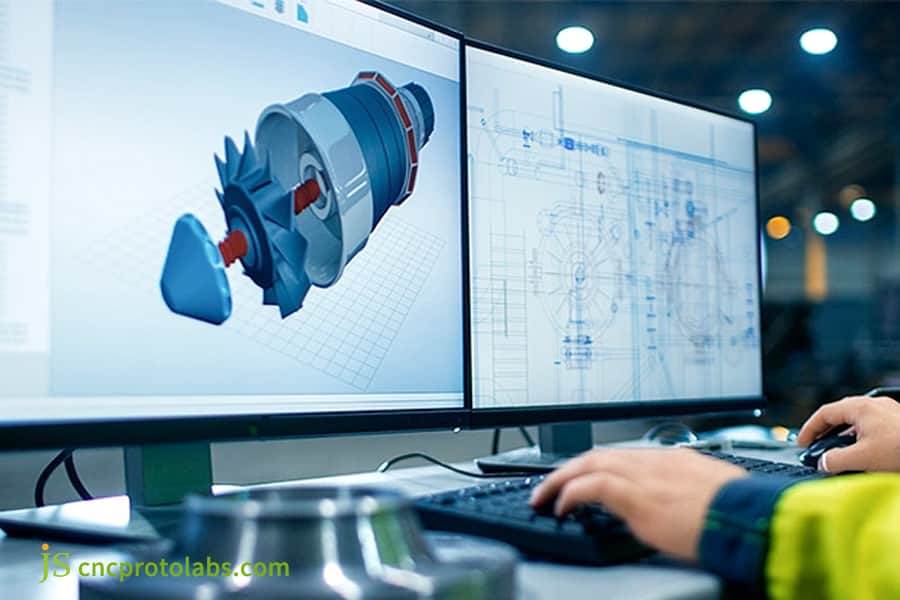
Figure 2: A dual-monitor workstation displaying 3D models and engineering drawings for the design of complex robot joints.
How To Achieve Ultra-Tight Injection Molding Tolerances For High-Performance Robot Parts?
Achieving ultra precision injection molding tolerances necessitates microsecond level closed loop control of process parameters.
This means that a very high precision mold temperature controller is needed to stabilize the crystalline plastic dimensions, together with accurately setting the V-P switching point and then using scientific injection molding data to ensure that the parts are consistent.
How Mold Temperature Control Affects the Dimensional Stability of PEEK and POM
The mold temperature is critical as it influences the crystallinity of the material, which subsequently dictates shrinkage and dimensional stability.
Therefore, by using a mold temperature controller, we ensure that the temperature difference is kept within ±1℃. In this way, crystallization is made uniform, and there is a decrease in the dimensional drift due to changes in the environmental temperature.
Mitigation of Tolerance Fluctuations by Microsecond Level Optimization of Pressure Switching Point
JS Precision manages to keep the V-P switching deviation within 0.1 mm, which in turn leads to weight fluctuations of the parts being less than 0.2%.
The main reason why injection molding tolerances keep meeting standards consistently is due to the fact that precise control of switching timing ensures the same molding conditions for every robot part.
|
Process Parameters
|
Control Precision
|
Part Weight Fluctuation
|
Dimensional Tolerance Range
|
Applicable Materials
|
|
Mold Temperature Control
|
±1℃
|
≤0.15%
|
±0.01mm
|
PEEK
|
|
Mold Temperature Control
|
±1℃
|
≤0.2%
|
±0.012mm
|
POM
|
|
V-P Switchover Deviation
|
≤0.1mm
|
≤0.2%
|
±0.01mm
|
PA66+30%GF
|
|
V-P Switchover Deviation
|
≤0.08mm
|
≤0.15%
|
±0.008mm
|
PPA+CF
|
|
Holding Pressure Control
|
±0.5MPa
|
≤0.18%
|
±0.01mm
|
PPS
|
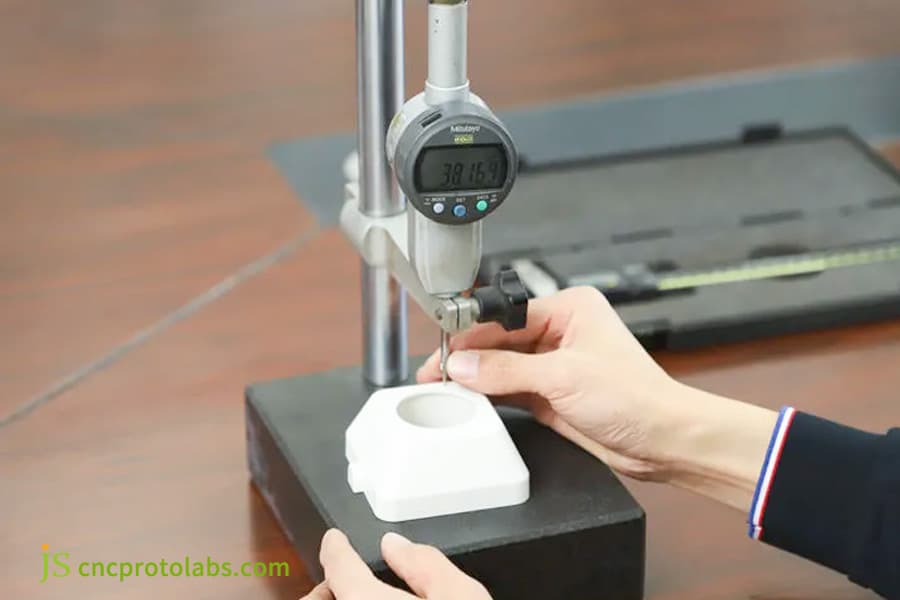
Figure 3: A person using a digital caliper to measure the dimensions of a white, precision-molded robot component.
Is Prototype Injection Molding The Best Way To Validate Functional Robotic Assemblies?
Prototype injection molding stands out as the best method for testing the kinematic reliability of robotic systems. This technique delivers uniform material characteristics that align with those of mass produced items, which is a significant step up from 3D printing.
Furthermore, injection molding assists you in pinpointing design issues swiftly and preventing scrap scenarios before you go into mass production.
How 3D Printed and Rapid Injection Molded Parts Differ
Parts made by FDM/SLA 3D printers exhibit weaknesses between layers and they fail to replicate the mechanical properties and resistance to wear of injection molded parts.
Furthermore, injection molded parts boast a Z axis tensile strength that is over 40% greater than that of 3D printed parts. This is a key factor in their suitability for handling high load robot joints.
Using Small Batch Trial Production to Verify Robot Mechanism Reliability
It is financially wise to confirm motion interference with rapid molding before opting for mass production.
JS Precision performs fatigue testing for 1,000 cycles on prototype components, gathering wear data which is then used to pinpoint problem areas and set the stage for a stable mass production run of robot parts.
Want to understand the actual effects of prototype injection molding? Click to view JS Precision's robot components prototype verification case studies to understand the specific application process.
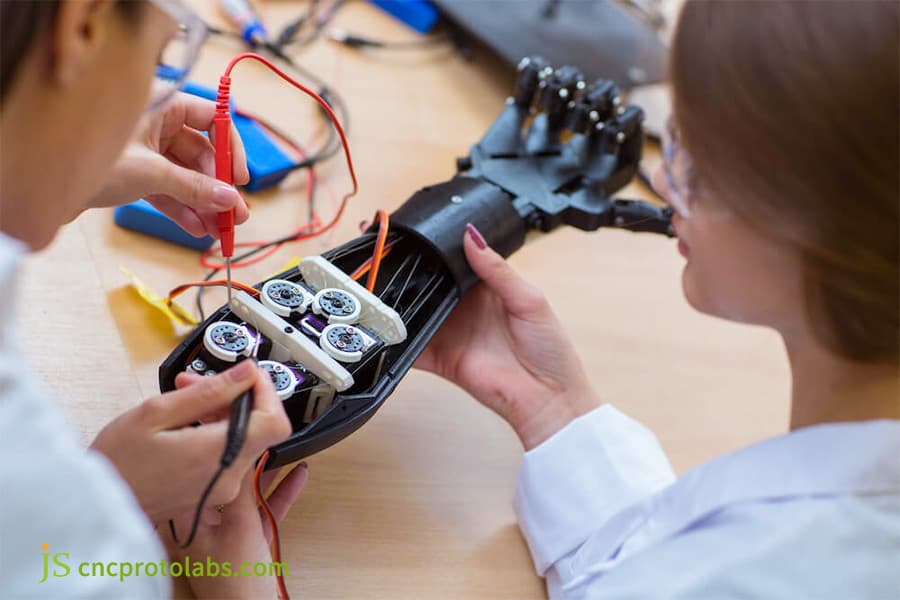
Figure 4: Two technicians collaboratively testing the circuitry of a black robot arm component on a workbench.
When Should You Choose An Aluminum Injection Mold For Low-Volume Robotic Production?
In the field of robotics, where high variety and low batch production are prevalent, aluminum injection mold provide a very high return on investment.
Because aluminum has a great ability to disperse heat, the manufacturing time can be reduced by 20%-30%, which is why it is mostly used for rapid prototyping and small batch production.
ROI Cost Analysis for High Variety, Low Batch Production in the Robotic Industry
The price of a 7075 aluminum mold is only 40%-60% of that of a P20 steel mold, and the delivery time will be shortened to 10-15 days. Therefore, in case of small batch production of less than 5,000 pieces, costs for the mold can be cut down by nearly 50%.
High Heat Dissipation of Aluminum Shortens Production Cycle
Aluminum's rate of heat transfer is significantly greater than steel, that cooling time has been reduced by over 30% as a result of this, thus avoiding deformation of thick walled parts and shortening the production cycle overall, easing the rapid bring to market of products.
Lifespan Limitations of Aluminum Molds When Dealing with Fiber Reinforced Modified Plastics
Using the material with a glass fiber content of higher than 30% will significantly decrease the life of aluminum molds (usually within 5,000 molding cycles).
Steel molds are recommended for operation of over 5,000 pieces. Aluminum molds are the most cost effective option for small batch production and also help with cost control of robot parts production.
What Are The Material Selection Challenges For High-Wear Robot Components?
Robot components joints need to balance self-lubricating and high rigidity under high-frequency friction.
When introducing high performance polymers such as carbon fiber reinforced PPA and modified PPS, the control of shrinkage fluctuation changes is a must, and DFM optimization, in turn, could be used to solve the problem of high pressure injection venting.
Shrinkage rate of high performance polymer precision injection molding
The shrinkage of carbon fiber reinforced materials depends on the fiber orientation direction. In fact, the difference between the shrinkage along the flow direction and the shrinkage in the perpendicular direction can be quite significant.
Our approach is to go for compensation of such variations beforehand by means of mold flow analysis and process optimization steps, thus ensuring dimensional accuracy.
Essentially, carbon fiber reinforced materials are similar to a textured wooden board in that the shrinkage rate in the direction of the grain is different from the shrinkage rate in the direction perpendicular to the grain.
We first determining this difference and then make a compensation for it during the mold design so that the parts do not, after molding, deform and/or develop dimensional deviations, i.e. misaligned building blocks.
Solving Venting and Air Trapping Technology in Injection Molding of High Rigidity Materials
As high performance materials need to be subjected to very high injection pressure, it is quite natural for defects such as scorching and air bubbles to occur.
In order to prevent such defects, we designed precision venting channels with a depth of 0.015 mm to allow the escaping gas from the mold cavity at once, thus guaranteeing the quality stability of parts for robot joints.
|
Material Type
|
Tensile Strength (MPa)
|
Shrinkage Rate (%)
|
Application Scenarios
|
Service Life (Mold Cycles)
|
Cost Advantage
|
|
PA66+30%GF
|
150-180
|
0.2-0.4
|
Reducer housing, joint bracket.
|
100,000+
|
Medium, cost-effective.
|
|
PEEK
|
200-230
|
0.1-0.2
|
High-end joints, parts in high-temperature environments.
|
150,000+
|
Low, excellent performance.
|
|
POM
|
80-100
|
0.3-0.5
|
Gears, transmission parts.
|
80,000+
|
High, low cost.
|
|
PPA+CF
|
160-190
|
0.15-0.3
|
End effectors, high-strength brackets.
|
120,000+
|
Medium, balancing strength and cost.
|
|
PPS
|
140-170
|
0.2-0.4
|
Corrosion-resistant, high-temperature parts.
|
110,000+
|
Medium, strong environmental resistance.
|
How To Ensure QA Consistency For Mass-Produced Robot Parts?
To maintain production quality in mass manufacturing of robot parts, it is essential to have a monitoring system at the level of Industry 4.0.
This system is a mixture of CT scanning, coordinate measuring machines (CMM), and in molding real time pressure curve recording, enabling full process traceability and ensuring the delivery of zero defect products.
Using CT and CMM to Monitor Key Dimensions
We combine the use of CT scanners and CMMs to check the dimensions of our more complicated, and at times, the inaccessible, features such as internal holes as well as non removable parts in the assembly.
The CMM guarantees that the spatial tolerances are within 5 micrometers, thus satisfactorily fulfilling the critical dimension based inspection requirements of the robot parts.
Industry 4.0 Level of Real time Pressure Curve Process Traceability
The pressure curve during the holding stage in the injection molding process is recorded for each mold cycle for use as a digital quality verification.
When the accuracy of the production is found to deviate, it is possible to locate the pressure fluctuation points by referring to the records, make the necessary adjustments to the parameters without any delay, sick the batch from being scrapped, and continue with stable mass production of the robot parts.
JS Precision Case Study: Injection Molding Solution For High Precision Reducer Housing
Reducer housings for robotics with collaborative features are the main hardware for these robots and a change in the precision of these components would directly influence their efficiency in power transmission as well as noise levels.
Below illustrates how JS Precision identifies the challenges of high precision injection molding and comes up with solutions that bring benefits to its customers.
Background and Objectives
A manufacturer of collaborative robots was in a hurry to produce a highly precise harmonic reducer housing. The main material of the part was going to be PA66+30%GF while the tolerance for the bearing seat inner diameter was to be 0.01 mm with no geometric deformation at all.
The prototype production of the original supplier was unsuccessful to meet the specification, resulting in the delay of the plan to launch the product in the market.
Technical Challenges and Lessons Learned
The initial batch of prototypes showed 0.15 mm anisotropic warping. Uneven distribution of glass fiber had caused the deformation of the bearing seat leading to an 18% reduction in transmission efficiency.
Uneven cooling and wrongly set holding pressure in the traditional processing brought about shrinkage and cracking of parts.
JS Precision In Depth Solution
From the lessons we have learned, our engineering team made changes to our technical approach:
- We did a new mold flow analysis, redesigned a 3-point symmetrical fan-shaped gate, and used simulation works to ensure uniform distribution of glass fiber in the bearing circumference, thereby minimizing anisotropic shrinkage differences.
- The implementation of a dual loop high performance mold temperature controller was introduced to perfectly stabilize temperature variations in the core mold area within 1 degree Celsius, thereby ensuring uniform crystallization of PA66 inside the mold cavity.
- The introduction of Scientific Molding - by using pressure sensors to capture the V-P switching point and limiting the switching deviation to 0.05 mm. Also, multi stage micro pressure holding technology is employed to make up for shrinkage without increasing stress.
Final Results
1.Precision Tolerances:
The inner diameter tolerance at the critical bearing position remains stable at 0.008 mm, greatly surpassing the customer's requirement of 0.01 mm.
2.Efficiency Improvement:
Thanks to the optimized cooling channel design, the cycle time has been reduced from 45 seconds to 38 seconds, thereby increasing efficiency by 15%.
3.Quality Performance:
The mass production qualification rate has increased from 82% to 99.5%, completely eliminating the need for CNC machining in the later stage. Customer's reducer noise has been lowered by 4 decibels, which has considerably boosted the market competitiveness of the final product.
- Customer Feedback:
"JS Precision exhibited great engineering transparency. They went beyond just telling us about the risks of stress concentration in our initial design.They even involved us in the controlled tolerances process by sharing scientific injection molding data.
This end-to-end service, from learning from failures to closed loop solutions, enabled us to launch the product successfully and ahead of schedule." -Project Chief Technology Officer (CTO)
Facing similar high precision injection molding challenges? Submit your 3D drawings to JS Precision to receive customized precision injection molding solutions and free cost estimates.
FAQs
Q1: What is the highest tolerance achievable with precision injection molding?
Generally, it can be steadily held at 0.02 mm, customized molds and methods can even achieve 0.01 mm, completely satisfying the requirements of high precision robot components.
Q2: Why is 3D printing prototypes not recommended for robot joints?
3D printing parts have layer weaknesses, which is why it is impossible to simulate the isotropic mechanical properties as well as wear resistance of injection molded parts, and therefore they cannot accurately show the operating state of robot joints.
Q3: What production volume is aluminum injection molding suitable for?
Generally aluminum injection molding is a good choice for small to medium batch production of 500 to 5000 parts, depending on the abrasiveness of the material. This production range ensures maximum cost savings from the use of aluminum injection molds.
Q4: How to reduce shrinkage marks in thin-walled robot parts?
In order to significantly reduce shrinkage marks, the thickness of the reinforcing ribs should be kept at 50% to 70% of the main wall thickness, together with proper pressure holding and refined mold temperature control.
Q5: What are the best materials for robot joint plastics that can handle very fast movements?
Plastics like POM, PEEK, and enhanced PA66 + PTFE or carbon fiber are highly capable due to their fine balancing of self-lubrication and high rigidity for application in high-frequency friction scenarios.
Q6: What steps does JS Precision take to maintain the utmost reality of the materials?
We issue full Certificates of Authorization (COA) for the materials and supply physical performance test reports of every batch thereby making sure that the materials are as per the customer's standard and effectively preventing the use of inferior materials.
Q7: How to achieve dimensional stability of injection molded parts at extreme temperatures?
Through the use of materials having low thermal expansion coefficients (minerals, for example) and also the use of post baking treatment to remove internal stresses, we are capable of manufacturing injection molding that hardly changes its dimensions even under very high or very low temperatures.
Q8: What's the fastest way to get a quote from JS Precision?
What you have to do is just uploading your 3D drawings (STEP or IGS format) and our engineers will not only give you DFM feedback but also a detailed quick quote within 24 hourscompletely free and without any barriers.
Summary
Precision injection molding plays a crucial role in breaking through the precision limits of robot parts. Each phase, from DFM optimization to scientific injection molding control, contributes to the component's ultimate performance.
By leveraging its extensive knowledge of highly intricate parts, JS Precision will assist your organization in resolving issues regarding precision, cost, and cycle time as well as aiding in the quality enhancement of your robot products.
Want to increase the accuracy of your robot parts? Get in touch with JS Precision, upload your 3D drawings, and get a free expert DFM review along with a competitively priced, fast quote. Join us in making more competitive robot products.

Disclaimer
The contents of this page are for informational purposes only.JS Precision Services,there are no representations or warranties, express or implied, as to the accuracy, completeness or validity of the information. It should not be inferred that a third-party supplier or manufacturer will provide performance parameters, geometric tolerances, specific design characteristics, material quality and type or workmanship through the JS Precision Network. It's the buyer's responsibility Require parts quotation Identify specific requirements for these sections.Please contact us for more information.
JS Precision Team
JS Precision is an industry-leading company, focus on custom manufacturing solutions. We have over 20 years of experience with over 5,000 customers, and we focus on high precisionCNC machining,Sheet metal manufacturing,3D printing,Injection molding,Metal stamping,and other one-stop manufacturing services.
Our factory is equipped with over 100 state-of-the-art 5-axis machining centers, ISO 9001:2015 certified. We provide fast, efficient and high-quality manufacturing solutions to customers in more than 150 countries around the world. Whether it is small volume production or large-scale customization, we can meet your needs with the fastest delivery within 24 hours. Choose JS Precision this means selection efficiency, quality and professionalism.
To learn more, visit our website:www.cncprotolabs.com
Resource