English




Automotive CNC milling plays an essential part in producing core automotive components, and IATF 16949 certification is an entry-level standard for the automotive supply chain. A valve core with a dim error of only 0.01 mm can lead to gear sticking, and a steering knuckle with micro-cracks can cause a massive recall of millions of vehicles.
The IATF 16949 puts the emphasis on "prevention first, " and the stability of the CNC milling process is one of the determining factors for the durability and safety of the product.
With the challenges of the new energy vehicle model iteration, is your supplier capable of transitioning from "processing" to "smart manufacturing"? In this article, the entire process of automotive CNC milling will be unveiled, including certification systems, process choices, and defect prevention.
Quick Overview of Core Answers
| Core Questions | Key Answers | Value for You |
| How to ensure the quality and delivery reliability of automotive CNC milled parts? | When you choose suppliers certified by IATF 16949, you can be sure that they have the capability to deliver defect free through SPC process controls and PPAP documentation. | Properly understanding the entry barriers of the automotive supply chain can prevent you from facing the mass recall risk due to the absence of a quality system. |
| How to balance precision and cost in high-volume aluminum part machining? | If high-speed cutting, micro-lubrication, and intelligent toolpath optimization are employed, then unit costs can be lowered by 15%-30%, and accuracy of ±0.01mm can still be maintained. | Being well-versed in cost systematic reduction methods can help you get more competitive procurement prices and keep the quality at the same time. |
| How to identify CNC machining partners with genuine delivery capabilities? | First, you need to check their equipment matrix (5-axis/milling/turning), material database (aluminum/copper/brass), and defect prevention measures (FMEA/online measurement). | Setting up a scientific supplier evaluation system will help you identify those strategic partners who will be with your company not only for the present but also for the future. |
Key Findings
- Certification is Just the Initial Step, Process Capability is the Real Turning Point:
IATF 16949 is simply the entry ticket to the automotive supply chain, however, the actual distinction comes from the supplier's process capability index (Cpk1.33) and defect prevention system.
- The Choice of Materials Sets the Process:
For example, aluminum alloys (6061/7075) are great for high-speed milling, brass (C3604) is mostly turned, and copper machining has to be done with considerations of its conductivity and burrs.
- Costs are Hidden in the Design:
By working together with suppliers right from the start on Design for Manufacturing (DFM), it is possible to resolve hidden cost issues like unnecessarily tight tolerances and complicated toolpaths, thus achieving systematic cost reductions of up to 30%.
- Micron-Level Precision = Equipment + Environment + Measurement:
A 0.01mm accuracy can only be achieved by the combined measures of a temperature-controlled workshop, CMM closed-loop inspection, and tool compensation algorithms.
How To Ensure Quality In Mass Production? JS Precision's Automotive CNC Milling Solutions
Quality control for high-volume production in automotive CNC milling is indispensable for ensuring a steady automotive supply chain. JS Precision has been very active in this area over the years and thereby, through total process control and on-site case studies, has attained zero-defect production of precision, milled automotive components.
We offer automotive precision CNC milling services to numerous Tier 1 suppliers worldwide. For core engine block and steering knuckle components, we have been able to demonstrate stable process capability with Cpk ≥1.33 by limiting the defect rate per million parts to 63 PPM, thus complying with the key criteria of IATF 16949.
During mass production of aluminum alloy steering knuckles, we apply high-speed cutting technology equipped with 5 axis machining centers which allows us to decrease a single-piece machining time by 40% and keep the accuracy of ±0.01mm at the micron level, thus assisting customers in lowering the unit cost by 22%.
In connection with process standards, we are very rigorous in sticking to the dimensional tolerance specifications of ISO 8713-1 and the level of CNC milling machining errors is controlled at the industry-leading level.
We have constructed a dedicated production line for automotive aluminum CNC milling of aluminum parts in the three, electric systems of new energy vehicles. The production line is fitted with a temperature-controlled spindle and online CMM inspection. We thus reached 24/7 uninterrupted production, dimensionally stable with dimension drift 0.005mm.
We made a thorough quality control system for automotive CNC milling mass production by implementing raw material inspection upon arrival, SPC real-time monitoring during processing, and full-dimensional inspection of finished products, which operations are all traceable-controllable, and auditable.
Want to achieve stable mass production quality and optimal cost for your automotive CNC milled parts? Contact JS Precision's engineering team immediately, submit your part drawings, and we will customize a dedicated automotive CNC milling solution for you within 24 hours, providing free DFM analysis and process planning.
Why Is IATF 16949 Certification Critical For Your Automotive CNC Milling Partner?
The essence of quality assurance in automotive CNC milling really lies in having a comprehensive quality system. The IATF 16949 certification is a mirror to a suppliers ability in defect prevention, process control, and supply chain traceability.
1.From ISO 9001 to IATF 16949: The Automotive Industry's "Quality Passport"
IATF 16949 incorporates the implementation of core tools like APQP and PPAP on top of ISO 9001. Cpk ≥1.33 and defect rate 63 PPM per million parts must be the guaranteed quality of the certified suppliers.
2.Process Approach vs. Outcome Inspection Traditional
"Post-production inspection" is no longer able to meet the requirements of the automotive supply chain. Besides, IATF 16949 mandates the establishment of an SPC monitoring system which can capture tool wear and thermal deformation in CNC milling in real-time and send the early warnings.
3.Zero Defects Goals Pathways
Suppliers conforming to IATF 16949 embed quality at each step and thus develop a total quality control network. Based on IATF 2025 report, this can lower the rate of batch recall by more than 80%.
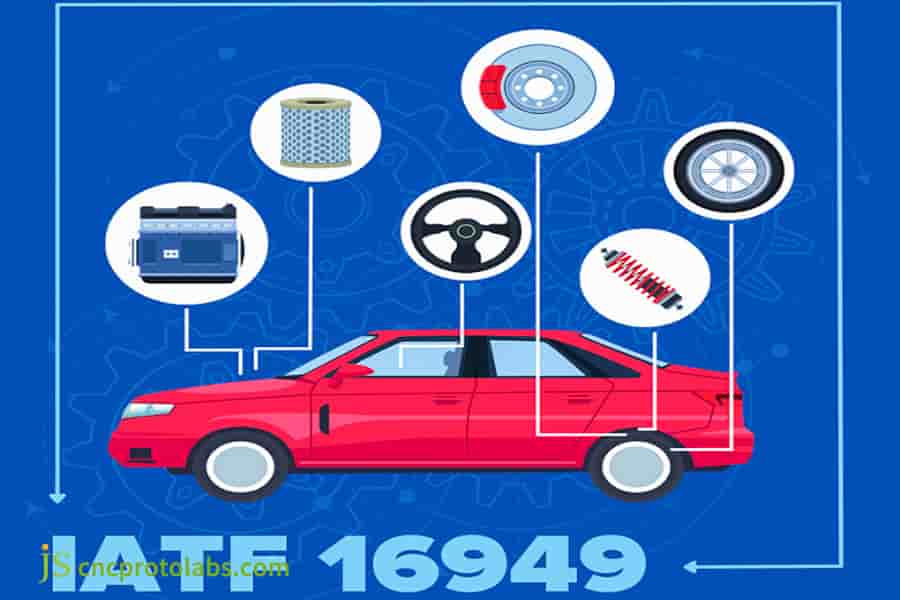
Figure 1: A red car surrounded by icons of key components like engine and brake disc, with the IATF 16949 certification prominently displayed below.
CNC Milling And CNC Turning: Which Is Right For Your Automotive Part?
The selection of a machining technique for automotive components has a huge effect on the efficiency and precision of the operation. CNC milling and CNC turning vary a lot and the decision has to be made in light of the nature of the parts.
Comparison of Process Principles
- CNC milling means that a rotating tool cuts into a workpiece that is kept fixed, and being able to machine complex contours, it is the main automotive precision CNC milling.
- CNC turning means that a fixed tool cuts into a rotating workpiece with a) special focus on b) c) rotating parts like shafts and discs.
Typical Application Scenarios
In the automotive industry, milling is a way of working on structural parts like engine blocks and steering knuckles, whereas turning is an excellent choice for half-shafts and valve cores. Brass CNC milling in conjunction with turning can increase the accuracy and surface quality of brass connectors.
Composite Machining Solutions
Mill, turn centers are able to do the complete machining of an automotive motor shaft, for example, in one setup only, which avoids the need for repeated clamping with the consequent risk of accuracy loss and also results in a lower turnaround expense.
Automotive Parts Process Selection Reference Table
| Part Type | Recommended Process | Applicable Material | Machining Accuracy | Surface Finish Ra |
| Engine Block | CNC Milling | 6061 Aluminum Alloy | ±0.01mm | ≤1.6μm |
| Automotive Half Shaft | CNC Turning | 45# Steel | ±0.008mm | ≤0.8μm |
| High-Voltage Connector | Mill-turn composite | Pure Copper T2 | ±0.005mm | ≤0.4μm |
| Steering Knuckle | 5-axis CNC Milling | 7075 Aluminum Alloy | ±0.01mm | ≤1.6μm |
| Sensor Connector | CNC Turning | C3604 Brass | ±0.008mm | ≤0.8μm |
Want to precisely select the machining process for your automotive parts? Inform JS Precision of your part characteristics and production requirements, and we will provide you with the optimal CNC milling and CNC turning process solution free of charge, calculating processing costs and delivery time.
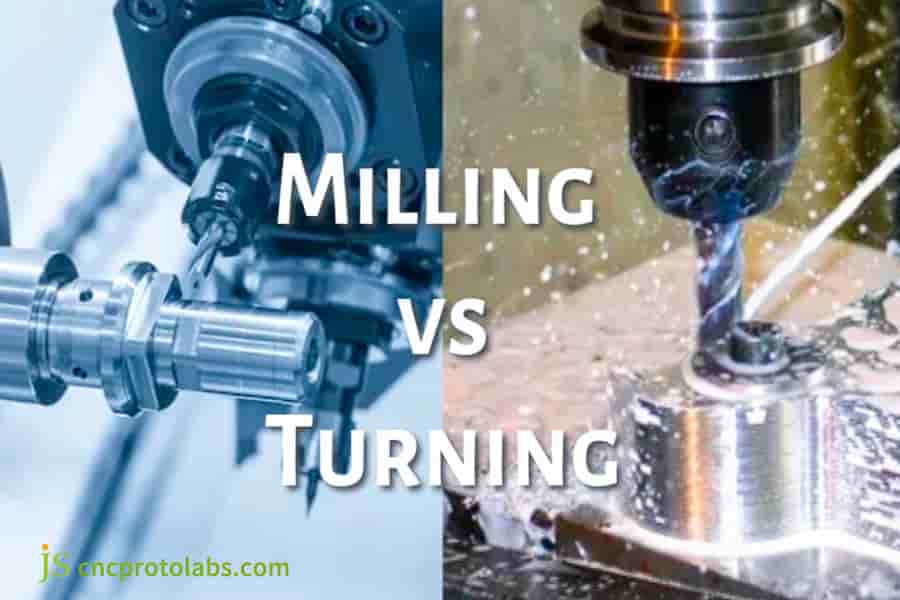
Figure 2: A side-by-side visual comparison showing a CNC milling machine and a CNC lathe in operation, each machining a metal automotive component.
How To Maintain Micrometer Level Accuracy Through Automotive Aluminum CNC Milling In Mass Production?
Automotive aluminum CNC milling plays a major role in the lightweighting of new energy vehicles. Achieving micron-level accuracy in mass production not only depends on equipment, technology, and the environment but also on the entire process including measurement.
Equipment Rigidity and Thermal Stability
To keep the accuracy within ±0.01mm, one needs to rely on high-quality machine tools. Meehanite cast iron beds, temperature-controlled spindles, and thermal deformation compensation guides are some of the features that can limit the dimensional drift to about ≤0.005mm even during 24-hour continuous production.
Toolpath Strategy and Wear Compensation
Since aluminum cutting speeds might be as high as 2000m/min, in order to maintain dimensional accuracy it is necessary to use adaptive toolpaths together with real-time wear compensation through online measurement probes.
Closed, Loop Temperature Control and Measurement System
Considering aluminum has a high coefficient of thermal expansion, it is necessary to have a temperature-controlled workshop of 20±1℃. A CMM (Chemical Machine Module) when used in conjunction with such a facility, results in a closed-loop "machining, measurement, compensation" system that can be trusted to yield precise automotive CNC milling.
Want to maintain micron-level precision in your mass-produced automotive aluminum CNC milling parts? Choose JS Precision's aluminum CNC milling machining service now! We will provide you with a dedicated temperature-controlled production line and online inspection system to ensure stable precision.
How To Prevent The Three Common Defects In Automotive Precision CNC Milling?
Defects in automotive precision CNC milling negatively impact the performance of parts that are manufactured. In mass production, there is a need to establish particular prevention measures for frequent defects.
Defect 1: Burrs (DeBurring)
Burrs may hinder the assembly and cause high-voltage short circuits. To prevent this, the cutting tools can be optimized, the cutting parameters can be adjusted, or the finishing methods such as electropolishing or abrasive flow can be used.
Defect 2: Dimensional Shift (Dimensional Shift)
Dimensional shift can be caused by insufficient warm, up of equipment and temperature fluctuations of the cutting fluid. It can be avoided by forced warm-up, temperature control, and SPC (Static Process Control) monitoring for early warning.
Defect 3: Poor Surface Finish
The sealing performance is negatively impacted by the tool marks and joint marks. The issue can be solved by optimizing the CAM toolpath, adjusting the dynamic balancing of the inspection equipment, and implementing full inspection through online roughness testing.
Why Choose Copper CNC Milling And Brass CNC Milling For EV Components?
With the trend of new energy vehicles, copper CNC milling and brass CNC milling have become the main focus of three-electric systems (battery, motor, and electronic control system). The upgrade of the processes contributes to the improvement of machining accuracy and efficiency.
1.Copper's Conductivity and Copper's Heat Dissipation Characteristics
Busbars and other connector parts of electric vehicles are required to have high conductivity (pure copper≥100% IACS).Copper CNC milling can realize accurate deforming, thus the surface is free of burrs and the high pressure risk is lowered.
2.Brass's Machinability and Cost Effectiveness
In brass CNC milling, the two most commonly used materials are C3604 and CW614N, which have low cutting forces, long tool life, and can be finished in a single setup with milling and turning processes, with dimensional integrity.
3.High-Voltage Connectors Machining Problems in New Energy Systems
The high-voltage connectors over 600V are required coaxiality ≤0.03mm and Ra≤0.8m. High-speed milling with micro-lubrication can prevent copper chips from sticking to the tool thus the surface can reach a mirror-like finish.
Copper/Brass Milling Machining Parameter Table
| Material Grade | Milling Speed (rpm) | Feed Rate (mm/min) | Depth of Cut (mm) | Tool Type | Surface Finish Ra |
| Pure Copper T2 | 18000 | 500 | 0.5 | K10 Carbide | ≤0.8μm |
| C3604 Brass | 15000 | 600 | 0.8 | K20 Carbide | ≤0.6μm |
| CW614N Brass | 14000 | 550 | 0.7 | Diamond Coated Tool | ≤0.6μm |
| Phosphor Bronze QSn6.5-0.1 | 12000 | 400 | 0.4 | Carbide Coated Tool | ≤1.0μm |
| Red Copper TU1 | 19000 | 450 | 0.4 | K10 Carbide | ≤0.8μm |
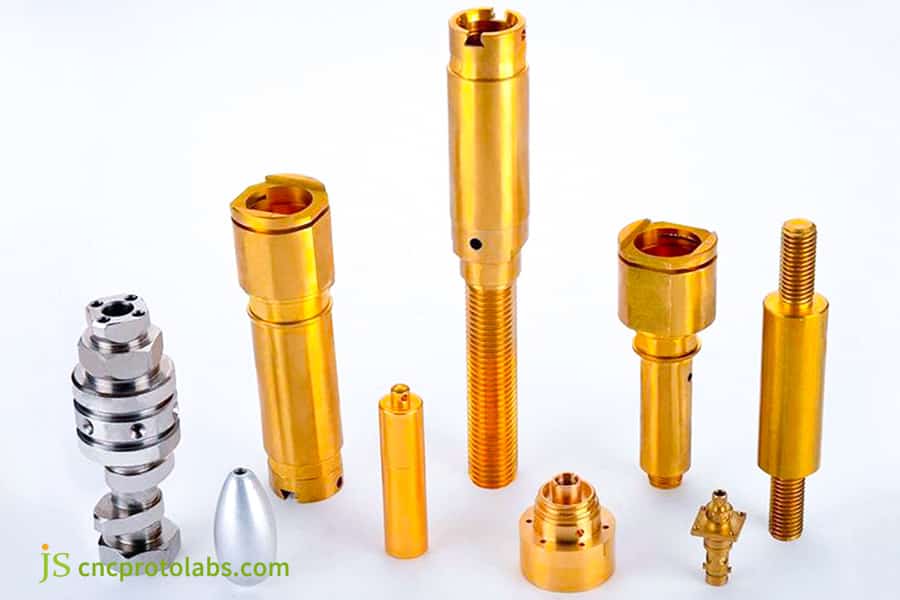
Figure 3: A collection of various high-precision, metallic cylindrical and shaped components produced by CNC turning processes.
How Can You Optimize Costs In High-Volume Automotive Aluminum CNC Milling?
High-volume automotive aluminum CNC milling places the primary focus on cost optimization. To this end, professional aluminum CNC milling machining service can achieve systematic cost reduction at multiple levels without compromising on quality.
1.Cost breakdown:
In a high-volume automotive aluminum CNC milling scenario, the materials share of the cost is 25%-35%, cutting tools make up 15%-20% and equipment labor accounts for 30%-40%. A holistic approach is needed to optimize costs.
2.Hidden cost traps:
Too tight tolerances and frequent changes in production lead to hidden costs. For example, a ±0.01mm requirement for non-mating surfaces can raise the processing time by 30%, while the hidden costs of production changeover adjustments go beyond the direct processing costs.
3.Value engineering approach:
Early DFM collaboration with suppliers by way of structural optimization, material changes, and process simplification can cut down costs by 15%-30%. JS Precision is an example of a company that optimized a motor housing for a client, reduced the cost per unit by $22, and shortened the delivery time by 40%.
How To Evaluate The Supplier's Actual Delivery Capability When Choosing Automotive CNC Milling Service?
To select a suitable automotive CNC milling service supplier, the most important thing is to evaluate their overall capabilities in detail. A professional aluminum CNC milling machining service supplier will have excellent capabilities in all areas.
1.Equipment Matrix and Process Coverage
Find out if the supplier possesses essential equipment like 5 axis machining centers and mill-turn centers. Besides the brand and quantity, also pay very close attention to the positioning accuracy (e.g., ±0.002mm) of the machines.
2.Quality System and Measurement Capabilities
Alongside IATF 16949 certification, ensure that their lab is equipped with a CMM (accuracy ≤1.5μm), surface roughness testers, and has MSA measurement system analysis capabilities.
3.Engineering Support and DFM Feedback Quality
Reliable suppliers will offer you DFM feedback even before the quotation stage, they will be able to identify the features that are hard to machine, they can point out economic tolerances, or suggest the use of alternative materials.
4.Case Studies and PPM Data
Suppliers should be able to provide case studies of similar projects and disclose PPM (≤100) and OTD (≥98%) data for the last 12 months. This is a core indicator of their delivery capabilities.
Want to scientifically evaluate your automotive CNC milling supplier? Request the "Automotive CNC Machining Supplier Evaluation Manual" from JS Precision to master quantifiable evaluation standards and find true strategic partners.
JS Precision Case Study: PPM Reduced From 850 To 42! Breakthrough In Steering Joint Processing By a Tier 1 Supplier
Challenge
A Tier 1 supplier for a European luxury brand had been struggling with the issue of insufficient dimensional stability in CNC milling for its aluminum alloy steering knuckles (material 6061-T6, annual demand 200, 000 pieces) for a long time.
The critical mounting hole position accuracy (CPK) was only 0.89, which led to frequent assembly line stoppages and a very high PPM of 850. The original supplier failed to break the technical bottleneck, which resulted in the delivery delay rate of more than 15%, thus causing the customer to face huge production and cost pressure.
Solution
After JS Precision's intervention, a three-step technological upgrade was implemented to address the process pain points of automotive aluminum CNC milling:
1. Process Restructuring:
The original three-stage dispersed machining process of "rough milling + semi-finish milling + finish milling" was upgraded to a "horizontal machining center + dual working areas" system that completes all milling operations in a single setup.
This removes the errors of repetitive positioning, thus the positioning accuracy is improved from ±0.015mm to ±0.008mm and the process flow time is reduced by 30%.
2. Tool Optimization:
To enhance tool performance further, PCD diamond tools were adopted for cutting purposes, thereby replacing carbide tools. The cutting speed was raised from 800m/min to 2500m/min, and the feed rate was set to 800mm/min. The time to machine one piece was cut nearly half, from 9.5 minutes to 4.8 minutes, and tool life was extended by 2.5 times.
3. Online SPC Closed-Loop:
On-machine measurement is automatically triggered every 20 pieces, achieving a measurement accuracy of 0.001mm. Measurement data is fed back to the CAM system in real time, automatically tool radius (compensation accuracy ±0.0005mm) adjustments, thus ensuring CPK remains stable above 1.33 and dimensional dispersion is controlled within 0.006mm.
Results
This process upgrade has generated a number of significant benefits:
- Position accuracy (CPK) rose from 0.89 to 1.47, thereby cutting dimensional dispersion by 60%.
- A qualitative leap in quality was attained, with PPM declining from 850 to 42, thus reaching industry-leading levels.
- Delivery efficiency was significantly improved, with lead time being shortened from 14 weeks to 8 weeks, and the on-time delivery rate going up to 99.5%.
- Overall costs have been dramatically cut, with a $18 per piece processing cost reduction, thus enabling the customer to save $2 million annually in procurement.
Want to achieve both quality and efficiency improvements for your core automotive components? Contact JS Precision now, share your processing pain points, and we will customize a dedicated process upgrade solution for you, replicating the cost reduction and quality improvement results of our successful case study.
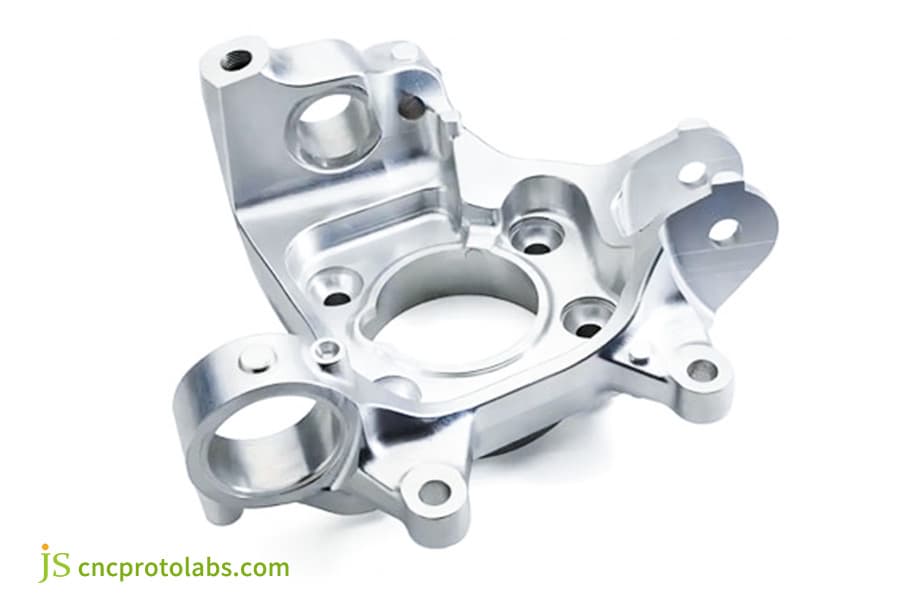
Figure 4: A single, complex-shaped aluminum automotive component with a smooth machined finish, showcasing precision milling.
FAQs
Q1: What differentiates IATF 16949 certification from ISO 9001?
IATF 16949 incorporates automotive-specific stipulations to ISO 9001, for instance, the use of APQP and PPAP tools, laying a strong focus on defect prevention, and the adjustment to automotive CNC milling requirements.
Q2: What sets apart 6061 and 7075 aluminum alloys for CNC milling?
6061 aluminum alloy is easy to weld and resistant to corrosion, as well as being a simpler material for machining. 7075 is strong, thus can be used for high-stress parts, however, during CNC milling, the tool wear rate is more.
Q3: What makes turning the valuable machining tool for brass?
Brass (C3604) is characterized by low cutting forces and can easily generate long chips. Turning can continuously chop up the chips and attain a surface finish of Ra = 0.8μm or even less, hence it is perfect for high-volume machining of threaded joints in brass CNC milling.
Q4: Are special tools necessary for copper CNC milling?
Since pure copper is highly ductile, copper CNC milling should be done with sharp K10/K20 carbide tools, at high rotation speeds and with little lubrication so that built-up edge can be prevented.
Q5: What Cpk value is deemed okay in SPC?
In automotive CNC milling, a Cpk value of 1.33 or more (defect rate not exceeding 63 PPM) is the most critical characteristic, whereas, for general characteristics, a Cpk value of 1.0 or more is necessary to satisfy basic requirements.
Q6: What does DFM mean? How important is it?
DFM is all about designing parts so they are optimized for machining, thus saving a large part of the costs and shortening the time for automotive aluminum CNC milling.
Q7: What kinds of automotive parts can be made using mill-turn machining?
Mill-turn machining can handle operations for complicated parts that have been rotating where turning the outer diameters and milling or drilling the planes are the steps needed. Mill-turn achieves the requirements of CNC milling and CNC turning while, in a single setup, it maintains coaxiality within 0.005mm.
Q8: How does CNC milling relate to the new energy vehicles?
The electrification of vehicles (battery, motor, and electronic control) in new energy vehicles gives rise to higher electrical and thermal conductivity requirements, more complex thin-walled structures, and the increased use of copper and aluminum. Consequently, the demand for automotive precision CNC milling is considerably elevated.
Summary
The central point of competition in the automobile industry is the capacity of the supply chain. The quality and efficiency in automotive CNC milling largely determines the competitiveness of a product.
IATF 16949 is merely the starting point, a high-quality partner can combine process, quality, and cost to continuously produce Cpk ≥1.33, thus ensuring accuracy and the reduction of costs.
JS Precision has been working for a long time in the automotive CNC milling area, therefore utilizing its entire process range and a plethora of case studies to turn into an accountable partner in the automotive supply chain.
Send your drawings or requirements now, and the JS engineering team is going to offer you DFM analysis plus a very competitive aluminum CNC milling machining service solution within 24 hours, thus making your core automotive components capable of entering the global market!

Disclaimer
The contents of this page are for informational purposes only.JS Precision Services,there are no representations or warranties, express or implied, as to the accuracy, completeness or validity of the information. It should not be inferred that a third-party supplier or manufacturer will provide performance parameters, geometric tolerances, specific design characteristics, material quality and type or workmanship through the JS Precision Network. It's the buyer's responsibility Require parts quotation Identify specific requirements for these sections.Please contact us for more information.
JS Precision Team
JS Precision is an industry-leading company, focus on custom manufacturing solutions. We have over 20 years of experience with over 5,000 customers, and we focus on high precisionCNC machining,Sheet metal manufacturing,3D printing,Injection molding,Metal stamping,and other one-stop manufacturing services.
Our factory is equipped with over 100 state-of-the-art 5-axis machining centers, ISO 9001:2015 certified. We provide fast, efficient and high-quality manufacturing solutions to customers in more than 150 countries around the world. Whether it is small volume production or large-scale customization, we can meet your needs with the fastest delivery within 24 hours. Choose JS Precision this means selection efficiency, quality and professionalism.
To learn more, visit our website:www.cncprotolabs.com
Resource