English





CNC turning for semiconductor provides an essential precision base for advanced semiconductor chip production, otherwise, a precision error of 0.1μm will result in the disposal of the entire production batch of wafers.
The functionality of key components like plasma chamber sealing surfaces, silicon electrode concentricity, and RF window surface finish is directly related to the process control of CNC turning for semiconductor. Even if the drawings require tolerances of ±0.005mm and surface finishes of Ra 0.4μm, regular machining plants will find it difficult to meet these requirements.
This paper will expose the essential technological challenges of CNC turning for semiconductors and offer a realistic guide for identifying a trustworthy semiconductor CNC turning supplier.
Key Answers Overview
| Key Challenges | Key Solutions | Value Brought to You |
| How to achieve sub-micron precision and contamination, free processing? | CNC Turning for Semiconductor Solution with High Rigidity Machine Tool, Thermal Compensation Technology, and Special Material Process Parameters. | Ensure the sealing of the cavity and the concentricity of the electrodes, thus resulting in a yield improvement of over 30%. |
| How to select reliable semiconductor suppliers? | By evaluating the cleanroom capability, the process capability Cpk 1.67, the DFM feedback speed, and the batch traceability system. | Lower supply chain risks and avoid wafer contamination accidents caused by tiny burrs. |
| How to balance cost and quality in China procurement? | Pick top suppliers of CNC turning parts China who are equipped with DMG MORI/Haas machines and lay down a Tier1/Tier2 tiered procurement strategy. | Get the overall costs down by 40-60% and at the same time, delivery stability remains guaranteed. |
Key Takeaways:
- Submicron accuracy is the key to semiconductor equipment. Plasma chamber Ra≤0.4μm and silicon electrode concentricity≤5μm are direct factors in determining wafer yield.
- Special materials such as high-purity aluminum and PEEK demand contamination-free processing processes and special tool designs. Material properties define the process.
- Early-stage DFM feedback can prevent processing difficulties, lower overall costs, and generate over 30% value.
- Supplier validation needs to be data-driven, including CMM report, SPC data, and process capability proof of Cpk≥1.67.
Why Trust This Guide? JS Precision Custom CNC Turning Experience
As a leading provider of custom CNC turning services for the semiconductor industry, JS Precision boasts 15 years of experience in delivering really important components to global OEMs and Tier 1 suppliers.
Our tangible hands-on experience ranges from tailoring high-purity silicon focusing rings for a US semiconductor equipment manufacturer, thereby slashing their delivery cycle by 60% and raising the yield to 99.2%.
We have a professional semiconductor processing team. Out of the 28 in-house semiconductor processing experts, 6 are precision machining certified by the Society of Manufacturing Engineers (SME), and are experts in the CNC turning for semiconductor’s whole process.
We have carried out more than 500 active semiconductor projects, touching different critical parts like plasma chambers, RF electrodes, and vacuum flanges. There have been no major quality incidents for the last 3 years, and we focus on custom precision CNC turning parts processing.
We have authoritative qualifications such as ISO 9001:2015 and ISO 14001. Our cleanroom complies with Class 1000 standards and we are a certified supplier to 3 of the world's top 10 semiconductor equipment manufacturers, having the right qualifications as professional semiconductor CNC turning supplier.
Besides that, we are dependable and trustworthy, as we have set up a full-process batch traceability system, which allows tracing from batch to part, machine tool, and operator.All critical dimensions have a mandatory Cpk ≥ 1.67, and every new project provides a third-party first-article inspection report.
Want to quickly verify JS Precision's semiconductor CNC turning capabilities and obtain our customer case studies and certifications? Submit your initial requirements, and we will arrange a dedicated engineer to connect with you within 24 hours, providing free custom CNC turning technical consultation.
Why Is CNC Turning For Semiconductor Critical For Achieving Sub-Micron Tolerances?
CNC turning in the semiconductor field basically means achieving extremely close tolerances at a level much less than a micron. This requires overcoming the three major issues of materials, equipment, and thermal compensation, thus basically ruling out machining variations and contaminants.
Material Properties and Processing Challenges
Semiconductor components are made from very special materials and so they can easily get scratched or deformed during the processing simply by contacting. Thus, special processes are needed. Specific parameters are as follows:
| Common Materials | Key Properties | Processing Challenges | CNC Turning for Semiconductor Solutions | Compliance Standards |
| High-purity Aluminum (6061/6061-T6) | Relatively soft, easily work-hardened. | Prone to surface scratches and burrs, affecting vacuum sealing. | Use sharp, uncoated carbide tools, control cutting speed. | Ra≤0.4μm, no obvious scratches. |
| PEEK | High temperature resistance, strong chemical stability. | Processing temperature exceeding 150℃ will lead to performance degradation. | Use low-temperature or high-pressure cooling, filtration accuracy ≤5μm. | No thermal deformation, dimensional tolerance ±0.005mm. |
| Aluminum Nitride (AlN) | High hardness (HV≈1200), brittle. | Prone to chipping and cracking, surface finish is difficult to meet standards. | Use ultrasonic-assisted turning, optimize tool geometry. | Ra≤0.4μm, no chipping or cracks. |
| Oxygen-free Copper | Good electrical conductivity, soft texture. | Prone to built-up edge formation, detached particles contaminate wafers. | High-speed, low-feed machining using oil-free processes. | no built-up edge and no surface impurities. |
Contamination control is a key element of semiconductor processing. From the start, measures such as oil-free machining, cleanrooms with HEPA filters, and anti-static processes are taken to stop the wafers from being contaminated.
Equipment Rigidity Requirements
To reach submicron precision, one of the factors that determine performance is the vibration resistance of the machine tool, which common machine tools are not capable of. The high-rigidity CNC turning centre machine have to satisfy the following core requirements:
- High-damping cast iron bed: Meehanite cast iron material has a high capacity for vibration absorption and therefore reduces part deformation.
- Heavy-duty structure: The total machine weight is 8 tons and there are super-sized guideways and ball screws to get rid of backlash.
- High-precision spindle: Hydrostatic or air-bearing spindle with radial runout ≤0.5μm, ensuring cutting stability.
The top quality of the product in terms of surface finish of Ra 0.16μm and tolerance of ±0.002mm can only be realised by machines of high rigidity which ordinary machine tools cannot achieve.
Thermal Compensation Technology
Extended machining without thermal drift can seriously affect critical dimensions. To solve this problem, the newest machine tools use thermal compensation technology in real time, which ionclude:
- Multi-point temperature sensing: 6-12 sensors are used to monitor the temperature changes very precisely and to find out the source of the thermal drift.
- Dynamic compensation algorithm: The thermal deformation model is pre-loaded, and the toolpath is adjusted in real time, keeping errors under ±2μm.
- Thermally stable environment: Class 1000 cleanroom with temperature control ±0.5℃, thus ensuring a stable process.
Without thermal compensation technology, even the most rigid machine tools cannot maintain sub micron level tolerances for a long time. If you want to know about device configuration, you can contact us to obtain actual test data.
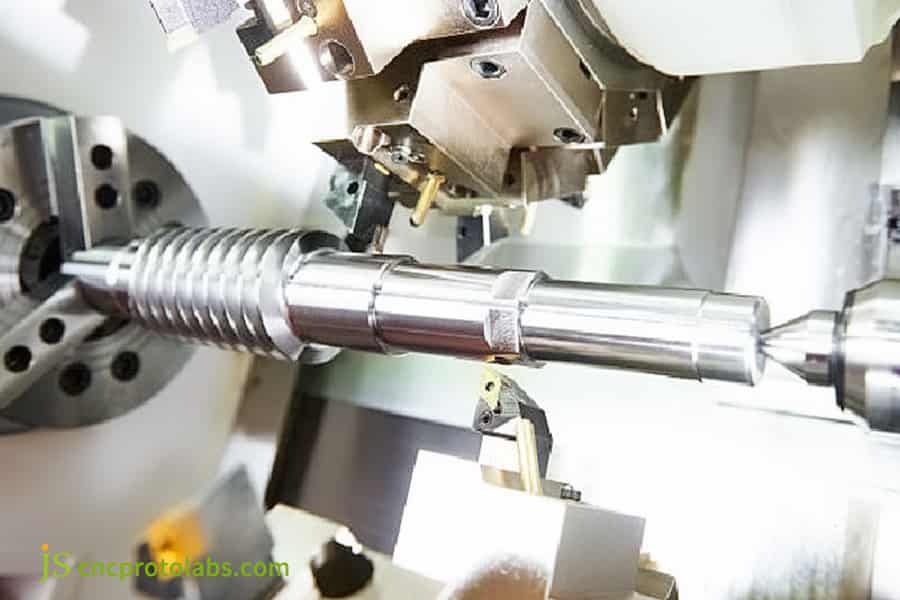
Figure 1: A close-up of a CNC lathe actively machining a threaded metal shaft, with multiple cutting tools positioned around it in a high-tech workshop.
How To Qualify a Semiconductor CNC Turning Supplier For High-Reliability Applications?
The heart of choosing a semiconductor CNC turning supplier is seeing their capability in delivering flawless parts consistently without any defects. Here is a logical screening framework to help you get started.
Certification and Cleanliness
A sound base is ISO 9001. A supplier that is compliant with semiconductor industries is able to focus on the verification of the following four points:
- Cleanroom: The production and packaging areas must be Class 1000, the most sensitive components Class 100, and the certification test must be available.
- Anti-static: The whole process shall be compliant with ANSI/ESD S20.20 standards and the records shall be provided.
- Contamination Control: Cutting fluid is filtered ≤5μm, dry machining and ultrasonic cleaning are used. Reports of particle counts are provided.
- Environmental Certification: ISO 14001/45001 certification to avoid supply chain compliance risks.
Technical Verification Indicators
Suppliers should be able to show quantifiable proof of their competence, at the core of which are these five points:
- DFM Report: turnaround within 24-48 hours, identifying risks early and offering past samples.
- Process Capability: Important dimensions Cpk 1.67, 3 batches of SPC control charts at least provided.
- First Article Inspection: AS9102 standard report, includes full test data.
- Microburr Control: Gives microscope photo and the process documentation of deburring.
- Traceability System: It is capable of full-process traceability of parts for compliance and fault analysis.
Below is a table of core parameters and corresponding performance data from industry mass production testing, facilitating companies to accurately match their processing needs.
| Machining Process Type | Equipment Model | Spindle Speed (rpm) | Cutting Accuracy (μm) | Surface Finish (Ra/μm) | Production Efficiency (pieces/8h) |
| Precision Horizontal Turning | DMG MORI NLX 2500 | 6000 | ±2.0 | 0.25 | 120-150 |
| Large Vertical Turning | DOOSAN VCF 850 | 2500 | ±3.5 | 0.40 | 30-50 |
| Compound 5-Axis Turning | Makino DA500 | 8000 | ±1.2 | 0.16 | 80-100 |
| Swiss Precision Turning | Swiss Precision Turning | 12000 | ±0.8 | 0.12 | 180-220 |
| Ultrasonic Assisted Turning | Chiron DZ 15 | 4500 | ±2.5 | 0.30 | 45-65 |
Worried about lacking the professional skills to fully verify the qualifications of a semiconductor CNC turning supplier? Tell us your screening needs, and JS Precision will provide you with a free supplier evaluation list to help you quickly eliminate unqualified suppliers and reduce supply chain risks.
What Are The Cost And Quality Implications Of Sourcing CNC Turning Parts China?
Many companies make the mistake of thinking that they have to choose between cost and quality when they want to purchase CNC turning parts China. Yet, if you find the right way, you can lower your expenses and still get semiconductor-grade processing quality.
First, the main factor to consider when you want to separate good cnc turning companies from the not-so-good ones is their equipment configuration. Give preference to suppliers who are already running high-end CNC turning centre machine like DMG MORI and Haas.
Such machines can achieve sub-micron precision very reliably, thus cutting the hidden costs of rework and scrap. JS Precision, as an industry leader, is equipped with a complete set of high-end equipment such as DMG MORI and DOOSAN, which can balance machining accuracy and cost.
Secondly, set up a Tier 1/Tier 2 tiered procurement strategy so that you can fine-tune cost and quality.
Which CNC Turning Centre Machine Features Are Essential For Complex Semiconductor Components?
Semiconductor components have very strict requirements for machine tool configuration. The following three key characteristics are necessary for machining:
Multi-Task Composite Machining
Machining complex components involves several tasks that need to be accomplished in a single clamping process. This requires a 5-axis CNC machine with a B-axis, which can control clamping errors within 3μm, preventing the accumulation of errors.
The Makino DA500 is designed specifically for semiconductors, allowing for simultaneous turning, milling, and drilling.
Vertical vs. Horizontal Turning Adaptability
The configuration should be chosen depending on the component size. Vertical configurations are preferred for large components, while horizontal configurations are preferred for small-long components. This ensures accuracy.
Automation and Intelligent Configuration
Automated loading and unloading systems allow for unmanned machining. Online measurement and real-time compensation for tool wear, as well as intelligent maintenance, can help decrease unplanned downtime by more than 30%.
What Differentiates Custom Precision CNC Turning Parts From Standard Machined Components?
The fundamental variance between custom precision CNC turning parts and standard parts is that the former are made specifically to fit the precision, contamination control, and intricate designs needed in the semiconductor industry, which, in fact, is three points that these parts are different:
Design and Manufacturability Collaboration
Unlike standard parts without such cooperative efforts, custom CNC turning is initiated in the Design for Manufacturing (DFM) stage, where engineers are deeply engaged in the design optimization process from the very beginning, thus mitigating machining risks.
In the case of RF electrode design optimization, JS Precision, for instance, replaces the inner right angles with R2 fillets, which not only reduce the machining time by 35% but also help to eliminate micro-burrs.
Machining Complex Geometric Features
Features that are intricately shaped, e.g., eccentric holes and micro-threads, cannot be done with standard parts, thus, turning out to be a necessity for high-end machine tools and specialized processes.
JS Precision, through the use of Swiss-type lathes, can machine slender shafts and perform composite machining, thus, satisfying the intricate requirements of semiconductor components.
Special Surface Treatment
While custom parts prioritize contamination prevention and precision maintenance, standard parts mainly focus on corrosion prevention through their respective surface treatment. The main differences are very significant:
- Electro-free Nickel Plating: 10-50μm thickness, avoiding plating peeling and contamination.
- Passivation treatment: Meets ASTM A967 standards to keep stainless steel from contaminating the wafer.
- Black anodizing: Strictly controlled film thickness, suitable for precision assembly.
When Should You Opt For Vertical CNC Turning Over Horizontal For Large-Format Semiconductor Hardware?
For huge semiconductor pieces that are more than 500mm in diameter, vertical CNC turning can provide some great benefits. The situations when it can be used and the main benefits are:
Gravity Effect and Precision Advantages
During horizontal turning, the weight of big parts can easily cause bending and deformation. Vertical turning adopts the use of gravity support, thus achieving flatness ≤3μm and more stable concentricity, meeting the Ra≤0.4μm requirement.
Clamping and Loading/Unloading Advantages
Large blanks value is very high. Vertical table clamping allows lifting without difficulty, hence lowering the risk of clamping damage by 80%. Vacuum chucks are used for thin-film components thus avoiding scratches and deformation.
The Rigidity Advantages of the Dual-Column Structure
The symmetrical dual, column structure has a very high vibration resistance level, which allows heavy machining of very hard materials while still maintaining a Ra 1.6μm surface finish, which is way beyond the horizontal turning efficiency.JS Precision has several high-end vertical machining centers that can handle big parts up to 2,000 mm in diameter.
Have large semiconductor component machining needs but unsure if vertical CNC turning is suitable? Tell us your component dimensions, weight, and precision requirements, and JS Precision will provide you with a customized machining solution and a free cost estimate for large CNC turning services.
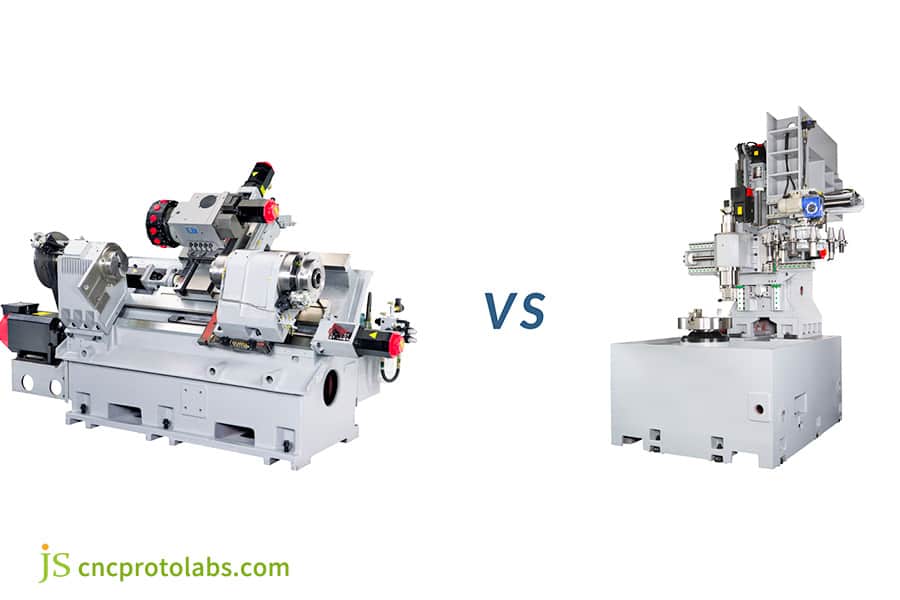
Figure 2: A side-by-side comparison of two CNC turning machines, highlighting the robust design of a semiconductor-specific model versus a general-purpose model.
JS Precision Case Study: Us Semiconductor Equipment Manufacturer Cuts Lead Time By 60% With Custom CNC Turning
Practical case studies are the most effective way to illustrate a supplier's skills. Here is an entire case study of JS Precision delivering custom CNC turning solutions to a US semiconductor equipment manufacturer, which clearly demonstrates our capability to address the main customer pain points.
Challenges
The customer's high-purity silicon focusing ring (outer diameter 420mm), originally supplied by the supplier using a horizontal multi clamping process, has three major pain points: concentricity deviation of 12 μ m (requirement ≤ 5 μ m), surface microcracks, and an excessively long delivery time of 8 weeks.
Solution
JS Precision, tapping into its custom machining know-how, resorted to a three-step upgrading scheme to solve these problems, semiconductor-grade CNC turning being the main technology used throughout the process.
1.Joint DFM Optimization:
In direct contact with the customer, we suggested the implementation of a 650 ℃ annealing step to remove the material stress, the optimization of the toolpath based on a "roughing allowance + natural aging + finishing" sequence, and the development of a special soft, jaw vacuum clamp to remove the clamping deformation and thus ensure concentricity.
2.Process Chain Upgrade:
By employing a DOOSAN VCF 850 vertical turning machine internal and external diameter machining were performed in a single clamping operation, thus no accumulated errors.
PCD diamond tools were used for finishing, thus cutting speed was increased and surface finish was ensured, and an online measurement system was set up to adjust tool wear in real time.
3.Rigorous Inspection and Release:
Full-dimensional inspection with ZEISS CONTURA CMM, surface roughness measurement with a surface roughness meter (ensuring Ra≤0.4μm), and ultrasonic testing to identify micro cracks. Only products that pass the inspection are released.
Results
We not only successfully addressed the customer's core pain points but also delivered results that exceeded their expectations by a large margin:
Focusing ring concentricity 3.2μm (Cpk=1.82), surface finish Ra 0.35 μm no cracks, delivery cycle was shortened to 3 weeks (including sea freight), a 60% reduction, procurement costs have been dropped by 35%. The customer awarded us 100% of the order for this component, with annual purchases of 800 units.
Are your semiconductor components also facing issues of substandard precision, slow delivery, and high costs? Refer to this success story and contact JS Precision. We will tailor a custom CNC turning solution for you to help solve machining pain points, shorten delivery cycles, and reduce procurement costs.
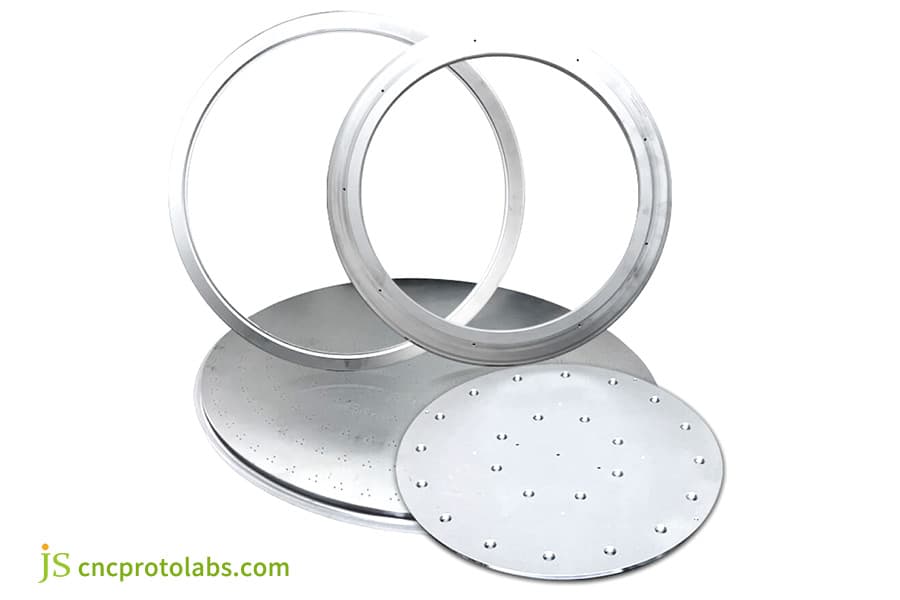
Figure 3: Several high-quality, custom-machined aluminum discs and rings, showcasing the finished components produced by CNC turning for semiconductor equipment.
FAQs
Q1: What materials are commonly used for CNC turning of semiconductor components?
High-purity aluminum, stainless steel, PEEK, oxygen-free copper, titanium alloys, and special ceramics are the mostly used materials for CNC turning of semiconductor components. All these materials require semiconductor-specific turning processes.
Q2: What is your minimum tolerance?
Our specialty precision CNC turned parts are capable of deliver a repeatability of ±0.005mm continuously and after the main feature optimization it can get to ±0.002mm, thus achieving fully the sub, micron requirements of semiconductor manufacturing.
Q3: How do you guarantee consistency in mass production?
We use SPC statistical process control, CMM sampling inspection, and full-process batch traceability. Based on the key characteristic Cpk ≥1.67 we are thus able to guarantee dimensional consistency in mass production.
Q4: What is the typical time frame for sample delivery?
Samples of standard semiconductor CNC turned parts are delivered within 7-10 days, while complex custom samples within 12-15 days. There is also an expedited service option that allows delivery and verification in only 5 days.
Q5: What is the minimum order quantity?
To help customers check instances of precision and quality, sample order of 1 piece are available, mass production minimum order quantity is 50-100 pieces with long-term client minimum order quantity restrictions being flexible.
Q6: How do I verify the supplier's cleanliness control capabilities?
To verify their cleanliness control capabilities totally, you could ask for their cleanliness control related certificates, test data, allow video audit and see the customer case studies.
Q7: Does surface treatment have any impact on dimensional tolerances?
Surface treatment does have an impact on dimensional tolerances. The before/after plating dimensions must be annotated on the drawings. To make sure that the changes conform to the standard, we will provide an adjustment suggestion in the DFM stage.
Q8: What is your machining capability for large components (>500mm)?
We have expert large-scale CNC turning capabilities, thus can manufacture large components at a maximum diameter of 2,000 mm and maximum load capacity of 5 tons, and still maintain a high level of precision and machining stability.
Summary
At the 2 nm process node, the accuracy of the semiconductor parts is nearing the submicron level. For semiconductors, CNC turning is the heart to pushing beyond the precision barriers. A partner's key to success lies in their unremitting chase for precision and quality.
JS Precision has been in the industry for more than 10 years, fully equipped with high-end machinery and has all the necessary certifications. They have served top global semiconductor equipment manufacturers and have gained a lot of hands, on experience.
Whether looking for a semiconductor CNC turning supplier, customizing custom precision CNC turning parts, or purchasing CNC turning parts China, JS Precision is one of top tier CNC turning companies in the industry and your reliable partner.
Send us your drawings or requirements, and we will provide you with a free DFM analysis and quotation within 24 hours, paving the way for your equipment to go beyond the limit of precision.

Disclaimer
The contents of this page are for informational purposes only.JS Precision Services,there are no representations or warranties, express or implied, as to the accuracy, completeness or validity of the information. It should not be inferred that a third-party supplier or manufacturer will provide performance parameters, geometric tolerances, specific design characteristics, material quality and type or workmanship through the JS Precision Network. It's the buyer's responsibility Require parts quotation Identify specific requirements for these sections.Please contact us for more information.
JS Precision Team
JS Precision is an industry-leading company, focus on custom manufacturing solutions. We have over 20 years of experience with over 5,000 customers, and we focus on high precisionCNC machining,Sheet metal manufacturing,3D printing,Injection molding,Metal stamping,and other one-stop manufacturing services.
Our factory is equipped with over 100 state-of-the-art 5-axis machining centers, ISO 9001:2015 certified. We provide fast, efficient and high-quality manufacturing solutions to customers in more than 150 countries around the world. Whether it is small volume production or large-scale customization, we can meet your needs with the fastest delivery within 24 hours. Choose JS Precision this means selection efficiency, quality and professionalism.
To learn more, visit our website:www.cncprotolabs.com
Resource