English



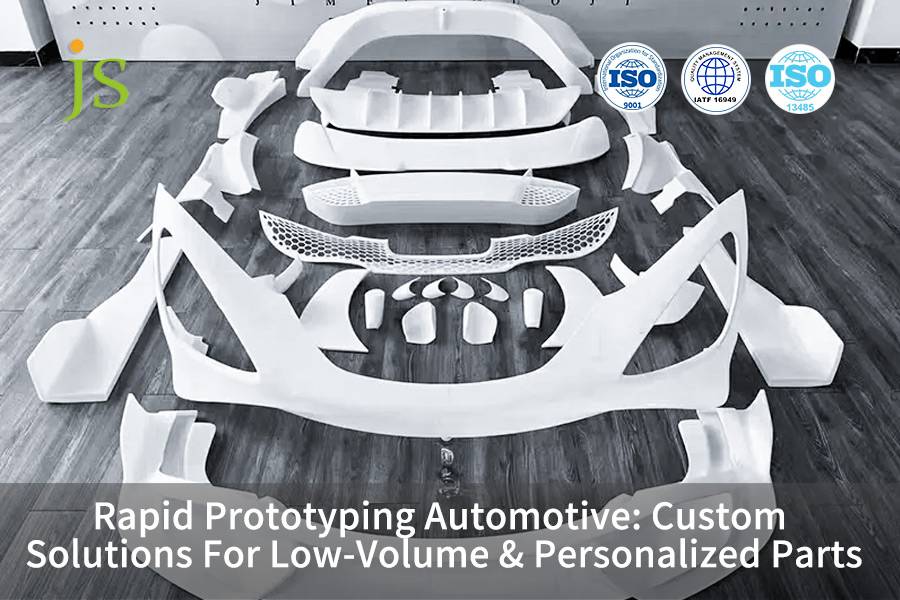

Rapid automotive prototyping is fast becoming a vital method for addressing the challenges of the automotive industry's race for innovation.
In this race-niche models, personalized customer modifications, and validation of the latest technologies are facing a common problem: the traditional mass production models are too slow and costly to fulfil the demands of "small batches, high customization".
How to get out of this stalemate and quickly, economically, and efficiently turn the unique designs into parts that are testable, demonstratable, and even small batch vehicle-ready functional? The solution is in thoroughly understanding and applying rapid prototyping automotive solutions.
This guide will deeply analyze the main route from idea to the finished product and thus help to understand why a partner with a profound knowledge of the industry is the key to agile development and personalized customization.
Key Answers Overview
| Core Questions | Key Answers | Value Brought to You |
| What is the best approach to get past the problem of very few pieces and personalization? | Through the combination of different techniques involved rapid prototyping in automotive industry (e.g., CNC, 3D printing, etc.), quick design changes and working model validation are done, thus traditional mold limitations are not even considered. | Match the rapid prototyping technology features to small batch production pain points thoroughly. |
| What criteria should you use to select a trustworthy service partner? | The evaluation should consider their technological range, industry experience, and the extent of their product prototyping services, at the same time, make sure the service partner is well-aware of automotive-grade performance and compliance requirements. | Create a logical supplier selection framework, and find partners with upscaling potential in delivering high quality prototypes. |
| What is the right way to move from a prototype to a small batch production? | Custom metal fabrication prototype services not only help with a testing of a working model but also provide a technological and data foundation for follow-up small batch production. | Learn how prototyping and production are inherently connected and how to design a smooth and safe industrialization path. |
| How to measure the efficiency of prototype testing? | Use the closest possible materials to the test condition and combine it with the rapid prototype machining to be sure of the structural accuracy as well as the test data authenticity and reliability. | Save yourself from unexpected test failures due to material or process deviations and thus, cutting down on rework costs at a later stage. |
Key Takeaways:
- Speed is the key to outrunning your competitors:
Rapid prototype machining in the automotive sector can bring down the time necessary for developing the main parts from several months to a few weeks, thus speeding up time to market.
- Material selection decides the extent of testing verification:
Choosing prototype materials in accordance with the test (e.g., short, term vehicle road testing vs. bench durability testing) is a condition for the production of reliable data.
- Maximizing the value of integrated services:
Comprehensive prototyping services may be able to collaboratively designing optimization reduce iterations costs by up to 30%.
- Functional prototypes are necessary investments:
Although the custom metal fabrication prototype used for safety and performance testing has a high cost, it can expose design risks in advance and avoid huge losses in the later stage.
Why Trust This Guide To Automotive Rapid Prototyping?
This guide is backed by JS Precision's more than 10 year hands-on experience in rapid prototyping in automotive industry and its 50+ automakers worldwide success stories.
JS Precision is a rapid prototyping technology expert and they've mastered the entire workflow starting from 3D printing and five axis CNC machining to vacuum molding, thus they are able to accurately satisfy the automotive industrys high demands in terms of precision, performance, and compliance.
Our staff is well, versed in the IATF 16949 quality management system and has manufactured more than 1,000 prototypes of core automotive parts, which include key components of EV battery brackets, intake manifolds, and chassis structural parts. Machining accuracy is always kept within 0.05mm.
We are involved in a variety of sub, sectors among them new energy vehicles and high end gasoline vehicles, and we are able to satisfy the customized requirements of different automakers. All of the prototypes have passed CMM three-dimensional inspection.
In particular, JS Precision has obtained ISO 9001:2015 quality system certification, which is a fundamental assurance of our services to high end automakers.
On cost control, via DFM optimization and process integration, we help clients cut the costs of prototype development on average by 25% and the cycle time by 40%.
One main factor behind the majority of European and North American car manufacturers choosing us is that we are able to offer not only lab-level highly accurate prototypes but also support the small batch production of vehicle assembly functional components, thus truly achieving "prototype as a prelude to mass production".
Want to verify if your prototype solution meets automotive-grade standards? Contact JS Precision now for free IATF 16949 compliance consultation and unlock a customized technical solution for rapid prototyping automotive.
How Does Rapid Prototyping In The Automotive Industry Solve Low-Volume And Customization Challenges?
This section clarifies the rationale for the use of rapid prototyping automotive and rapid prototyping in the automotive industry in small batch production by referring to the data on 15% annual growth of the global automotive prototyping market (Verified Market Research report, report number: 535930).
Small Batch vs. Large, Scale Manufacturing: Economic Inflection Point Analysis
Traditional mold-making is often more than $100, 000 and has a cycle of 2-3 months, so it is only suitable for mass production of 500 units or more. Small-batch rapid prototyping automotive does not require molds, is priced per unit, and if production volumes are 100-500 units or less, choosing this technology may result in a cost reduction of over 60%.
Personalized Customization Technology Implementation Path
Rapid prototyping in automotive industry accomplishes personal customization by a principal three-step path:
- Get the data of original vehicle components either by 3D scanning or getting customer creative design drawings made.
- Do reverse engineering and CAD optimization to ensure the new design can be manufactured practically.
- Employ 3D printing or CNC machining technology to give material existence to the digital model.
This method can carry out customized interior panels, exclusive logos, and similar products very fast, in only 7-14 days.
From Weeks to Days: The Commercial Value of Speed
Traditional concept validation takes 8-12 weeks, with rapid prototyping, this can be shortened to 2-4 weeks, helping automakers quickly gather feedback, accelerate decision-making, and seize market share.
Comparison of Mainstream Manufacturing Processes for Automotive Prototypes
| Process Type | Core Technology | Applicable Scenarios | Accuracy Range | Unit Cost (USD) | Delivery Time (Days) |
| CNC Machining | Five-axis CNC cutting | Metal functional parts, high-strength structural parts | ±0.05-0.1mm | 50-500 | 3-7 |
| SLS 3D Printing | Laser sintering of nylon powder | Complex internal cavity parts, concept models | ±0.1-0.2mm | 20-200 | 2-5 |
| Vacuum Molding | Silicone mold injection with resin | Small batch appearance parts, non-load-bearing parts | ±0.2-0.3mm | 10-100 | 5-10 |
| Sheet Metal Processing | Laser cutting + bending | Body panels, bracket parts | ±0.1-0.3mm | 30-300 | 4-8 |
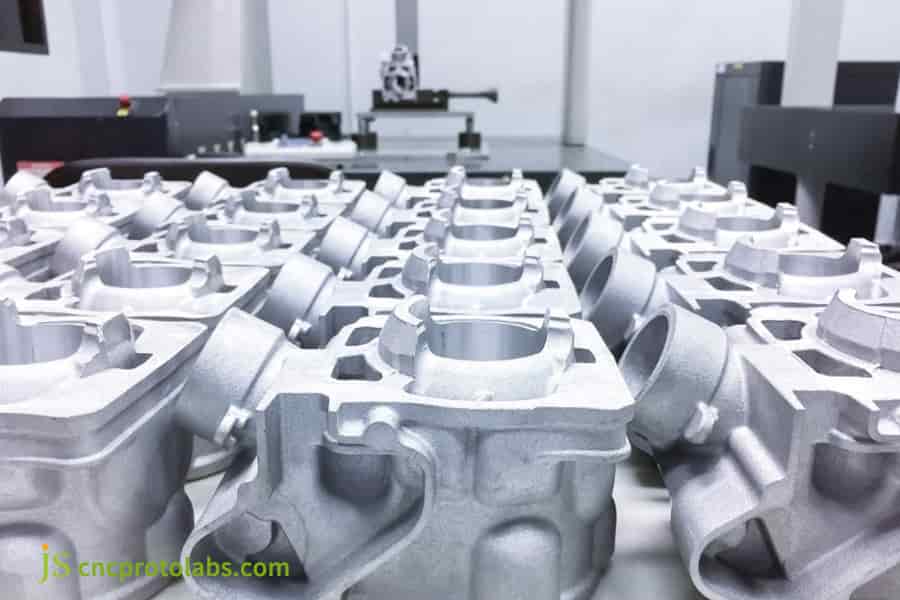 Figure 1: Several complex, shiny metallic automotive part prototypes arranged on a workbench with CNC equipment visible in the background.
What Should You Look For In Professional Automotive Prototyping Services?
Choosing professional prototyping services is the key to project success, and the following is a clear evaluation framework.
Technical Capabilities and Industry Knowledge Checklist
Look at the vendors mainly from these three angles:
- The Extent to Which the Process Is Covered: A multi axis CNC factory combining industrial, grade SLS/SLA 3D printing and vacuum forming.
- Work Experience: There are case studies of successful projects with automotive parts such as battery brackets for the electric vehicle and intake manifolds.
- Quality Performance: Well-versed with GD&T standards and able to deliver a CMM report.
Importance of Comprehensive Service Support
A good prototyping partner should be able to go through the whole cycle, from the initial DFM review, the mid term process consulting, to the final finishing, to the point that the parts can be used right away after delivery.
Main Question: Are they capable of giving me the performance I desire?
Get to the bottom of the suppliers by asking: Do they have long term mechanical performance data for prototype material at 80℃? Can they provide production records IATF 16949?
Case Study: 40% Cost Reduction & 6-Week Time Saved For a Custom EV Component
Challenge
One of the top European manufacturers of electric go, karts got stuck with a challenge to develop a lightweight and structurally complex aluminum alloy chassis prototype to be used in their crash simulation and track testing programs. The quote from the local fabricator was as high as $20, 000 with a lead time of 10 weeks, which didn’t fit the clients testing schedule.
JS Precision's Solution
JS Precision's response was that their team first focused on three key elements:
1.DFM Optimization:
By using ANSYS stress analysis tools, JS Precision engineers performed a full mechanical simulation of the initial design. We accurately pinpointed the areas of highest stress and then added reinforcing ribs to these points in a way that made sense.
As such, the strength of the components was increased while the material was not unnecessarily used. At the same time, they rationalised the cutting path so there were fewer non-cutting moves and the cutting time was thus shortened by about 15%, resulting in further cost savings in processing.
2.Process Selection:
To satisfy the core requirements of a lightweight yet strong chassis prototype, the process selected was five axis rapid prototype machining. This single-step machining from one piece (6061-T6 aluminum billet) totally avoids the precision errors that are caused by multiple positioning steps.
This guarantees the overall dimensional accuracy to be stable within 0.1mm, and the crash and track testing strength requirements are thus fully met.
3.Project Collaboration:
We decided to work on a dedicated online project management platform where the main focus was sharing the information about machining progress, tool wear, and CMM (Calibrated Dimension Machine) data in real time. Customers were able to check part machining details or dimensional reports whenever they wanted.
Besides, a personal engineer was allocated for the customer who got the design adjustment requests handled very quickly and receiving transparent communication with zero-delay collaboration throughout the process.
Results
The final prototype delivered was 12% lighter while still having the rigidity to the design standards, the total cost was reduced by 40%, being only $12, 000, the development cycle was shortened from the 10 weeks to 4 weeks, thus giving the client more testing time.
This case is an excellent point of reference for the benefits of rapid prototype machining in the development of high performance automotive parts.
Want to replicate the cost reduction and efficiency improvement results of this case? Submit your part requirements, and JS Precision engineers will provide a rapid prototype machining customization plan within 24 hours, along with a free cost estimate.
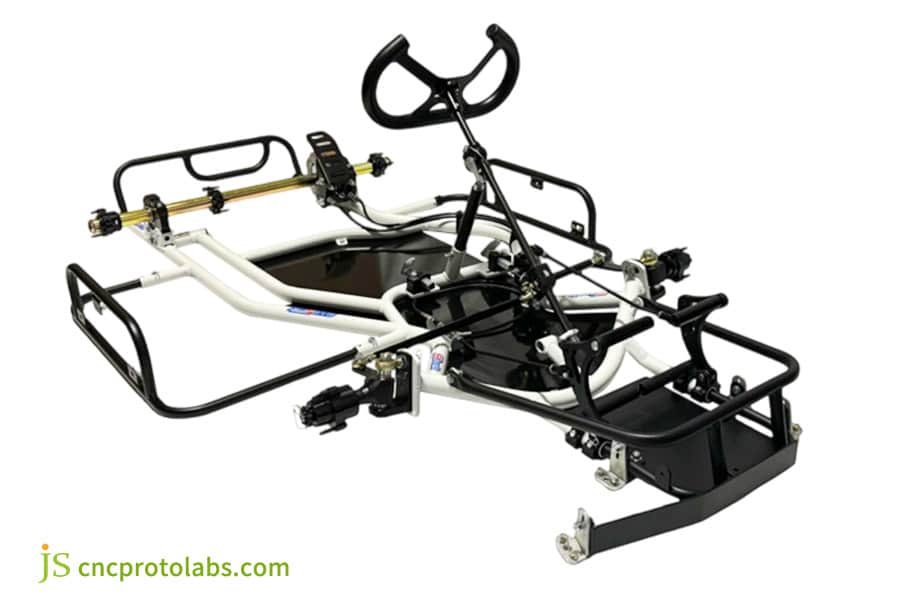 Figure 2: A single-seater electric go-kart chassis prototype made of silver aluminum, featuring a control bar, two rear motors, and a seat mount, isolated on a white background.
What Are The Key Considerations When Choosing Prototype Materials For Automotive Parts?
Considerations when selecting prototype materials directly determine the effectiveness of testing, and the following is the core selection logic.
Functional Testing in Simulated Real, World Environments
Various test scenarios necessitate exact material correspondence:
- Stiffness testing of chassis parts: CNC machined 6061-T6 aluminum alloy, tensile strength ≥240MPa.
- Engine compartment parts testing: High-temperature resistant PEI resin, heat resistance up to 180℃.
- Exterior parts display: ABS resin, easy to spray paint on the surface, restores the texture of mass production.
Cost and Performance Trade-offs
The choice of material has to balance the cost with the testing requirements, thus being flexible to the different cases:
- Proof of Concept: Cheap PLA material, price per unit below $50/kg.
- Functional Testing: Engineering plastics or metals with a performance almost at par with the production, price per unit $50-$500/kg.
- Vehicle Display: High surface quality resin material, focusing on the looks.
Direct Material Influence on Part Performance
The tensile strength, heat resistance, chemical resistance of a material have a direct bearing on the success and life of the prototype testing.
Property Table of Commonly Used Materials for Automotive Prototypes
| Material Type | Tensile Strength (MPa) | Heat Resistance Temperature (°C) | Applicable Test Scenarios | Unit Price (USD/kg) |
| 6061-T6 Aluminum Alloy | ≥240 | 120 | Structural stiffness, collision testing | 3-5 |
| 304 Stainless Steel | ≥520 | 800 | Corrosion resistant parts testing | 5-8 |
| Nylon 12 (SLS) | ≥40 | 80 | Complex internal cavity parts testing | 20-30 |
| PEI Resin | ≥90 | 180 | High-temperature environment parts testing | 40-60 |
| ABS Resin | ≥45 | 80 | Appearance parts display, assembly testing | 5-10 |
Want a customized material selection plan? Tell JS Precision your test scenario and you can get free professional advice on considerations when choosing prototype materials.
How Can Integrated Product Prototyping Services Streamline Your Development Cycle?
The main benefit of product prototyping services is that they are able to integrate the entire process, thereby helping car manufacturers to shorten their development cycles.
Design-Engineering-Manufacturing Integration
Product prototyping services providers are able to substantially optimize part structures, lessen the difficulty of manufacturing, and in effect slash the following costs by as much as 15% if they become involved in the design process at an early stage.
Efficient Iteration Mechanism
Combined services can make it possible for a rapid 72 hour closed loop to be achieved starting from the very first moment of "design modification to programming to manufacturing to delivery," thus verification is accelerated and traditional distributed services are outperformed.
Case Study: Integrated Services Shorten Custom Part Development Time by 50%
A certain car manufacturer customized a car mount with a decentralized service cycle of 8 weeks. After choosing JS Precision's product prototyping services, the cycle was reduced to 4 weeks and the cost was reduced by 20%.
Why Is Rapid Prototype Machining a Game-Changer For Functional Automotive Testing?
Rapid prototype machining is one of the most crucial processes for automotive functional testing, offering major benefits.
Comprehensive Application Scenarios of Multiple Processes
Different processes adapt to different testing needs, accurately matching scenarios:
- High-precision rapid prototype machining (CNC): Mainly used for functional testing of metal parts and structural parts with high strength.
- SLS/DLP 3D printing: Mainly used for parts with complex internal structures such as flow channels.
- Vacuum molding: Mainly used for small batch prototype production of 20-50 pieces.
Capability to Grab High Strength and Complex Shapes
Five axis CNC is able to machine complex curved surfaces and deep cavity structures. For example, titanium alloy exhaust valve covers and suspension linkages with a yield strength >900MPa can be produced with a precision and strength level similar to forgings.
Producing Mass, Production Functional Parts
Prototype parts from high-precision machining and post-processing can be used directly for wind tunnel, vehicle real-road test, or top-level exhibition. These parts are very close to mass production ones in quality.
Want to manufacture high-strength automotive functional prototype parts? Submit your 3D drawings, and JS Precision's rapid prototype machining team will provide a free feasibility assessment and a precise quote.
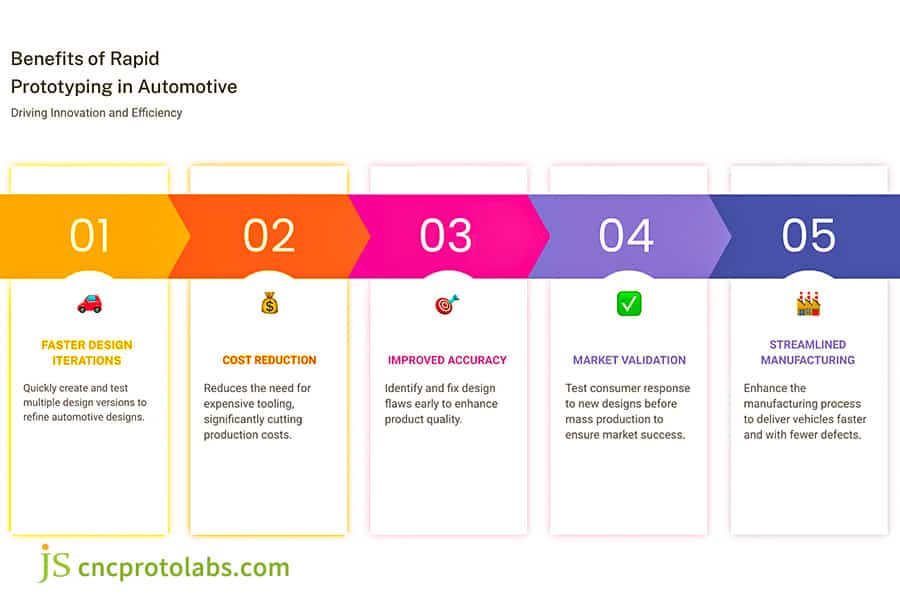 Figure 3: An infographic titled “Benefits of Rapid Prototyping in Automotive” listing five advantages like faster iterations and cost reduction with icons.
When Do You Need a Custom Metal Fabrication Prototype For Automotive Applications?
Custom metal fabrication prototype plays a vital role and cannot be replaced in critical automotive testing. Here are the main application scenarios and their importance.
Recognizing Major Application Scenarios
Custom metal fabrication prototype is an absolute demand in the following key scenarios:
- Turbine intake manifold: it should be able to endure very high temperatures and pressures, plastic prototypes are not capable of offering the conditions of the real world.
- Active rear wing actuation mechanism: it should comply with the high requirements for fatigue strength, test results with metal prototype are considered to be more reliable.
- Customized forged wheel style verification: it is necessary to generate the metallic texture and the structural strength.
The Irreplaceability of Metal Prototypes in Critical Testing
Crash, thermal management, and long term durability testing the use of metal prototypes' physical realism cannot be replaced by plastic or resin prototypes, thus they have accurate data.
Efficient Small Batch Production
Excellent custom metal fabrication prototype process data can be reused for small batch production directly as mold references, thus industrialization risks are lessened.
Looking to develop highly reliable metal functional prototypes? Contact JS Precision, tell us your testing needs, and we'll provide a custom metal fabrication prototype solution and free process design.
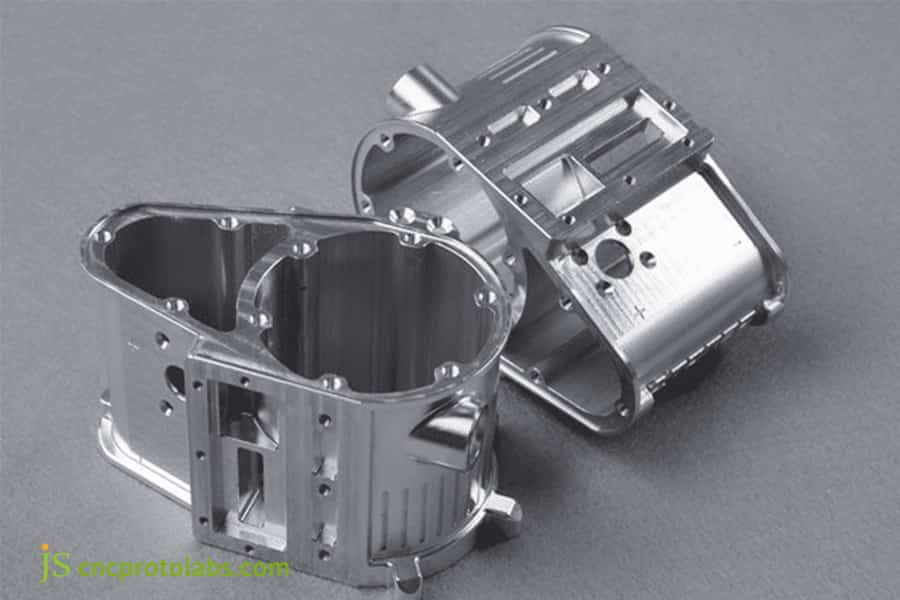 Figure 4: Two shiny, precision-machined metal parts with complex cutouts and holes, placed on a neutral surface for automotive prototyping.
FAQs
Q1: What are the commonly used processes for automotive rapid prototyping?
The main processes are CNC machining, industrial 3D printing, vacuum casting, and sheet metal fabrication which are suitable for prototyping metal functional parts, complex structural parts, small batch exterior parts, and body panels, respectively.
Q2: How to decide between metal prototypes and 3D, printed plastic prototypes?
Metal prototypes are the choice for functional testing, load-bearing, or high-temperature environments, whereas concept-proof-airflow analysis, or lightweight structure development using high-performance engineering plastic prototypes is still an option.
Q3: What automotive prototype materials can you supply?
We work with metal materials like aluminum alloys, stainless steel, and titanium alloys as well as engineering plastics like ABS, nylon, and PEI, thus complying with the material needs of various testing scenarios.
Q4: What is the typical precision level of the prototype parts?
The precision of CNC metal machining can be within ±0.05–0.1mm, and that of industrial, grade 3D printing is ±0.1–0.3mm, depending on the size and geometric complexity of the part.
Q5: How long is the usual delivery lead time for receiving the prototype after supplying the drawings?
We can turn around the first version of simple structural parts within 3-5 working days, while the lead time for complex components is 1-3 weeks usually, based on what process is selected and if the post-processing will be done.
Q6: How do you maintain the confidentiality of prototype data?
A specially strict NDA agreement will be signed between us, and the ISO 27001 information security management system will be implemented so that the customers design drawings and process data will not be leaked throughout the entire process.
Q7: Will you assist me with the prototype to the small batch production (100, 1000 pieces) transition?
We can support you at all times. To guarantee that the small batch parts are consistent with the prototype, we can directly transfer the prototype's process data to small batch CNC machining or soft mold casting.
Q8: Have you dealt with prototypes of automotive fluid systems (such as oil lines and cooling pipes) before?
We have, among many others, developed prototypes for engine oil pans and transmission cooling pipes components, working closely with the automakers, and highly considering the control of sealing surface precision and internal cavity cleanliness.
Summary
The use of rapid prototyping in the automotive sector has undergone a great transformation from being used merely as a media for demonstration of concepts to become the main driver of innovation and the facilitation of customized and flexible manufacturing.
Various technologies such as rapid prototyping automotive and rapid prototype machining are changing the traditional model of automotive parts development.
By selecting JS Precision, which has a wide technical capability, extensive knowledge of the industry, and integrated service abilities, you will be able to realize your ideas at a lower cost and in a shorter time.
Get in touch with us now, send us your part requirements or 3D drawings and our experienced team will get back to you with a professional solution within 24 hours, hence supporting you in putting your ideas into reality.

Disclaimer
The contents of this page are for informational purposes only.JS Precision Services,there are no representations or warranties, express or implied, as to the accuracy, completeness or validity of the information. It should not be inferred that a third-party supplier or manufacturer will provide performance parameters, geometric tolerances, specific design characteristics, material quality and type or workmanship through the JS Precision Network. It's the buyer's responsibility Require parts quotation Identify specific requirements for these sections.Please contact us for more information.
JS Precision Team
JS Precision is an industry-leading company, focus on custom manufacturing solutions. We have over 20 years of experience with over 5,000 customers, and we focus on high precisionCNC machining,Sheet metal manufacturing,3D printing,Injection molding,Metal stamping,and other one-stop manufacturing services.
Our factory is equipped with over 100 state-of-the-art 5-axis machining centers, ISO 9001:2015 certified. We provide fast, efficient and high-quality manufacturing solutions to customers in more than 150 countries around the world. Whether it is small volume production or large-scale customization, we can meet your needs with the fastest delivery within 24 hours. Choose JS Precision this means selection efficiency, quality and professionalism.
To learn more, visit our website:www.cncprotolabs.com
Resource