English



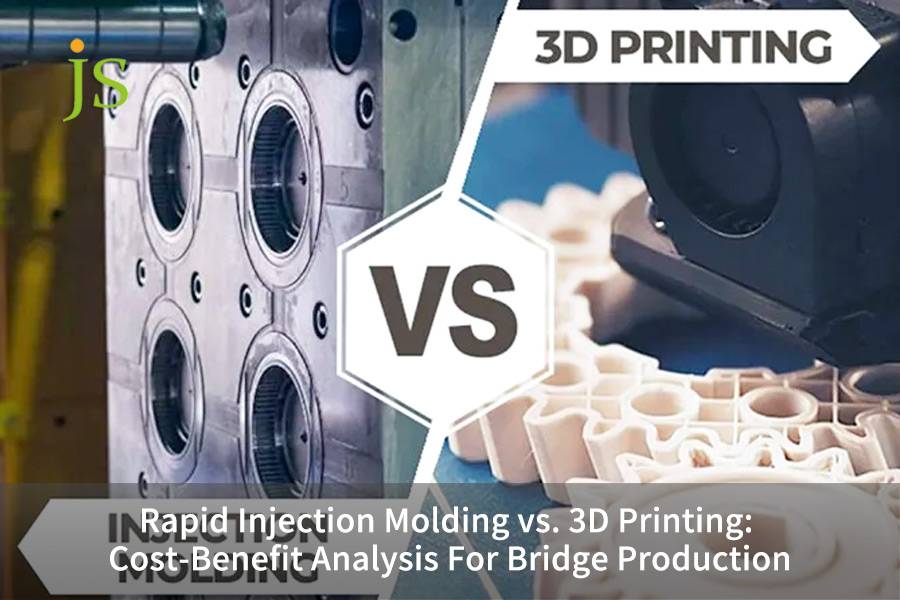

Rapid injection molding services provide a vital link between prototyping and mass production. They are even used in sectors like medical devices, automotive electronics, and high end consumer goods.
Many R&D engineers are confused when they have bridge production of 500 to 5000 units: on the one hand, they can continue to take advantage of the flexibility of 3D printing. On the other hand, they have to do a big investment first with traditional injection molding.
Actually, the biggest problem is that by 3D printing there are no costs for molds, but after a certain break even point, the unit price goes up and the mechanical properties of the material can hardly simulate the mass produced parts.
This article, taking the real data of JS Precision as the basis, analyzes the cost and technological deficiencies of both methods and gives a suitable manufacturing selection solution.
Core Answer Summary
| Core Question | Core Answer | Applicable Scenarios |
| Bridging Production Best Process | Rapid injection molding services provide the best solution to changeover from prototyping to mass production. They beat 3D printing by a wide margin. | Can produce 500-5000 transitional production pieces along with functional test parts. |
| Rapid Injection Molding Cost Benefits | Cost parity with 3D printing for moderately complex parts is 250-400 pieces, thus the mold investment can be cut by more than 60%. | Great for SMEs' small batch production as well as cost sensitive projects. |
| Rapid Injection Molding Major Benefits | Closely mimics mass production materials, production of consistently high quality surfaces, and can easily deal with complicated structures. | Good for bridging production of medical devices, automotive electronics, and high end consumer goods. |
| Ways to Manage Risks | Finalizes mass production setting parameters and double checks designs through small batch injection molding thereby minimizing risks that scaling might introduce. | Good for shifting from prototyping to mass production and manufacturing complicated parts. |
Why JS Precision Is Your Trusted Partner For High-Precision And Fast Injection Molding?
The bridging production sector highly relies on the manufacturing partner's reliability for a project's success or failure. JS Precision has specialized in injection molding services rapidly for the last 15 years and has more than 2000 clients worldwide, out of which 300+ are from the medical device and automotive electronics sectors.
In fact, our operational team has managed a total of 1200+ complicated bridging production projects, with a 99.8% delivery performance on time rate and 98.5% customer satisfaction rate. These results are more than just statistics but demonstrate our capability of addressing clients' challenges effectively.
For instance, one of the automotive electronics companies in Europe was under a time constraint of delivering 3000 sensor housings of high precision within two weeks period. The client first chose to 3D print but their parts were found unsatisfactory when impact resistance tests were done.
JS Precision responded by offering rapid injection molding employing S136 pre-hardened steel quick molds. Mold opening was finished in 8 days and parts delivery was completed 3 days before schedule.
Our parts successfully faced the impact resistance tests required by the automotive industry and the unit costs were lowered by 45% compared to 3D printing. To make sure the traceability and stability of every product batch, we comply strictly with ISO 9001:2025.
Partnering with us means you can forget about erratic quality or delivery postponements. We own more than 50 Haitian precision, injection molding machines and a complete set of Zeiss CMM testing equipment, enabling a one stop service from material selection consultation to 100% dimensional reports thorough documentation.
Even if you require injection molding for low volume production or complex part machining, we can offer you customized cost benefit injection molding solutions.
Want to learn how JS Precision's rapid injection molding services mitigate the risks and reduce costs of bridging production? Download the "Rapid Injection Molding Bridging Production White Paper" to learn core selection techniques and industry test data for free.
Why Is Bridge Production Injection Molding The Strategic Choice For Functional Testing After Prototyping?
Making a connection between injection molding and 3D printing can not only help to imitate the material characteristics of the parts that are mass produced but also eliminate the deviations in test results for 3D printed parts.
Therefore, it is the best strategic option to test the prototypes functionally after manufacturing.
Fundamental Benefits: Performance Contrast of Injection Molding and 3D Printing
The point of bridging the gap between production is that the materials used changes from experimental to mass produced ones (e.g. PEEK, fiber reinforced nylon). Fast injection molding is the hidden weapon to help make this change, as it quite faithfully replicates the material properties of mass produced parts.
Testing Standards: How Injection Molding Guarantees Data Correctness
JS Precision team identified that parts made by 3D printing are major sources of test deviations in terms of heat distortion temperature (HDT) and anisotropic strength.
Adhering to ASTM D648-18 standards, rapid injection molding remains the only method that guarantees 100% actual physical properties, and its molecular chain orientation characteristic is a feature that 3D printing can't even attempt to replace.
Data Support: Intuitive Performance Comparison
The chart underneath compares the performance of the injection molded and 3D printed parts, which were made from the same material (fiber reinforced nylon):
| Performance Metric | Injection Molded Parts | 3D Printed Parts | Difference | Impact on Functional Testing |
| Heat Deflection Temperature (HDT, °C) | 125 | 98 | 27°C Lower | Fails to pass high temperature operational tests |
| Tensile Strength (MPa) | 85 | 62 | 27% Lower | Prone to fracture during load bearing tests |
| Strength Anisotropy | Low (±3%) | High (±15%) | Significant Difference | Test data is not reproducible |
| Elongation at Break (%) | 18 | 10 | 44% Lower | Fails to meet fatigue resistance requirements |
Bridge production injection molding not only aligns the functional test results with the mass production but also helps in completely minimizing the risk of rework due to unchecked data deviations.
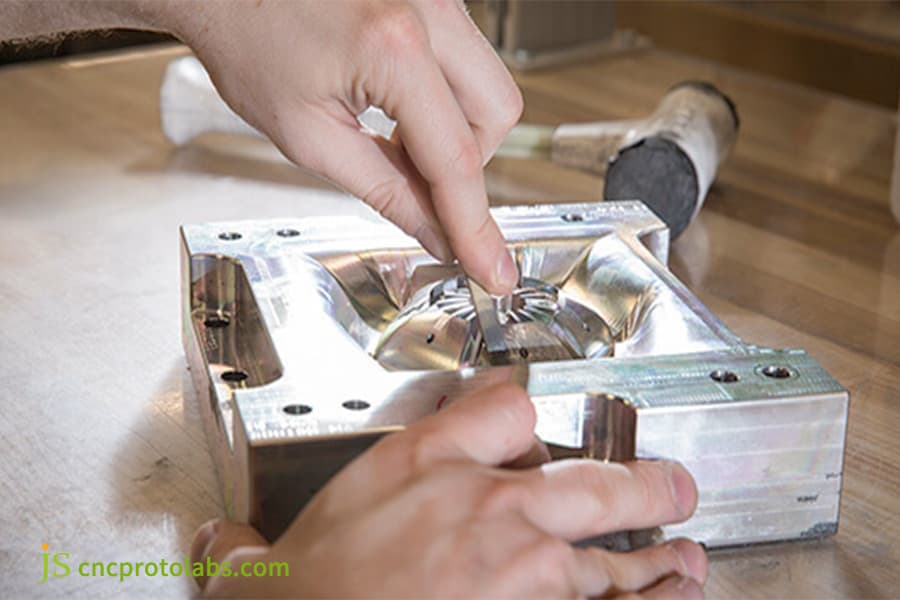
Figure 1: A pair of hands meticulously adjusts a complex, high-gloss metal mold, a key tool for bridge production injection molding, on a workshop bench.
How Can Rapid Injection Molding Services Significantly Reduce Your Initial Tooling Investment For Low Volume Runs?
Rapid injection molding services principally involve rapid molds of aluminum alloy or pre-hardened steel. By implementing standard designs, the cost of mold making can be cut by more than 60%, which really lowers the investment in small batch molds.
Pain Point Analysis: The High Investment Dilemma of Traditional Molds
In the traditional case, the price of single cavity steel mold can be as high as $20,000 to $50,000. No wonder small and medium sized enterprises (SMEs) with small batch projects often consider them too expensive. In fact, rapid injection molding services are the perfect answer to this problem.
Solution: Cost Optimization Logic of Rapid Molds
JS Precision has been working with T6-7075 aluminum alloy or S136 pre-hardened steel rapid molds since they achieve the over 60% reduction in mold making costs and have at the same time been standardizing mold base and insert designs.
Also, molds are produced and shipped within 7-10 days, and the unit price is much lower than industrial grade 3D printing for the batches of more than 300 pieces.
Actually, it is similar to buying semi finished furniture; you don't need to make the entire set from scratch but only the standardized parts, here the standardized parts are the molds, supplements the scheme of saving money and providing quick assembly.
Data Reference: Cost Comparison of Different Molds
The table below shows a cost comparison of different mold materials and cavity numbers for rapid injection molding:
| Mold Material | Cavity Number | Mold Cost (USD) | Delivery Time (days) | Applicable Production Batch (pieces) | Unit Mold Cost (USD/piece, 1000 pieces) |
| T6-7075 Aluminum Alloy | 1 | 1,500-3,000 | 7-8 | 100-5,000 | 1.5-3.0 |
| T6-7075 Aluminum Alloy | 2 | 2,700-5,400 | 8-9 | 500-10,000 | 2.7-5.4 |
| S136 Pre-hardened Steel | 1 | 5,000-8,000 | 9-10 | 1,000-20,000 | 5.0-8.0 |
| S136 Pre-hardened Steel | 4 | 9,000-14,400 | 10-12 | 5,000-50,000 | 9.0-14.4 |
| Traditional Steel Mold | 1 | 20,000-50,000 | 30-45 | 100,000+ | 20.0-50.0 |
Consequently, injection molding benefits can be reaped without excessively burdening the small batch bridge production with high mold costs.
At What Precise Quantity Does The Rapid Injection Molding Cost Become More Competitive Than Industrial 3D Printing?
For parts moderately complex and about 50mm in size, the cost break even point between rapid injection molding and 3D printing is usually in the range of 250-400 pieces.
Break even Analysis: Critical Batch Range
According to practices and experiences of nearly a thousand projects by JS Precision, the cost break even point between the two processes, rapid injection molding and 3D printing, for a 50mm volume part of moderate complexity is around 250-400 pieces.
Cost Logic: The Core Impact of Cycle Time
The main reason is that rapid injection molding can offset the mold costs by greatly reducing the cycle time (only 20 seconds per part, which is way faster than the several hours of 3D printing).
This is also the key advantage of injection molding vs 3D printing in terms of cost competitiveness.When batch sizes get bigger, the unit cost goes down quite sharply, whereas the unit cost of 3D printing stays more or less constant.
It is like choosing a taxi versus a bus journey. Bus is cheaper for short distances, whereas taxi is efficient and comfortable for long distances. When batch sizes are at the level of the equilibrium point, the low cost lead of rapid injection molding will become more and more obvious.
Data Support: Cost Comparison for Different Batch Sizes
The table below compares the costs of rapid injection molding and 3D printing for medium complexity (50mm³) parts:
| Production Batch Size (pieces) | Rapid Injection Molding Cost (USD/piece) | Industrial 3D Printing Cost (USD/piece) | Cost Difference (USD/piece) | Total Rapid Injection Molding Cost (USD) | Total 3D Printing Cost (USD) |
| 100 | 18.5 | 12.0 | -6.5 | 1,850 | 1,200 |
| 250 | 8.2 | 12.0 | 3.8 | 2,050 | 3,000 |
| 400 | 5.8 | 12.0 | 6.2 | 2,320 | 4,800 |
| 1000 | 3.2 | 12.0 | 8.8 | 3,200 | 12,000 |
| 5000 | 1.9 | 12.0 | 10.1 | 9,500 | 60,000 |
These data provide purchasing managers with quantitative decision-making support.
Want to accurately calculate the rapid injection molding cost and 3D printing break even point for your parts? Get a free customized cost benefit analysis report to clearly plan your procurement strategy.
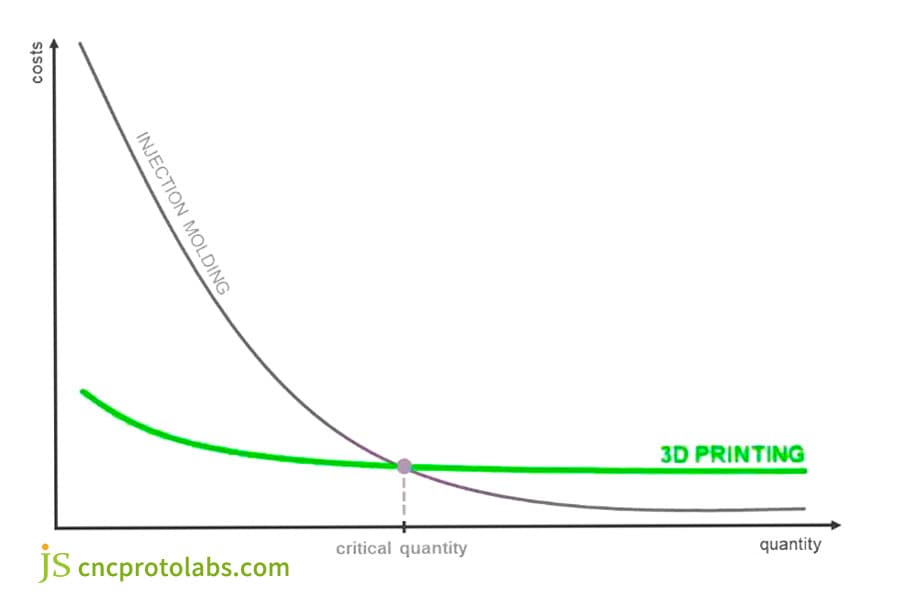
Figure 2: A line graph comparing the costs of injection molding and 3D printing, showing the “critical quantity” where injection molding becomes more cost-effective as production volume increases.
How Do Rapid Injection Molding Services Ensure 100% Surface Finish Consistency Compared To 3D Printing Layers?
Rapid injection molding services use a range of surface treatment processes to remove 3D printing defects, delivering stable part roughness and 100% surface finish consistency.
Pain Point Addressed: Problems With 3D Printing Surfaces
Features such as the staircase effect and texture orientation in 3D printing can detract from the visual appeal and functionality of parts and may even lead to higher fluid resistance, which is a concern for precision parts requiring a high level of aesthetics and/or fluid dynamics.
Solution: Surface Accuracy in Injection Molding
JS Precision is capable of providing you with several choices in terms of injection molding services, ranging from SPI-A2 mirror polishing to MT-11010 texturing.
At the transition phase, injection molding process cuts 3D printing dimensional deviation risk resulting from post-3D grinding, satisfying that the surface roughness (Ra) remains consistent throughout 0.1m from the 1st to the 5,000th piece.
Customer Value: The Core Guarantee of Consistency
The implication of this is that parts' appearance and performance can be highly similar and any worries about product quality being affected by inter individual differences can be eliminated.
Can Rapid Tooling For Bridge Production Handle Complex Geometries With The Same Agility As Additive Manufacturing?
JS Precision, equipped with multi directional sliders, automatic core pulling, and DFM (Design for Manufacturing) optimization technology, turns rapid tooling into a method that can create geometrically complex parts as if using additive manufacturing.
Industry Misconceptions: Molding by injection is not possible for complicated parts?
Actually, we will reveal the working mechanism: Through DFM optimization, we can break down or modify complex parts that initially needed 3D printing into parts that can be produced using rapid tooling for bridge production.
In fact, this can be compared to making a floor plan before renovation and changing the furniture arrangement and the movement of people in order to prevent waste of time and money on the subsequent rework.
Technical Analysis: DFM Optimization and Process Breakthrough
The basic principles which we will describe require DFM optimization to transform 3D printed structures into bridge production tools through structural optimization. The optimization process includes two different paths which we can follow:
1. The draft angle must increase by 3-5 degrees.
The part remains operational after this small change because it enables simple mold release which stops tearing and deformation problems while making mold production easier and cheaper to accomplish.
2. The design of the reinforcing ribs needs precise adjustment.
The distribution and size of reinforcing ribs must be optimized to protect structural strength at weak points which appear in complex cavity areas while preventing defects from achieving proper injection filling and shrinkage cavities that result from complicated structural designs.
Customer Value: Balancing Efficiency and Flexibility
The delivery cycle reductions of more than 30% which these optimizations enable maintain full part functionality while producing rapid injection molding results that let manufacturers create complex parts through efficient bridging production techniques.
Worried about complex parts not being compatible with rapid tooling? Upload your 3D drawings, and our engineers will provide free DFM optimization suggestions to help achieve efficient rapid injection molding implementation.
Case Study: How JS Precision Helped a Medical Device Startup Save 40% In Bridge Production Costs For Surgical Handles?
Medical device bridging production needs to balance three factors which are rapid production methods and budget limitations and medical requirements. JS Precision delivered an exact solution which solved all production challenges faced by a high end medical startup during their surgical handle bridging process.
Client Dilemma
They needed to deliver 1200 high strength, sterile-resistant composite surgical handpieces within 3 weeks. The combination of industrial grade SLS 3D printing A cost of $28 per item with its surface porosity failed to meet medical standards (ISO 13485:2016) requirements.
The client required immediate delivery of surgical handpieces because clinical trials depended on their arrival. The client experienced extreme anxiety because the surgical handpieces delivery would determine when clinical trials could continue.
JS Precision Solution
JS Precision engineered team developed a solution after they gathered information about client requirements.
- The company used NAK80 pre-hardened steel rapid prototyping because it provided both part strength and surface quality while reducing mold making time.
- The team completed a Design for Manufacturing (DFM) review within 48 hours, optimizing the gate location to prevent warping of the fiber reinforced nylon material used by the client, and designing a 2-cavity mold to improve production efficiency.
- We maintained precise control over the injection molding process by setting injection pressure at 100MPa and mold temperature at 60°C to achieve consistent results across all parts.
Results and Value
The project reached completion 12 days after start, which marked 9 days before the client deadline; project costs decreased by 40% through 3D printing, the components passed high pressure steam sterilization test (134°C, 30 minutes), which supported the client's clinical trials.
Facing bridge production injection molding challenges in medical device?Contact our engineers to customize a dedicated rapid injection molding solution, locking in delivery cycles and costs in advance.
How Does Injection Molding For Low Volume Production Mitigate The Risks Of Scaling From Prototype To Mass Manufacture?
Using injection molding for low volume production at an early stage also ensures that mass production processes are locked in and design feasibility verified, quite effectively reducing various scaling risks from prototype to mass production.
Key Risks: Typical Hidden Pitfalls from Prototype to Mass Production
At the heart of the production bridging process lies risk management. Through small batch injection molding, it is possible to identify certain risks of mass production that are not visible by 3D printing.
For example, shrinkage, and weld lines (elongated mark resulting from limited flow of the molten plastic to the mold cavity during injection), therefore able to prepare for mass production.
Risk Control Measures: Risk Avoidance in Small Batch Injection Molding
JS Precision controls risks with a two fold strategy by using injection molding for low volume production:
- They lock in mass production process parameters ahead so that subsequent mass production can directly use them.
- They also get part designs verified ahead to identify and fix any production unfriendly issues resulting finally in "design equals mass production."
1. Locking in Mass Production Process Parameters in Advance.
When we carry out small batch bridging production, the first thing we do is to reproduce mass production injection conditions and find out the most suitable process parameters.
For instance, setting the injection pressure at 80-120MPa and the mold temperature at 60 degrees Celsius. In this way, such parameters can be used directly for mass production without causing any quality problems due to a change of parameters during mass production.
2. Verifying the Mass Production Feasibility of Part Designs in Advance.
We not only observe the molding effect of the parts during the bridging production stage but also identify and fix the design defects that prevent mass production.
For example, repairing areas with uneven wall thickness and changing the gate location could be done without any difficulties. So, when an order size is increased fivefold (from 5,000 to 50,000), there is no need to modify the parts again, and real "design-to-production" can be realized.
Customer Value: Seamless Transition to Mass Production
Such a management style will help you to avoid rework, time loss, and cost increase in mass production, thereby greatly raising the likelihood of project success.
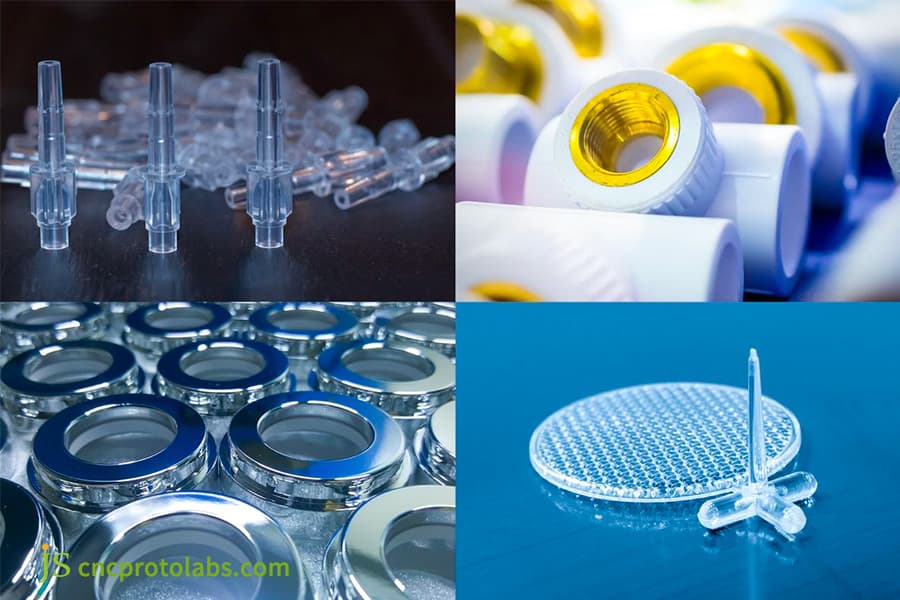
Figure 3: A montage of close-ups showing various precision injection molded parts, including tubes, rings, and grid structures, in different materials and colors.
Why Choose JS Precision As Your Rapid Injection Molding Services Manufacturer For High Precision Industrial Parts?
JS Precision was selected for its comprehensive services in one place, rigorous quality control programs, and tailored solutions which exactly correspond to your requirements for high precision rapid injection molding services.
Supply Chain Requirements: Essential Features for B2B Supply Chain
Capability of the supply chain is one of the most critical requirements in B2B supply chain. Technology partner JS Precision with over 50 precision injection molding machines and a full set of testing equipment are able to provide one stop service from material consultation to dimensional reports.
Main Benefits: Technology and Service Dual Guarantees
We can ensure the traceability of the products through the ISO 9001:2025 system, perform very rigorous quality control at each stage, and provide the injection molding solutions that are cost effective and tailored to the project requirements, working on the speed/cost trade off.
Cooperation Value: A one stop and worry free experience
Our extensive experience, along with state-of-the-art technology, will be your trusted supports in case you are looking for high precision injection molding or small batch production.
Need a high precision rapid injection molding manufacturer? Fill out the consultation form to get a free quote and a one-stop service solution, seamlessly connecting prototyping to mass production.
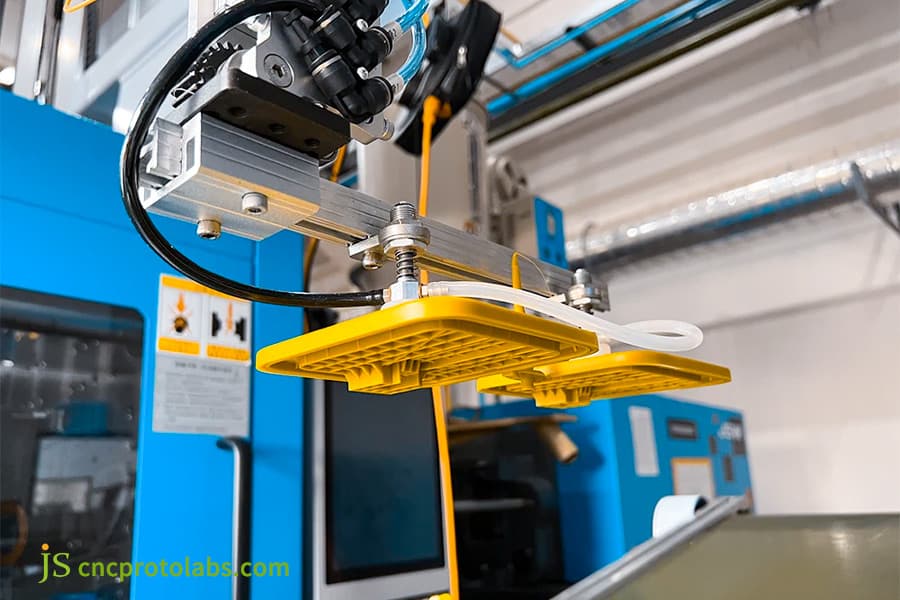
Figure 4: A close-up of a yellow suction-cup robotic arm performing automated part removal in a high-precision industrial manufacturing environment.
FAQs
Q: What is the standard turnaround time for rapid injection molding at JS Precision?
We have streamlined our work to be able to give you high quality T1 samples in 7-12 calendar days. Also, for simple parts, the lead time can be cut down to 5 days only which would be able to fulfill your bridge production needs.
Q: Is it possible for me to utilize production-grade resins such as PEEK or PPS in bridge production?
Absolutely, our injection molding service can handle not only more than 500 kinds of engineering-grade thermoplastics, but also high performance resins like PEEK and PPS to perfectly meet your material requirements for the volume production.
Q: How many pieces can an aluminum rapid mold typically produce?
Utilizing 7075 aluminum alloy, the molds can produce without quality loss around 5,000 to 10,000 normal resin parts. Hence, they are perfectly suitable for small batch bridge production in addition to providing excellent cost-effectiveness.
Q: Will JS Precision give me DFM feedback prior to placing rapid injection molding order?
We certainly will provide you with a free DFM report highlighting the critical features of your part such as draft angles and wall thickness. Also, we will share the complete report with you within 24 hours to further help you improve your design.
Q: What is the minimum order quantity (MOQ) for low-volume injection molding?
We essentially don't have a minimum order quantity. In fact, we can handle bridge production runs from around 100 to even above 10,000 parts and still maintain the flexibility to satisfy a wide spectrum of small batch requirements.
Q: How do you ensure the dimensional tolerance of bridge production parts?
Generally, the tolerance is 0.05 mm, however, for critical dimensions to achieve 0.02 mm, we use precision fine-tuning to guarantee that the parts are accurate enough to meet the specifications.
Q: Can the mold be amended after we receive the first T1 sample?
Sure, our rapid molds have flexible designs that can accommodate even minor changes such as reducing hole diameters or adding strengthening ribs, ultimately leading to less time and cost as well as greater flexibility for the project.
Q: How does the price of rapid injection molding stack up against traditional molding?
Due to the use of modular inserts and rapid machining technologies, our first mold expenses are 40% to 70% cheaper than traditional multi-cavity steel molds, which turns this into a very cost-effective option for small batch production.
Summary
When producing a bridge, the decision to use rapid injection molding or 3D printing involves a thorough analysis of cost, material quality, and market timing. Rapid injection molding suits best for production runs of 500 units or more, enabling a seamless flow from prototype development to full-scale manufacturing.
If you want to find a cheap manufacturing option for your small batch project, don't be held back by mold cost or limited 3D printing materials.
Call JS Precision's senior engineering team, send us your 3D files (STEP/IGS/X_T format), and get a free, fast, and accurate rapid injection molding quotation along with a detailed DFM review.
Be it 100 functional test samples or 5,000 top quality market parts, JS Precision will offer you the lowest prices with highly skilled technical support.

Disclaimer
The contents of this page are for informational purposes only.JS Precision Services,there are no representations or warranties, express or implied, as to the accuracy, completeness or validity of the information. It should not be inferred that a third-party supplier or manufacturer will provide performance parameters, geometric tolerances, specific design characteristics, material quality and type or workmanship through the JS Precision Network. It's the buyer's responsibility Require parts quotation Identify specific requirements for these sections.Please contact us for more information.
JS Precision Team
JS Precision is an industry-leading company, focus on custom manufacturing solutions. We have over 20 years of experience with over 5,000 customers, and we focus on high precisionCNC machining,Sheet metal manufacturing,3D printing,Injection molding,Metal stamping,and other one-stop manufacturing services.
Our factory is equipped with over 100 state-of-the-art 5-axis machining centers, ISO 9001:2015 certified. We provide fast, efficient and high-quality manufacturing solutions to customers in more than 150 countries around the world. Whether it is small volume production or large-scale customization, we can meet your needs with the fastest delivery within 24 hours. Choose JS Precision this means selection efficiency, quality and professionalism.
To learn more, visit our website:www.cncprotolabs.com
Resource