English



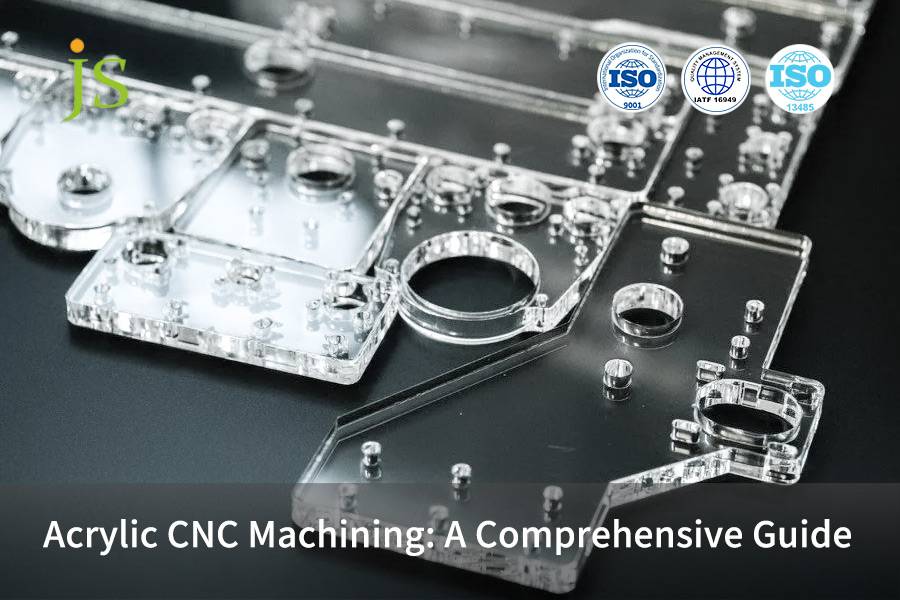

Acrylic CNC machining is a very accurate production method that fully utilizes the beneficial properties of polymethyl methacrylate (PMMA, acrylic for short).
Acrylic has three fundamental properties: light transmittance is very high, weather resistance is excellent, and it is easy to machine. Consequently, it has been adopted in high end signage, medical equipment, optical components, and consumer electronics.
CNC machining is the method of choice if one needs to obtain high precision, complicated shapes, and excellent surface finish in acrylic workpieces.
As your ultimate guide, this article will delve into the entire process from design optimization to precision manufacturing, helping you avoid processing pitfalls and create perfect customized acrylic components.
Key Answer Summary
| Your Core Concerns | JS Precision's Solutions | Core Value Brought to Project |
| How to tackle machining problems such as acrylic's fusibility and cracking? | By adhering to a strict temperature control, leveraging our extensive experience, using specialized tools, optimizing process parameters, and thoroughly controlling temperature, we deliver clean cutting. | Your perfect, stress-free precision acrylic machining parts. Scrap rates are drastically reduced. |
| How to get extremely complex designs that are still precise? | Assuming the Design for CNC Machining (DFM) standards are followed, DFM analysis is offered, multi axis equipment is employed for one-time molding. | Turning complex ideas into feasible ones is the key to accurate custom acrylic parts perfectly fitting and assembling. |
| How to select a trustworthy machining partner? | As one of professional CNC machining center manufacturers, we have the luxury of offering from start to finish control through to offering transparent communication. | One-stop shopping with you saving the cost and time of trial and error and arriving at high quality parts very fast. |
Key Takeaways
- The main difficulty when doing acrylic CNC machining is to keep thermal effects (melting) and mechanical stress (cracking) under control. Using dedicated single, flute helical end mills and optimized cooling solutions is a must.
- It is very important to design for CNC machining: following design guidelines such as internal angle radius 1mm and wall thickness 2mm can not only greatly increase the success rate but also reduce the cost and delivery time.
- When dealing with parts that have complex curved surfaces or multi angle features, choosing 5 axis CNC machining center manufacturers is the optimal solution to ensure quality and efficiency.
- The final surface optical effect (e.g. crystal, like transparency) depends very much on the finishing parameters and post-processing techniques (polishing, flame treatment), so the requirements have to be clearly stated to the manufacturer.
- A choice of CNC machining center manufacturers such as JS Precision which has a wealth of experience in doing acrylic projects is a kind of assurance one can trust the most for the successful completion of the project.
Acrylic CNC Machining: The JS Precision Advantage
JS Precision has been a major player in the acrylic CNC machining industry for more than a decade. Over 5, 000 custom acrylic parts projects have been accommodated.
With several high end CNC machining centers, it can work with a wide range of acrylic materials such as casting, extrusion, and modification. Cutting parameters are tailored to each material, thus a number of solutions are available to the problems of the machining processes, such as weld bonding and cracking.
By leveraging our professional CNC equipment with high precision spindles and linear guides, and over a thousand process experiments, we have brought the scrap rate of precision acrylic machining parts down to 1.5%.
For complex curved surface parts, we use a top-of-the-line 5 axis CNC machining center with an intelligent control system to achieve one time molding. Considering intelligent toolpath planning, this delivery time is 30% less than the traditional multi clamp method.
According to ISO 9001:2015, the core of acrylic machining is the specialized tooling. We have assembled a dedicated tool library that stocks a wide range of specialized tools such as single, flute spiral end mills and diamond, coated polishing cutters.
Professional edge treatment is performed on all tools to make them suitable for machining different grades of acrylic. We also perform equipment calibration on a regular basis to maintain the accuracy and monitor the cutting stability closely.
In medical optics, we produce fluid chamber parts with reliable dimension accuracy 0.025mm and optical, grade transparency, which perfectly meet the industry's high end application requirements, only by using medical grade CNC machining equipment dedicated to our cleanroom, as well as 2D imaging systems and coordinate measuring machines for high, precision testing.
Want to verify our acrylic CNC machining capabilities? Contact JS Precision engineers now. Within 48 hours, you can receive free samples of optical-grade acrylic parts and customized process solutions to experience our machining precision firsthand.
What Is Acrylic CNC Machining? What Unique Challenges Does It Face?
Gaining a deep insight into what acrylic CNC machining truly is and its main issues is not only a must for making top, notch custom parts but is also the very essence of successfully introducing precision acrylic machining and CNC machining technologies.
Acrylic's Nature Advantages and Its Processing Worth
Acrylic has a light transmittance of 92%, which is the same level as optical glass, its impact strength is 16X that of normal glass and it has great weather resistance so it wont turn yellow even if used outdoor.
Compared to injection molding processes, acrylic CNC machining is irreplaceable in the small batch production and rapid iteration of custom acrylic parts. It makes production without the use of expensive molds possible, thus even complicated structures, such as microchannels and aspherical surfaces which are difficult to be made by injection molding, can be produced.
Three Overarching Challenge and Expert Answers
Challenge 1: Melting Adhesion and Burrs
Acrylic's melting point is approximately 160℃, which is why machining chips can easily stick to the surface of the workpiece.
A sharp and single, edged spiral end mill with large chip flutes may be utilized while using cold air or mist cooling instead of water cooling, along with a high spindle speed of 15000-20000 RPM and a medium feed rate of 500-1500 mm/min.
Challenge 2: Surface Scratches and Stress Cracking
Acrylic is a pretty soft material and if the clamps dont apply pressure evenly or the tools suddenly stop, this may lead to stress concentration.
One may apply flexible fixtures to distribute the force of the clamp or custom tooling and programming to stabilize the continuous feed of the tool. Parts are stress annealed after machining.
Challenge 3:Producing Optical, Grade Transparent Surfaces
Light is scattered by toolpath marks and micro-scratches, which deteriorate the optical performance. Roughing, semi-finishing, and finishing are the three stages of the procedure. The finishing depth of cut is monitored at 0.1 mm. Then the product transparency is increased by diamond polishing or flame polishing.
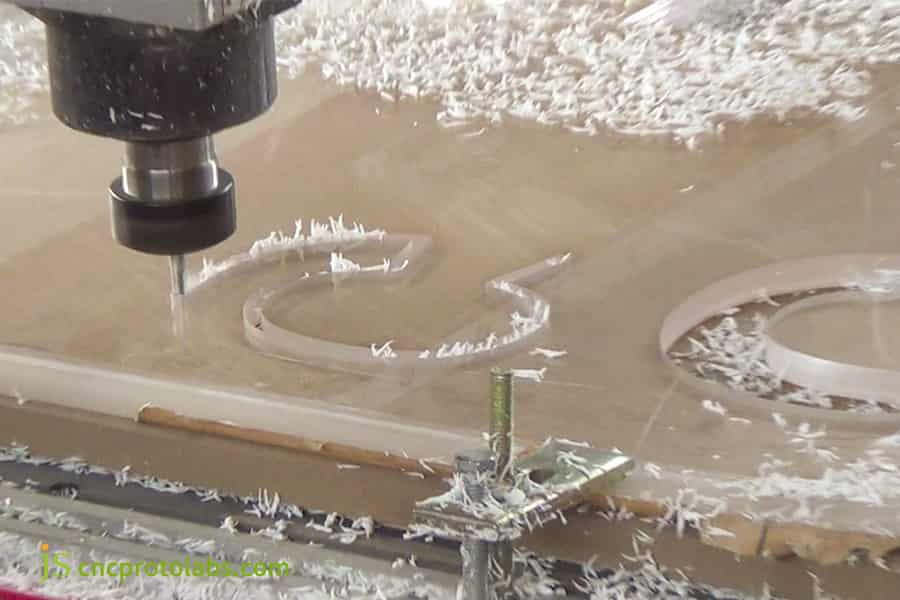 Figure 1: A CNC milling tool cutting into an acrylic sheet, generating fine white chips, demonstrating the precision of the machining process.
How To Optimize Customized Acrylic Parts Through The Principles Of Design For CNC Machining?
A well thought-out Design for CNC Machining Plan can greatly ease the machining of custom acrylic parts and lower the costs, but it is also vital for the projects to have a higher success rate.
Key DFM Guidelines: How to Think in Design to Minimize Risks?
1. Internal Corner Radius: All corners should be rounded. It is better if they are at least equal to the tool radius (usually ≥1mm) to avoid both the concentration of stress and damage to the tool caused by sharp corners.
2. Minimum Wall Thickness: The total wall thickness is better to be ≥2mm including the thinner areas ≥1.5mm, as the thicker walls will reduce the chance of vibration, induced deformation during machining or cracking during later use.
3. Text and Engraving: The depth of engraved text is 0.3mm, and the width of the line is 0.5mm. Rounded fonts are used for clarity and better tool life.
4. Deep Cavity Machining: If a cavity's depth is more than 5 times its width, then it will be necessary to do the machining in layers with the extended tool holders, the cost and time will be thus increased. The design phase should be used to make this assessment.
Efficient Collaboration: Clear Document Preparation and Requirements
Customers should provide a 3D model in STEP format and 2D drawings specifying the key dimensions and tolerances, especially the surfaces to be optically polished and clamping areas allowed, to avoid rework due to a lack of clarity.
What Precision Can Precision Acrylic Machining Achieve?
The precision of precision acrylic machining directly determines the performance of the parts, in accordance with the ISO 286-1:2010 standard. Professional CNC machining center manufacturers can achieve higher precision through multi-dimensional control.
Major Elements Influencing Precision
1. Equipment and Stability: CNC machine tools of high rigidity and low vibration are a fundamental requirement. CNC machining center manufacturers, in order to ensure the stable movement of the tool, equip their machines with high precision spindles and linear guides.
2. Temperature Control: The thermal expansion coefficient of acrylic is near 7×10^-5 /°C. Processing heat as well as changes in the ambient temperature cause disturbances in the dimensional accuracy, therefore, it is necessary to have a constant, temperature workshop at 22°C.
3. Process Planning: A good sequence of operations, new tools, and a scientific toolpath are the three major factors that ensure the dimensional stability.
Typical Achievable Precision Range
Precision Acrylic Machining Accuracy Grade Comparison Table:
| Precision Grade | Applicable Scenarios | Dimensional Tolerance | Geometric Tolerance (Flatness/Parallelism) | Surface Roughness Ra |
| Standard Grade | Ordinary Signs, Display Racks | ±0.1mm | ≤0.15mm/100mm | ≤0.8μm |
| Precision Grade | Medical Equipment Components | ±0.025mm | ≤0.1mm/100mm | ≤0.2μm |
| Optical Grade | Lenses, Light Guides | ±0.01mm | ≤0.05mm/100mm | ≤0.01μm |
Need optical-grade precision acrylic machining accuracy? Contact JS Precision. We will introduce you to temperature-controlled workshops and 2D imaging equipment to ensure parts meet accuracy standards.
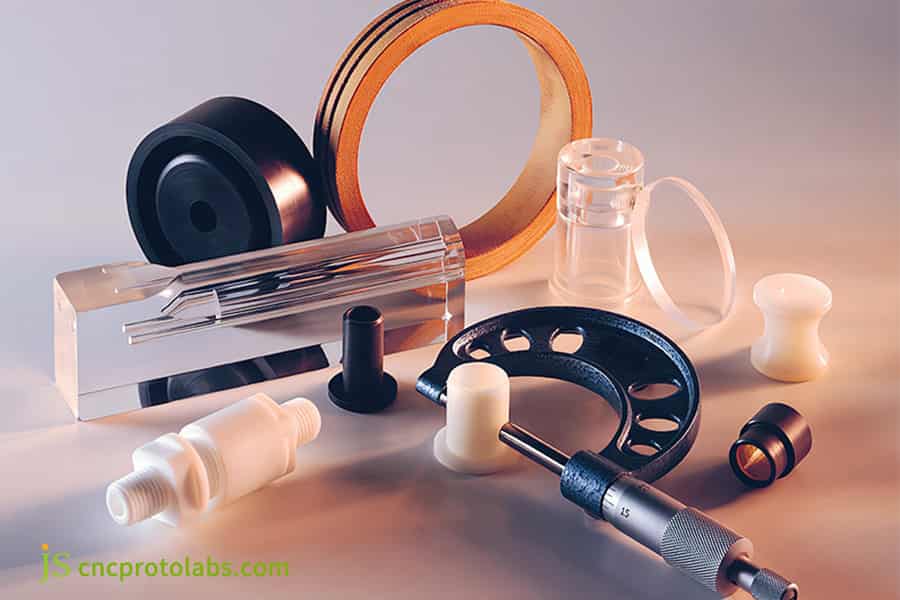 Figure 2: Various clear machined acrylic parts, including a cylinder, placed next to a micrometer showing a precise measurement on a light surface.
Why Is It Crucial To Choose Professional CNC Machining Center Manufacturers?
Successful acrylic CNC machining projects are very much a matter of having partners in processing who are reliable. There is a world of difference between professional CNC machining center manufacturers and common general workshops.
Differences Between Specialized Manufacturers and General, Purpose Workshops
- Process Knowledge Base: Specialized manufacturers have several databases covering different types of acrylic (casting, extrusion), and a well developed collection of solutions to problems.
- Dedicated Equipment and Environment: Equipped with acrylic, specificcooling systems, low dust workshops, and high precision measuring equipment such as 2D imaging systems to prevent parts from being scratched.
- Quality Control Process: Making a family of quality control measures cooperatingtogether from the inspection of raw materials (internal stress checking and scratch inspection) through the inspection during the process and the final full inspection.
Key Points for Evaluating Potential Suppliers
- Look through various case studies of the supplier's acrylic machining, payingespecial attention to the surface quality of the transparent and complex parts, and ask for CNC machining pictures.
- Ask the supplier about the specific methods they use to tackle the core issuesof weld bonding and cracking, and find out whether they can offer DFM feedback.
Looking for reliable CNC machining center manufacturers to partner with? JS Precision offers a complete collection of acrylic machining case studies and CNC machining pictures, and can also arrange on-site workshop visits, giving you peace of mind when collaborating.
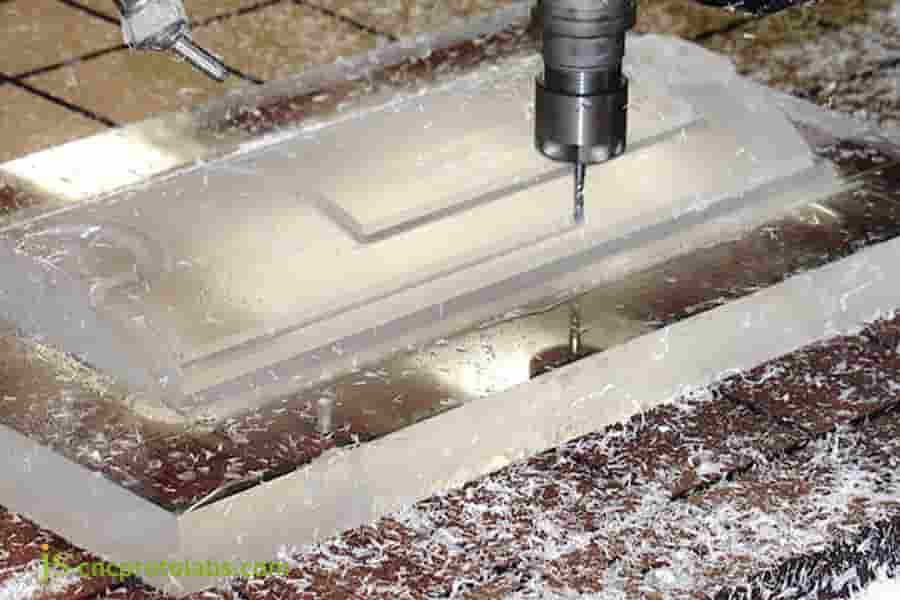 Figure 3: Close-up of a CNC drill bit cutting into beige acrylic, creating white plastic chips on a checkered work surface.
When Should We Consider Using The 5 Axis CNC Machining Center Manufacturers Service?
For custom acrylic parts with complex structures, the service of 5 axis CNC machining center manufacturers can solve many pain points of traditional 3-axis machining.
Main Features of 5 Axis Technology
- Single pass machining of complex geometries: One of the biggest advantages is to make parts with undercuts, complex curved surfaces, and slanted holes, without any errors caused by multiple clamping operations and fixture interference.
- Better surface quality: By changing the angle of the tool, the cutter is always in the best position to touch the work piece and thus a more even and smooth surface is obtained.
- Higher precision and productivity: Less time spent on the change of clamps, less requirement of special fixtures, time is saved in production, and overall parts' precision is improved.
Typical Application Cases
These include integrated LED lampshades with freeform surfaces, medical device parts with angular interfaces, complex architectural scale models, and acrylic panels with 3D textures.
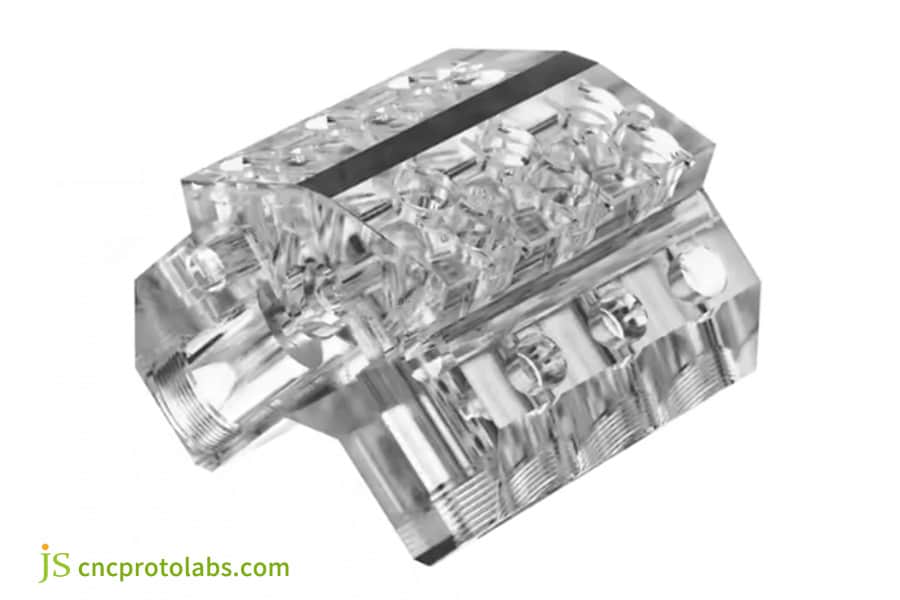 Figure 4: A single transparent acrylic part with intricate internal channels and precisely drilled holes, displayed on a white background to highlight its complex structure.
What Are The Popular Industry Applications For Custom Acrylic Parts?
Custom acrylic components are widely used across various industries because of their excellent performance. Also, precision acrylic machining is capable of meeting the upscale demands of different sectors.
Medical and Life Sciences
Medical industry requirements such as fluid chambers, observation windows, and surgical guides involve a condition of no microcracks, high transparency, and resistance to gamma-ray sterilization.
JS Precision's expertise lies in cleanroom machining, offering a biocompatibility certificate, and fabricating microchannel structures with tolerances of 0.05mm.
Optics, Lighting, and Displays
The industry demands include components such as light guide plates, lenses, and optical testing brackets, where the core is the control of light transmission and refraction, thus demanding very low haze.
JS Precision's contribution is the use of 5 axis CNC machining for aspherical lens molds, achieving an ultra smooth surface with Ra<0.01m by diamond polishing.
High End Retail and Consumer Electronics
Industry requirements such as luxury display racks, electronic housings, and interactive panels are aimed at having crystal, like edges and seamless joining.
JS Precision's contribution is the provision of perfect matching between components through precision machining and the supply of personalized post processing, e.g., mechanical polishing and UV coating.
Different industries have significantly different requirements for the machining precision, material specifications, and post-processing of custom acrylic parts.
Below is a table of core machining parameters for each industry, which can provide a precise reference for project selection.
| Application Industries | Recommended Material Types | Core Precision Requirements | Minimum Wall Thickness Requirements | Common Post-Processing Methods | Single Processing Batch Range |
| Medical & Life Sciences | Medical Grade Cast PMMA | ±0.025-±0.05mm | ≥1.0mm | Diamond Polishing + Aseptic Cleaning | 10-50 pieces |
| Optics, Lighting & Displays | Optical Grade PMMA (Transmittance ≥93%) | ±0.01-±0.025mm | ≥0.8mm | Flame Polishing + Anti-Reflective Coating | 50-200 pieces |
| High-End Retail | High-Gloss Cast PMMA | ±0.05-±0.1mm | ≥1.5mm | Mechanical Polishing + UV Anti-Scratch Coating | 30-100 pieces |
| Consumer Electronics | Impact-Resistant PMMA Alloy | ±0.03-±0.06mm | ≥1.2mm | Matte Polishing + Anti-Fingerprint Treatment | 100-500 pieces |
| Architectural Models | Ordinary Extruded PMMA | ±0.1-±0.15mm | ≥2.0mm | Simple Deburring + Cutting & Chamfering | 20-80 pieces |
Need custom acrylic parts for your industry? Tell JS Precision your application scenario, and we will recommend suitable materials and precision acrylic machining processes to enhance product competitiveness.
What Is The Complete Custom Acrylic Parts Manufacturing Process From Design To Delivery?
The manufacturing process of custom acrylic parts is highly dependent on each other. JS Precision keeps quality at every step of the way through process standardization, and this is the main factor behind the successful implementation of Design for CNC Machining and the smooth running of the CNC machining center.
Step-By-Step Workflow
- Discussions & Pricing: The customer submits a design plan, and JS Precision goes over the practicality, materials, and processes and gives a fair quotation within 24 hours.
- DFM adjustment and approval: The engineers provide the customer with a detailed Design for CNC Machining suggestion report and get the client's confirmation of the final design.
- Programming and Preparation: CAM engineers design effective toolpaths and prepare specialized tools and stress, relieved acrylic sheets.
- Precision Machining and Process Inspection: A high end CNC machining center working, involves the machining, with on machine measurements being taken after key processes.
- Post-processing and Final Inspection: Deburring and polishing are performed, and full, dimensional inspection is conducted in the measurement room. CNC machining pictures are provided as progress updates.
- Scratch-resistant Packaging and Shipment: Parts are protected by a protective film and single compartment packaging before delivery.
Working Collaboratively with JS Precision Involving manufacturers at the product design stage, keeping communication channels open, and making use of their engineering skills can realize the best compromise between cost, quality, and time of delivery.
Ready to start a custom acrylic parts project? Contact JS Precision now for a one-stop service from design to delivery, and get free DFM analysis and progress visualization services.
FAQs
Q1: What are the differences between acrylic CNC machining and laser cutting?
Acrylic CNC machining can be used for 3D modeling, drilling and tapping, and offers higher edge quality and the option of polishing the edges to transparency, laser cutting is laser cutting mainly 2D contour lines, with flame-polished edges, but its precision and perpendicularity are way less than CNC machining.
Q2: How to solve the problem of edge whitening or haziness when machining acrylic?
Our sharp, single-edged cutting tools, specially designed and made, are used with air cooling. At the finishing stage, we take very shallow depths of cut and use high rotation speeds. Whitening edges are recoverable by flame polishing or mechanical polishing to transparency.
Q3: Can it achieve a completely transparent effect similar to glass?
Absolutely. By fine-tuning acrylic machining parameters, along with diamond polishing or flame polishing, acrylic parts can be made crystal clear, like glass, thus fulfilling optical requirements.
Q4: What is the smallest hole or detail that can be machined?
JS Precision employs micro-milling cutters that can accurately and reliably machine holes dia 0.5mm and above. As for very thin fonts or patterns, a width of no less than 0.3mm is recommended for both clarity and tool life.
Q5: What is the maximum machining size for acrylic parts?
The size of the machining depends on the CNC Machining Center's travel. JS Precision's standard CNC machines can machine 1200x600mm sheets. Larger dimensions can be obtained by splicing or using custom, made large, travel equipment.
Q6: Can you process colored acrylic?
Absolutely possible. We offer various colors of cast and extruded acrylic sheets, but dark materials are more prone to heat absorption during processing, so it is necessary to adjust the cutting parameters of acrylic CNC machining to avoid melting and sticking.
Q7: What is the normal lead time?
Simple structured custom acrylic parts can be delivered within 3-5 working days. For parts with complex designs, high-precision requirements, or special post-processing needs, the delivery time is 7-15 working days. Special requirements can be negotiated for urgent delivery.
Q8: Is it possible to produce acrylic and metal parts in the same order?
Sure. JS Precision is a one-stop supplier that allows you to place one order for acrylic parts and metals such as aluminum and stainless steel, thus, simplifying your supply chain and reducing your acquisition cost.
Summary
Acrylic CNC machining is more than just cutting, it is a method that harmonizes the characteristics of the material with precision engineering. If you want to make flawless custom acrylic parts, the secret lies in knowing the properties of acrylic, following the "design for CNC machining" rule, and finding a skilled partner such as JS Precision who has the right know how and the latest equipment.
JS Precision is not only one of CNC machining center manufacturers but also a product development engineering consultant. They keep their quality commitments with 0.025mm precision and transparent parts.
Get your project off the ground: Upload your 3D design files and JS Precision will offer you a full package solution including DFM review and a detailed quote within 24 hours, thus they will make sure that your acrylic concepts are accurately turned into top, notch products.

Disclaimer
The contents of this page are for informational purposes only.JS Precision Services,there are no representations or warranties, express or implied, as to the accuracy, completeness or validity of the information. It should not be inferred that a third-party supplier or manufacturer will provide performance parameters, geometric tolerances, specific design characteristics, material quality and type or workmanship through the JS Precision Network. It's the buyer's responsibility Require parts quotation Identify specific requirements for these sections.Please contact us for more information.
JS Precision Team
JS Precision is an industry-leading company, focus on custom manufacturing solutions. We have over 20 years of experience with over 5,000 customers, and we focus on high precisionCNC machining,Sheet metal manufacturing,3D printing,Injection molding,Metal stamping,and other one-stop manufacturing services.
Our factory is equipped with over 100 state-of-the-art 5-axis machining centers, ISO 9001:2015 certified. We provide fast, efficient and high-quality manufacturing solutions to customers in more than 150 countries around the world. Whether it is small volume production or large-scale customization, we can meet your needs with the fastest delivery within 24 hours. Choose JS Precision this means selection efficiency, quality and professionalism.
To learn more, visit our website:www.cncprotolabs.com
Resource