English



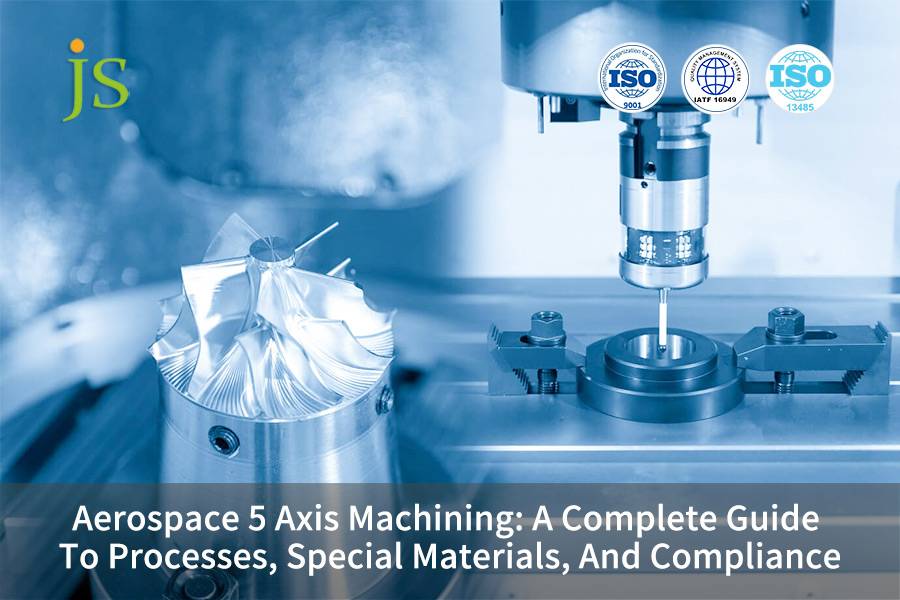

Aerospace 5 axis machining is an essential tool to get around technological bottlenecks in the aerospace manufacturing industry. The problems currently faced by the aerospace manufacturing industry are significant:
The geometric complexity of parts keeps on increasing, a large portion of the materials used such as titanium alloys and Inconel 718 are difficult to machine, and there is a need to strictly control critical dimensional tolerances within ±0.005mm. Besides, the AS9100D system sets very tough requirements for process control and traceability.
This technology, being the only way, breaks the limits of aerospace parts manufacturing, thus, paving the way for the global supply chain to realize a perfect combination of precision, efficiency, and compliance.
Key Answers Overview
| Key Questions | Key Answers | Value Brought to You |
| How to address the machining challenges of aerospace parts? | Aerospace 5 axis machining can be the solution to the difficult machining problems of titanium alloys/Inconel by single setup completing complex geometry machining. | Track the whole story of how 5 axis technology results in aerospace-grade precision and delivery cycles at their best. |
| How to ensure aerospace parts meet AS9100 standards? | Complicated aerospace precision machining system + full-process traceability + on-machine measurement and CMM inspection. | Get compliance, cut quality risks, and expedite the airworthiness certification process. |
| Why choose a Chinese 5 axis machining partner? | After a thorough evaluation of equipment capabilities, experience with hard-to-machine materials, AS9100 certification, and engineering support, JS Precision is able to provide cost and technology dual advantage. | This creates a logical evaluation framework for the identification of strategic partners who can really bring down total costs. |
Key Conclusions:
- Precision equals safety: The tolerance for aerospace parts is often held to within ±0.005mm. Aerospace precision machining is the technical basis for achieving reliability in flight.
- Materials decide processes: Titanium alloy has only half the thermal conductivity of stainless steel, and Inconel 718 is characterized by extremely high strength at elevated temperatures, thus a 5 axis CNC mill strategy is targeted.
- Compliance creates value: AS9100D certification together with complete process traceability is the key to international supply chain integration for the aerospace parts manufacturing industry.
- Advantages of Chinese manufacturing: Leveraging a mature industrial chain and quick response capabilities, China's 5 axis CNC machining centers are turning into one of the best choices for global aerospace manufacturing.
Why Trust This Guide? JS Precision's Aerospace 5 Axis Experience
The fundamental value of this guide comes from JB Precision's more than ten years of hands-on experience in aerospace 5 axis machining.
Having delivered over 5,000 5 axis CNC machining projects and served more than 30 Boeing and Airbus supply chain companies, JS Precision has created a proprietary process database of titanium aerospace parts 5-axis machining and Inconel 718 aerospace 5-axis machining.
All of our lead engineers have at least 15 years of experience in the aerospace manufacturing industry, which gives them the capability to accurately foresee and resolve more than 99% of technical risks in machining, such as titanium alloy machining deformation and Inconel 718 tool wear, which are common industry issues.
Our process solutions are all proven in production. For instance, a case study of aero, engine turbine blade machining showed that optimization through a 5 axis CNC mill cut the production cycle by 45% and brought the scrap rate down to less than 0.8%.
Besides that, JS Precision's quality system is in full accordance with AS9100D standards, hence a certified supplier recognized by global top-tier aerospace manufacturers.
On the machinery front, JS Precision boasts a total of 28 5 axis CNC machining centers from top global brands such as DMG MORI and Makino, which include all configurations like dual-table and tilting-head types, with a maximum machining range of 2000×2000×1800mm, thus, capable of handling any category from micro-precision parts to large structural components.
Besides this, we have set up a special lab for exotic materials where we keep on refining the cutting parameters for Titanium alloys as well as Inconel 718, thereby maintaining our process solutions at the forefront of the industry.
Want to verify our aerospace 5 axis machining technology capabilities? Contact JS Precision's engineering team now, tell them your part machining needs, and you can get a free customized process feasibility analysis report, directly addressing your machining pain points.
What Is Aerospace 5 Axis Machining And How Does It Revolutionize Aerospace Parts Manufacturing?
The fundamental distinction between 5 axis CNC machining and conventional three axis machining lies in the breakthrough of motion dimension. It is compatible with the serves the aerospace industry, thus, leading the transformation of aerospace parts manufacturing and allowing complex part machining to achieve a balance between precision and efficiency.
The Core Principles of 5 axis Machining
Traditional 3 axis machining with its "2.5D" limitations is different from 5 axis CNC machining in that the latter has added A and B rotary axes to the X, Y, and Z axes, so that the tool can move through five degrees of freedom.
The tool can complete complex curved surfaces in one setup only, thereby avoiding accumulated positioning errors and meeting the precision machining standards of aerospace parts completely.
A Paradigm Shift in Aerospace Part Manufacturing
1. Extreme Precision: Single setup cuts down positioning errors from over 0.02mm to within ±0.005mm, thus the dimension precision requirements of aerospace parts can be easily satisfied.
2. Complex Surface Capability: Integral bladed disks, turbine blades, etc., can be done in one run only, thus lowering the process waiting time.
3. 40% Shorter Delivery Cycle: Reducing manpower and fixture design, the streamlining of processes, and the adaptation to the fast delivery needs of aerospace projects are the results.
Want to learn how your aerospace parts can achieve process optimization through Aerospace 5 axis machining? Submit your 3D model, and JS Precision engineers will create a customized 5 axis CNC mill solution for you free of charge, unlocking a path to cost reduction and efficiency improvement.
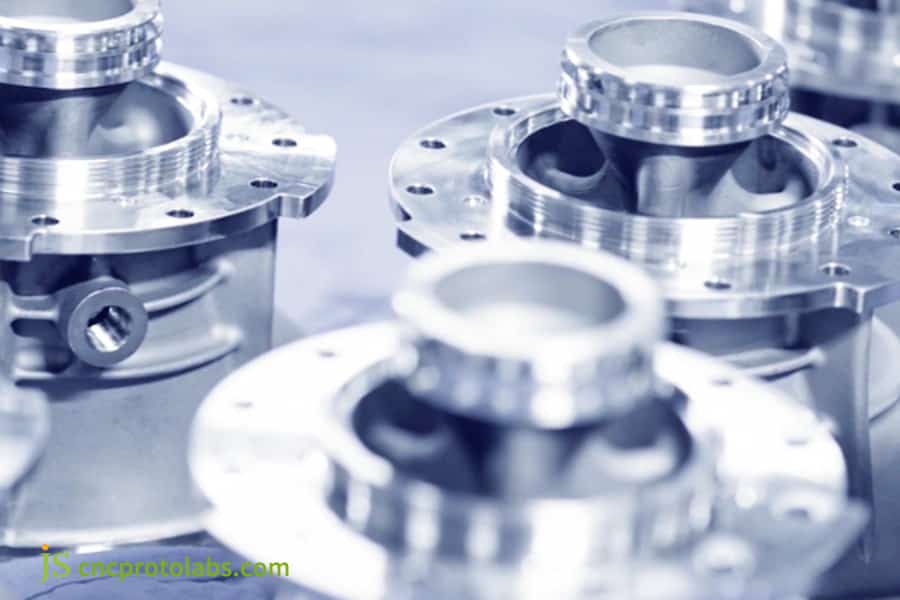
Figure 1: A close-up of several high-precision, complex-shaped titanium alloy components, showcasing the results of advanced manufacturing.
What Are The Key Challenges In Machining Titanium And Inconel With a 5 Axis CNC Mill?
The material properties of aerospace components largely govern the degree of difficulty for CNC 5 axis milling. Titanium alloys and Inconel 718, as main materials, are difficult to machine due to the distinctive physical characteristics of these materials, thus special process strategies are necessary.
The thermal aspect of titanium alloy machining
The thermal conductivity of titanium alloys is only half of that of stainless steel (for Ti-6Al-4V it is about 7 W/m·K). In cutting, the heat is mainly generated at the contact point between the tool and the workpiece that shortens the tool life.
The problem can be solved by maintaining the best cutting conditions using 5 axis linkages, high-pressure cooling, and active vibration damping systems.
The challenge of high-temperature strength of Inconel 718
Inconel 718 retains its high strength above 600, but its machinability is very poor and the tool wear is quite fast. Therefore, ceramic or high-performance carbide tools must be used, coupled with trochoidal milling methods and finely tuned cutting parameters to get a compromise between productivity and tool life.
Comparison of Machining Core Parameters between Titanium Alloy and Inconel 718:
| Material | Recommended Cutting Speed (m/min) | Feed Rate (mm/tooth) | Cooling Method | Tool Type | Machining Hardness (HRC) | Thermal Conductivity (W/m·K) |
| Ti-6Al-4V | 30-50 | 0.05-0.12 | High-Pressure Internal Cooling (70bar) | TiAlN Coated Carbide | 32-38 | 7 |
| Inconel 718 | 20-40 | 0.03-0.08 | High-Pressure Internal Cooling (100bar) | Ceramic Tool/Cubic Boron Nitride | 40-45 | 11 |
| 304 Stainless Steel | 80-120 | 0.15-0.25 | Conventional Cooling | Ordinary Carbide | 20-25 | 16 |
| 7075 Aluminum Alloy | 300-500 | 0.2-0.4 | Emulsion Cooling | Carbide | 15-20 | 167 |
Want to solve the machining challenges of titanium alloy/Inconel 718? Schedule a one-on-one consultation with a JS Precision process engineer and receive a free, customized CNC 5 axis milling parameter table to improve machining efficiency.
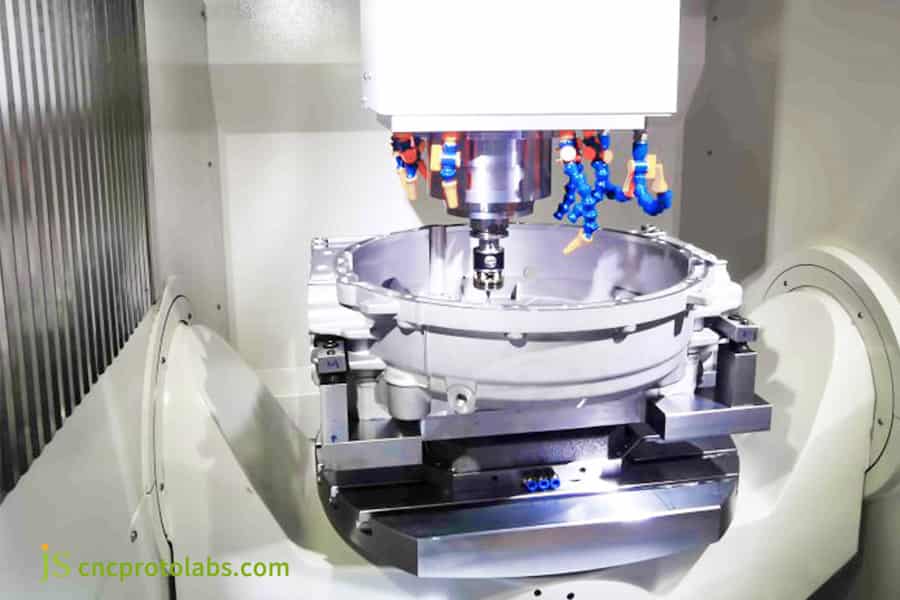
Figure 2: A powerful 5-axis machining center is actively milling a large, circular titanium aerospace component, with coolant visible.
How To Ensure Quality And Compliance In Aerospace Precision Machining?
The essence of aerospace precision machining is having "zero-defect" products. The AS9100D standard is very strict and limits the options. The dual guarantees to satisfy the requirements of this standard are the upgraded 5 axis CNC machining center technology and an all-inclusive quality system. The whole process has to be traceable and controllable.
In-machine Measurement and Closed-Loop Control
Nowadays, the 5 axis CNC machining center come equipped with spindle displacement sensors and laser tool setting systems that allow the machine to detect and compensate the critical dimensions in real-time. JS Precision has limited the variation of a part from the aerospace industry to 0.003mm, thus providing the cutting edges without burrs.
Coordinate Measuring and Full-Process Traceability
Parts after being machined must be measured by a CMM coordinate measuring machine (CMM) and a report must be issued. The recording of the key information is a must in aerospace precision machining. JS Precision uses an MES system for full-process data digitization.
AS9100D Quality Management System
AS9100D is the minimum standard for any supplier in the aerospace industry. The certification of JS Precision has brought three major benefits: mutual understanding of the specifications, third-party audit assurance, and smooth global supply chain integration.
The Effect of Surface Treatment on the Fatigue Life of Aerospace Components
Aerospace components require surface integrity at a very high level. JS Precision's titanium alloy shot peening and Inconel 718 passivation processes are in full compliance with MIL-DTL-5541 standards.
Common Surface Treatments and Process Requirements for Aerospace Parts
| Process | Applicable Materials | Core Purpose | Standard | Surface Roughness Requirement (Ra) |
| Shot Peening | Titanium Alloy/Inconel 718 | Improves fatigue resistance | MIL-STD-1316 | ≤0.8μm |
| Hard Anodizing | Aluminum Alloy 7075/2024 | Enhances wear resistance | MIL-A-8625 | ≤0.6μm |
| Passivation | Inconel 718/Stainless Steel | Improves corrosion resistance | ASTM A967 | ≤0.4μm |
| Micro-Arc Oxidation | Titanium Alloy | Enhances surface hardness | GB/T 30754 | ≤1.0μm |
5 Axis CNC Machining Center: Trunnion Table Vs. Swivel Head – Which To Choose?
The arrangement of a 5 axis CNC machining center has a direct impact on the machining efficiency and precision of aerospace parts. It is a very delicate step to precisely choose the parts based on their features. JS Precision has both a double, trunnion table and a swivel head configuration to satisfy various requirements.
Pros and Cons of the Double, Trunking Table Structure
- Pros: Resistant to high rigidity, moderate cost, stable toolpath, good for large-scale production of aerospace structural components of small and medium sizes, and can be used for titanium alloy parts like satellite supports.
- Cons: Limited table load capacity (usually ≤500kg), not suitable for machining large titanium alloy beam, frame parts.
Use Cases for the Swivel Head Structure
- Pros: Able to process large workpieces weighing over 5 tons, has a wide machining range, is suitable for large parts such as aircraft wing spars, and is capable of milling deep cavities and large-sized parts.
- Cons: Expensive equipment, demanding requirements for 5 axis programming and post=processing software, and needs a professional technical staff to operate.
How to Select the Right Equipment Based on Part Characteristics?
JS Precision suggests taking into account the size, material, and batch size of a part:
- For titanium alloy structural parts with a diameter greater than 1000 mm, a tilting head type machine is considered the best choice.
- For small to medium sized high precision components, a double-tilt type is used to achieve both efficiency and accuracy.
- As an illustration, a double-tilt type increases the machining efficiency by 25% for small turbine disks, whereas a tilting head type allows for single-clamp machining of large fuselage frames.
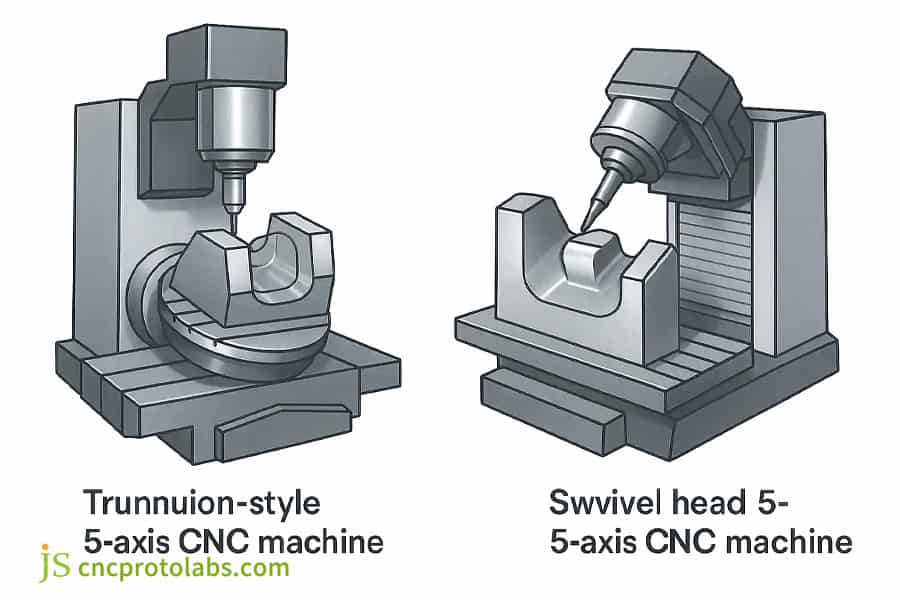
Figure 3: A side-by-side diagram compares a trunnion-style and a swivel-head style 5-axis CNC machine.
Why Partner With JS Precision For Your Aerospace 5 Axis Machining Needs?
In aerospace 5 axis machining, the technology, equipment, and compliance of a partner directly affect whether machining will be successful or not. JS Precision has been deeply involved in the aerospace industry for more than 10 years. Their core competencies are titanium alloys and inconel 718 aerospace machining 5-axis, which makes them a premium aerospace partner worldwide.
Experience and Expertise
JS Precision's engineering team has dealt with more than 2,000 types of aerospace parts, so they have a complete database of difficult-to-machine materials and processes. They can foresee and fix 99% of machining issues, which include the deformation of thin, walled titanium alloy parts.
Equipment and Capabilities
The factory has 5 axis CNC machining centers from DMG MORI and Makino, with a maximum machining range of 2000×2000×1800mm and a workpiece capacity of 5 tons. These match the heavy-duty machining titanium alloy requirements and allow one, stop machining.
One-Stop Service
JS Precision offers a top-level solution running from DFM optimization, material purchasing, 5 axis machining, to surface treatment, which shortens supply chain management.
Compliance and Reliability
JS Precision has AS9100D and NADCAP special processes certifications. Every batch of parts is issued with a material quality certificate, CMM inspection report, and FAI first article report, thus complying fully with compliance requirements.
JS Precision Case Study: 40% Cost Reduction! Us Aero Engine Supplier Breaks Titanium Component Bottleneck
Challenge
A US aero, engine Tier 1 supplier is the main fan of the titanium alloy bottleneck (material TC4, diameter 850mm, thinnest wall thickness 1.2mm) which had two major pain points:
- The lead time of the original European supplier was up to 22 weeks.
- The machining deformation rate was as high as 12%, with a single bottle machining cost exceeding $8, 000, which severely impacted the project progress and profits.
The supplier after comparative studies, decided to collaborate with JS Precision to discover process breakthroughs and cost optimization.
Solution
JS Precision which had extensive experience in aerospace parts manufacturing introduced a three-step process optimization strategy:
Step 1: DFM Optimization and Process Simulation
Redistributing the blank allowance based on finite element analysis, giving top priority to heat treatment in order to minimize deformation resulting from machining stress release, and developing a specially designed flexible fixture to control clamping errors within 0.03mm.
Step 2: 5 axis Process Innovation
Following a gradual process trail of "roughing + semi-finishing + aging + finishing, " the finishing stage cycloidal milling is used to control cutting force fluctuations with one side allowances being uniformly removed and deformation of thin, walled parts being prevented.
Step 3: In-Machine Measurement and Closed, Loop Compensation
In, machine measurement is done after finishing each key feature during machining. Furthermore, the measurement data is automatically sent back to the CAM system to adjust the toolpath for the next feature, therefore ensuring that the wall thickness tolerance is continually within ±0.05mm.
Results
In the end, JS Precision achieved a significant improvement in processing efficiency:
- The deformation scrap rate of titanium alloy fan casing has been reduced from 12% to within 1.5%.
- Total procurement costs were decreased by 40% in comparison with the European suppliers (unit cost was lowered to less than $4, 800).
- Delivery time was kept within 10 weeks, thus the customer was able to speed up engine delivery and got secured long-term cooperation orders.
Want to replicate this cost reduction and efficiency improvement? Tell JS Precision engineers about your parts machining pain points, and you can get a free customized aerospace 5 axis machining process solution to overcome production bottlenecks.
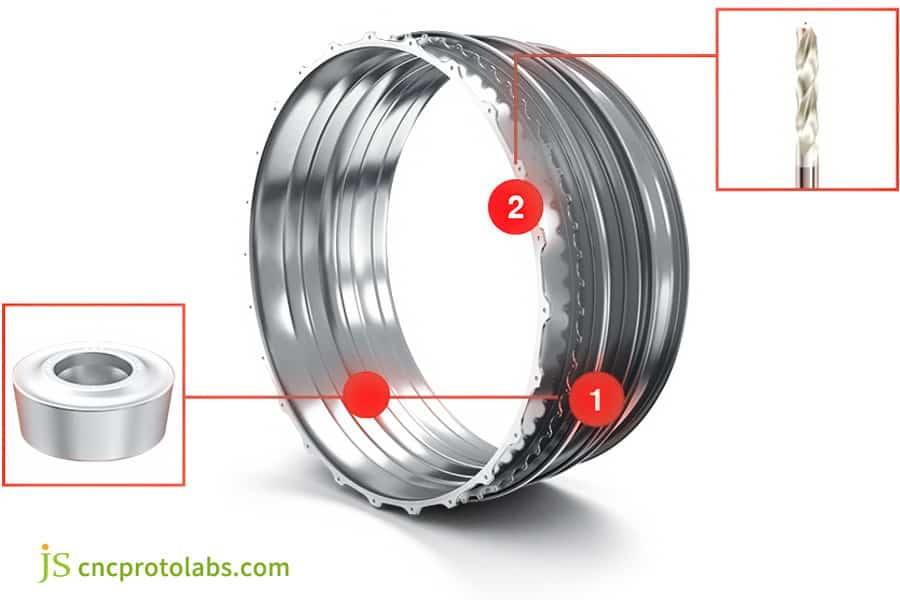
Figure 4: A main image of a finished cylindrical aerospace part, surrounded by small icons depicting steps in the 5-axis machining process.
How To Get a Detailed Quote For Custom Aerospace 5 Axis Machining?
Getting an accurate price quote is the primary step to partnership. The accuracy of a quote relies on the extent that the technical data is supplied. The professional and swift quoting process of JS Precision offers customers clean and clear cost details thus giving them a control over their costs.
What technical details should be provided for a quote?
- 3D model (STEP/IGES format), clearly annotating all features of the part.
- 2D drawings (marking key dimensional tolerances and surface treatment requirements), clearly defining precision standards.
- Material specifications (titanium alloy TC4, Inconel 718, etc.), determining the process direction.
- Annual demand and delivery schedule, facilitating production scheduling.
Key Factors Affecting Pricing
- Material Cost: Titanium alloys are 5-8 times more expensive than aluminum alloys, and Inconel 718 is about 1.5 times more costly.
- Machining Time: The intricacy of the part affects the machining time costs, thus, complex curved surface parts are more costly.
- Quality Control Requirements: CMM full inspection and SPC process monitoring add to the inspection costs but they help in minimizing quality risks.
Quick quotation process for JS Precision
JS Precision is able to provide a manufacturing feasibility assessment, itemized quotation, sample delivery cycle, and batch scheduling within 24 hours on receipt of the drawings. Also, the company promises to provide the above details in a very clear way and with no hidden charges.
Want a quote for your customized aerospace 5 axis machining? Upload your part's technical data to JS Precision, noting "Aerospace Parts Quote," and you'll receive a detailed quote within 24 hours, accelerating your project.

FAQs
Q1: What are the main benefits of 5 axis machining over 3 axis machining?
5 axis machining can machine complex curved surfaces in one operation without the need to reposition the workpiece multiple times. This not only prevents the accumulation of errors but also results in a high level of accuracy, up to ±0.005mm. In addition, it greatly reduces the production cycle of aerospace parts.
Q2: What makes machining titanium alloys rapidly lead to tool wear?
Titanium has a very low thermal conductivity, so the generated heat stays in the cutting zone. In addition to this, the tool tip gets chemically attacked because titanium is very reactive and easily sticks to the tool surface. Thus, to minimize tool wear, one needs to apply 5 axis tilting cutting along with high-flow-rate cooling.
Q3: Which tool material is the most suitable for machining Inconel 718?
It is common to use either ceramic or high-performance cemented carbide tools to machine Inconel 718. To maintain the rigidity of the tool and minimize tool runout in 5 axis machining, an HSK-A125 tool holder should also be used.
Q4: What weight does AS9100 certification hold for aerospace parts suppliers?
AS9100 certification is pretty much the base requirement that top aerospace manufacturers put forward for their suppliers. It guarantees the quality systems and traceability of the entire process, therefore it is in line with the precision machining requirements of the aerospace industry.
Q5: What are the typical tolerance ranges for aerospace parts?
The key dimensional tolerance of aviation parts is usually ± 0.005mm to ± 0.01mm, and the core part needs to be free of burrs. The surface roughness needs to meet the precision standard of Ra ≤ 0.8 μm.
Q6: How do you maintain consistency in mass production?
Using SPC for process monitoring, first, piece inspection, and batch sampling CMM, the whole five axis machining process is under digital control which allows to consistently and stably achieve the dimensional accuracy of mass-produced parts.
Q7: How long does it take from drawings to prototypes?
For typical complicated aerospace parts, the first piece can be delivered 2-3 weeks after drawing confirmation. JS Precision's five axis machining centers are capable of quick production scheduling to satisfy prototype verification needs.
Q8: Would you be able to offer material traceability reports?
Yes, JS Precision keeps quality assurance certificates for every batch of materials, logs furnace batch numbers, processing flow data, and can provide a full traceability report that meets AS9100D standards.
Summary
Aerospace parts manufacturing faces triple tests of precision, materials, and compliance.
Aerospace 5 axis machining is the core solution, which can process complex surfaces in one clamping, overcome the bottleneck of difficult machining of titanium alloys and Inconel 718, and meet the full process compliance requirements of AS9100D.
JS Precision has rich knowledge of this industry, combining technology, equipment, and hands, on experience to help aerospace precision machining stay standardized and efficient, thus assisting the global aerospace companies to complete the aerospace parts manufacturing at low cost and high precision.
If you are dealing with the machining difficulties for aerospace components, or are searching for a trustworthy aerospace 5 axis machining partner, JS Precision can be your best choice at any time.
Don't hesitate to act now to change your design ideas into dependable components flying in the sky, and let precision manufacturing pave the way for the future of aerospace.

Disclaimer
The contents of this page are for informational purposes only.JS Precision Services,there are no representations or warranties, express or implied, as to the accuracy, completeness or validity of the information. It should not be inferred that a third-party supplier or manufacturer will provide performance parameters, geometric tolerances, specific design characteristics, material quality and type or workmanship through the JS Precision Network. It's the buyer's responsibility Require parts quotation Identify specific requirements for these sections.Please contact us for more information.
JS Precision Team
JS Precision is an industry-leading company, focus on custom manufacturing solutions. We have over 20 years of experience with over 5,000 customers, and we focus on high precisionCNC machining,Sheet metal manufacturing,3D printing,Injection molding,Metal stamping,and other one-stop manufacturing services.
Our factory is equipped with over 100 state-of-the-art 5-axis machining centers, ISO 9001:2015 certified. We provide fast, efficient and high-quality manufacturing solutions to customers in more than 150 countries around the world. Whether it is small volume production or large-scale customization, we can meet your needs with the fastest delivery within 24 hours. Choose JS Precision this means selection efficiency, quality and professionalism.
To learn more, visit our website:www.cncprotolabs.com
Resource