English



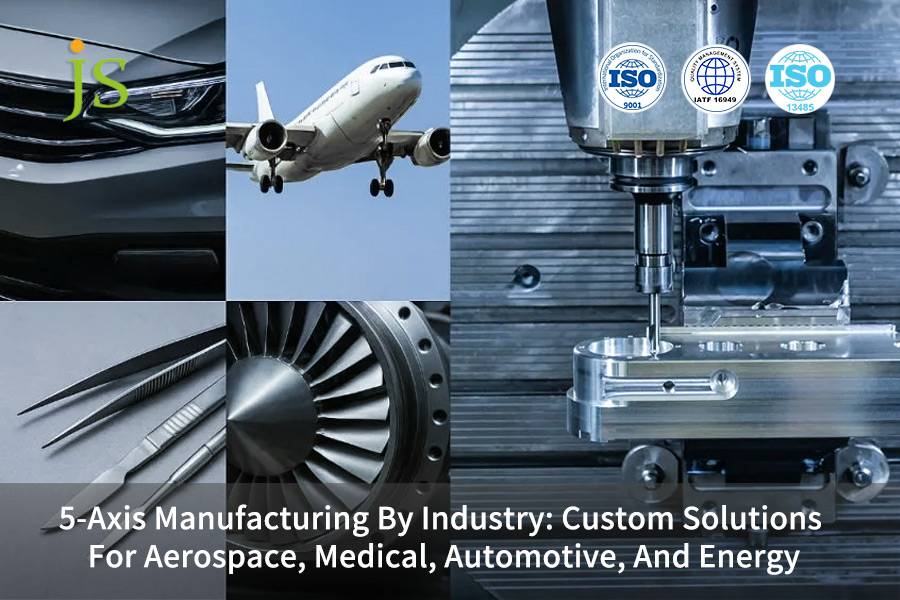

5 axis industries are facing the core pain points of design inspiration being constrained by traditional craftsmanship, difficult to machine materials raising tool costs, and difficulty balancing lightweight and structural strength.
Five axis CNC machining technology will be the instrumental factor to breaking down the above, mentioned barriers. It certainly is more than just a mere tool upgrade, it is an engineering philosophy that offers tailor-made solutions to 5 axis industries such as aerospace, medical, and energy.
This piece of writing is going to focus on how four major industries can take advantage of 5 axis CNC machining services to make breakthroughs and also how to select a partner capable of translating your designs into reality flawlessly.
Key Answers Overview
| Key Questions | Key Answers | Value for You |
| How does 5 axis technology help various industries to overcome their manufacturing challenges? | Provide a complete set of 5-axis CNC machining services for the core challenges of 5 axis industries, from complex surface forming to handling difficult to machine materials. | Knowing the way five axis technologycan bring direct empowerment to product innovation and performance breakthroughs. |
| What are the ways to keep the production of customized parts running smoothly and at a low cost? | Through design for manufacturability optimization and intelligent process planning, up to the cost structure of processes such as titanium CNC machining can be optimized. | Have an internal view before launching the product to get a timely and cost-effective solution to your project. |
| What should be done to choose a partner correctly? | Beyond comparing device models, evaluate industry expertise, engineering support, and 5-axis robotic arm integrated secondary processing capabilities. | Make a comprehensive framework for supplier evaluation with the help of this guide and discover that it is the value, based partners who are the most trustworthy. |
Key Takeaways:
- Industry-specific customization is key:
The universal five axis strategy is not feasible, as aerospace, medical, and other fields have unique requirements for accuracy, materials, and certification, requiring in-depth industry knowledge.
- Materials are the main factor for process choice:
Titanium alloys must be machined at very low linear speeds (60-90 m/min), whereas aluminum alloys can be machined at high speeds (over 1000 m/min). This means that completely different strategies have to be employed in these cases.
- Value is generated by design, manufacturing teamwork:
Today, designers and manufacturers can work together very closely by using the DFM method. A 10-25% reduction in costs and lead times can be achieved with optimized part structure through early DFM analysis.
- Post-processing and Automation are the Future:
A leading trend to achieve high consistency and reduce labor costs, is the integration of a 5 axis robotic arm for deburring and polishing.
Why Trust This Guide? JS Precision 5-Axis Industries Customized Solutions
The main expert of this guide is JS Precision which has had in the business 15 years 5 axis CNC machining. We have been specialists in 5 axis machining for the aerospace, medical, and energy industries. We have delivered over 100, 000 high-precision parts. Our main line of equipment is certified to ISO 13485 and AS9100.
In titanium CNC machining, we have succeeded in extending the tool life for titanium alloy parts by 35% through the use of optimized tool axis angles, which is way beyond the industry average. In medical device 5 axis machining, we are capable of making surface finishes with Ra < 0.2μm, thus ensuring implant biocompatibility requirements are met.
Our advantage lies not only in having top-notch 5-axis machining center manufacturers equipment, but also in our ability to build a full process solution of "design processing post-processing".
Take for instance the aerospace component machining, we are capable of giving the customer a full-chain service from DFM analysis, process planning, to machining verification based on the customer's 3D model, which can save costs by eliminating design inadequacies. There are many customer case studies that reveal that our tailored solutions have helped customers reduce the time-to-market by over 20%.
Want to verify the feasibility of your 5-axis CNC machining solution? Contact JS Precision's application engineers now, submit your 3D part model, and receive free customized process assessment and cost calculation to gain a technological advantage.
Why Is 5-Axis Technology Indispensable For Precision Machining For Aerospace?
The aerospace sector has very stringent requirements for integrated, lightweight, and material, specific components. Standard 3 axis machining is unable to fulfill these requirements, thus making 5 axis CNC machining not only an indispensable solution but also the core technological support of the 5 axis industries.
Overcoming Difficult-to-Machinable Materials
Titanium alloys (e.g., Ti-6Al-4V) and nickel, based superalloys (e.g., Inconel 718) are the most frequently used materials in the aerospace sector, and they set the scene for work hardening, low thermal conductivity, and rapid tool wear problems.
Complying with the AS9100 standard, 5 axis continuous tool axis control spreads the load through side, cutting, which helps tool life increase by more than 30% and, at the same time, part surface integrity is preserved, thus no harmful recast layers and microcracks are formed.
From Lightweight Skeleton to Complex Internal Flow Channels
5 axis machining is capable of performing the machining of complex aluminum parts (such as 7075-T6) in one single operation, including wing ribs and engine mounts, thus enabling a 40% weight reduction through integrated weight, reduction cavities and complex curved surfaces.
At the same time, it is able to machine parts with complex blade profiles or cooling channels, e.g., engine fuel nozzles and turbine casings, thus resulting in one-piece molding that traditional methods cannot achieve.
Want to overcome the difficult material processing problem of machining for aerospace? Request a white paper on titanium alloy machining from JS Precision to learn how to increase tool life by over 30% and reduce production costs.
How Does Medical Device 5-Axis Machining Achieve Perfect Complex Surfaces For Implants?
Medical implants have very stringent requirements for biocompatibility, surface finish, and customization. Medical device 5-axis machining is one of the main ways to satisfy these demands and a major application area of the 5 axis industries.
Dealing with the Challenges of Medical Titanium Alloys and Cobalt Chromium Alloys
Medical-grade titanium CNC machining (e.g., Ti-6Al-4V ELI) and cobalt, chromium alloy (CoCrMo) machining require measures to be taken to ensure that there is no contamination and that there are no microcracks.
Five axis technology allows for very accurate micro, sculpting of trabecular bone structures and further produces a surface of extremely high quality with Ra < 0.2μm for subsequent sandblasting and electropolishing, thereby implant biocompatibility is obtained.
From Technical to Medical and Surgical
Five axis machining can, by utilizing patient CT data, produce toolpaths in a very short period of time with the help of dedicated CAM software, and as a result, achieve a very accurate fabrication of personalized knee joint pads or craniofacial prostheses.
This not only decreases the traditional week-long cycle of manual grinding and casting to a mere few days but also greatly enhances the surgical planning of the operation both in terms of efficiency and certainty.
Need a customized solution for medical device 5-axis machining? Tell us your implant dimensions and material requirements, and JS Precision can quickly provide a quote and delivery timeline compliant with ISO 13485 standards.
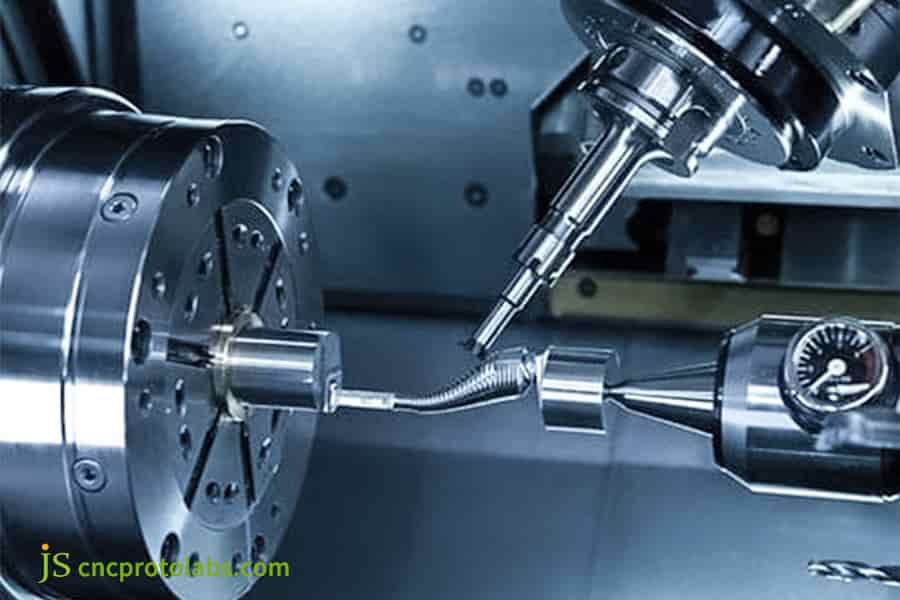 Figure 1: Close-up of a precision-machined aircraft engine turbine blade made of titanium alloy, highlighting the complex aerodynamics achievable through advanced 5-axis machining.
How Are Complex Cooling Channels Accurately Made In Turbine Blade 5-Axis Machining?
Turbine blades are the heart of energy and aero-engines. Their complex internal cooling channels have a direct impact on their efficiency. Turbine blade 5-axis machining is the only method that can handle this structure and forms the technological summit of the 5 axis industry.
Multi axis Linkage for Deeply Engraving Irregularly Shaped Pores
5 axis machine tools are capable of using slender end mills with a diameter of 3mm and a length-to-diameter ratio of 15:1 for the machining conformally curved cooling channels at given angles and along curved paths with the help of XYZAC five axis linkage. They manage to keep the diameter tolerances within ±0.05mm, which is a feat totally out of the question for 3 axis machine tools.
Ensuring Channel Surface Quality and Consistency
The inner walls of the cooling channels in the high-temperature alloy blades must have a surface roughness Ra < 0.8μm. The five axis technology optimizes the spiral interpolation and cycloidal milling strategies to avoid tool chatter, ensure smooth inner walls of the airway, and guarantee stable and efficient cooling airflow.
Five-Axis Machining Accuracy Parameters for Turbine Blade Cooling Channels
| Blade Type | Channel Diameter (mm) | Length-to-Diameter Ratio | Diameter Tolerance (mm) | Surface Roughness (Ra/μm) | Machining Strategy |
| Aero-Engine Blade | 3.0 | 15:1 | ±0.05 | ≤0.8 | Five-Axis Helical Interpolation |
| Industrial Gas Turbine Blade | 4.5 | 12:1 | ±0.08 | ≤1.0 | Cycloidal Milling |
| Steam Turbine Blade | 6.0 | 10:1 | ±0.10 | ≤1.2 | Side Cutting |
| Small Turbine Blade | 1.5 | 20:1 | ±0.03 | ≤0.6 | Micro Milling |
Want to achieve high-precision cooling channel machining for turbine blade 5-axis machining? Check out JS Precision's turbine component case studies to learn how to control tolerances within ±0.05mm.
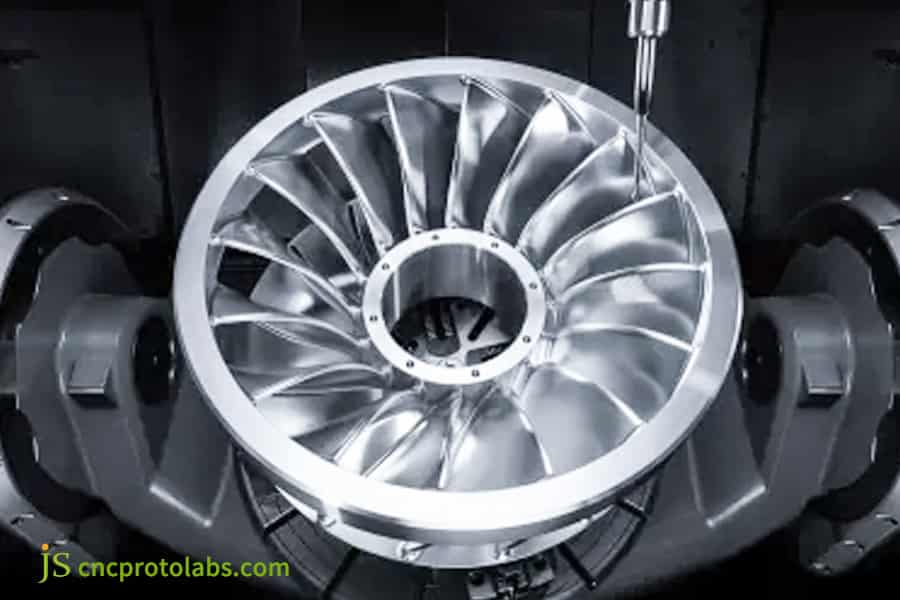 Figure 2: A turbine blade undergoing 5-axis machining, with the cutting tool visible, showcasing the precision manufacturing process in an industrial setting.
How To Optimize 5-Axis Strategies For Different Materials Like Titanium Vs. Aluminum?
Material properties directly determine 5-axis machining strategies. Machining parameters differ significantly between different materials, therefore, appropriately adjusting the strategy is key to improving efficiency.
Comparison of Core Parameters for Five-Axis Machining of Different Materials
| Material Grade | Linear Speed (m/min) | Radial Depth of Cut (% of Tool Diameter) | Cooling Pressure (bar) | Surface Roughness Requirement (Ra/μm) | Applicable Industries |
| Ti-6Al-4V ELI | 70 | ≤30 | >70 | ≤0.2 | Medical, Aerospace |
| 7075-T6 Aluminum Alloy | 1200 | ≤50 | 40 | ≤0.8 | Aerospace, UAVs |
| Inconel 718 | 80 | ≤25 | >80 | ≤1.0 | Aero Engines |
| PEEK | 200 | ≤40 | 30 | ≤0.5 | Medical, Precision Instruments |
Precision Machining of Titanium Alloys: Strategies for Coping with High Heat and High Strength
Titanium CNC machining needs a continuous low linear speed of only 70 m/min, a radial depth of cut ≤30% of tool diameter, and high-pressure internal cooling >70 bar to ensure chip removal and cooling. The tool axis vector must be changed very smoothly so that the sudden change in cutting angle does not cause chatter.
High-Speed and High-Efficiency Machining of Aluminum Alloys
For finishing aluminum components, the five axis dynamic milling can be a solution with very high speeds (>18000 rpm) and large feed rates, which can be combined with cycloidal or scroll toolpaths to keep the cutting forces stable and at the same time to achieve a high rate of material removal.
At the same time, step-by-step machining and optimized clamping make it possible to hold the dimensions of thin-walled features with a wall thickness of <1mm.
Can Professional 5 Axis CNC Machining Services Optimize My Design For Cost Reduction?
Professional 5 axis CNC machining services may dramatically lower the cost of part machining if the design is changed early on, which is a major way of making a project more cost-effective.
Early collaboration: the secret to cost reduction
JS Precision engineers can suggest changes even when the design is still at the conceptual stage, such as making the radius of very tight interior corners bigger from R0.5 to R2 to use standard tools, or turning one ultra-complex part into two assembly components that can be optimized separately, thus lowering total machining time by 35%.
Process Integration: Less Clamping and More Operations
By taking advantage of the multi, faceted machining features of 5 axis machine tools, the machining datum and process sequence of parts can be changed, combining in one to two clampings what used to be 4-5 clampings, and getting the same or higher accuracy with less labor and lower costs of the workflow.
Case Study: Cost Reduction Of 28%, European Drone Companies Break Through Bottleneck Through Five Axis Integrated Processing
Challenge
The primary load, bearing frame (material: 7075 aluminum alloy) of a European high-performance drone producer was initially conceived as an assembly of 12 riveted parts. This lead to an overall excessive weight, complicated assembly stress, and a production cycle of up to 6 weeks, thus limiting the competitiveness of the product.
Solution
JS Precision offers comprehensive 5 axis CNC machining services:
1.DFM reconstruction:
The first 12-part riveted design was changed into 3 large aluminum parts (7075-T6 material) by integrating a meshed lightweight rib plate acetal molding.
The rib plate thickness is accurately maintained within 1.2-1.5mm, which accounts for an 18% reduction in material waste compared to the initial design. Extremely accurate positioning holes (tolerance 0.02mm) are also offered to get rid of the assembly variation.
2.Process Innovation:
By combining a large 5 axis machine tool with a travel range of 1200×800×600mm, and a high-speed spindle of 18000rpm, all the significant features of the part (the interfaces of irregular forms, the mounting surfaces, the weight, reduction cavities) are machined in one single setup.
The flatness is very strictly kept within 0.05mm and the geometrical tolerances are ≤0.03mm, thus eliminating the positioning errors that are caused by multiple setups.
3. Post-processing Integration:
Introducing a highly accurate 5 axis robotic arm that has a load capacity of 5kg, coupled with a separate 0.8mm deburring tool. Optimized routes are created through offline programming, which makes it possible to automate the deburring and finishing of complicated internal cavities and edges.
The efficiency of deburring is increased by 70%, and the surface roughness of the parts is always maintained at Ra≤0.8μm, with a consistency of over 99.5%.
Result
- The number of parts has been reduced by 75%, the overall structure has been reduced by 15%, and the stiffness has been increased by 20%.
- The total cost of production per unit has been reduced by 28%, which means that about $120 is saved per unit.
- The lead time from design to the first-article verification was cut in half from 6 weeks to 3 weeks, thus the product was able to quickly take advantage of the market opportunities.
Want to replicate the cost reduction case of the drone frame? Call JS Precision's hotline now, mention "drone project," and you can get a customized solution to reduce production costs by more than 20%.
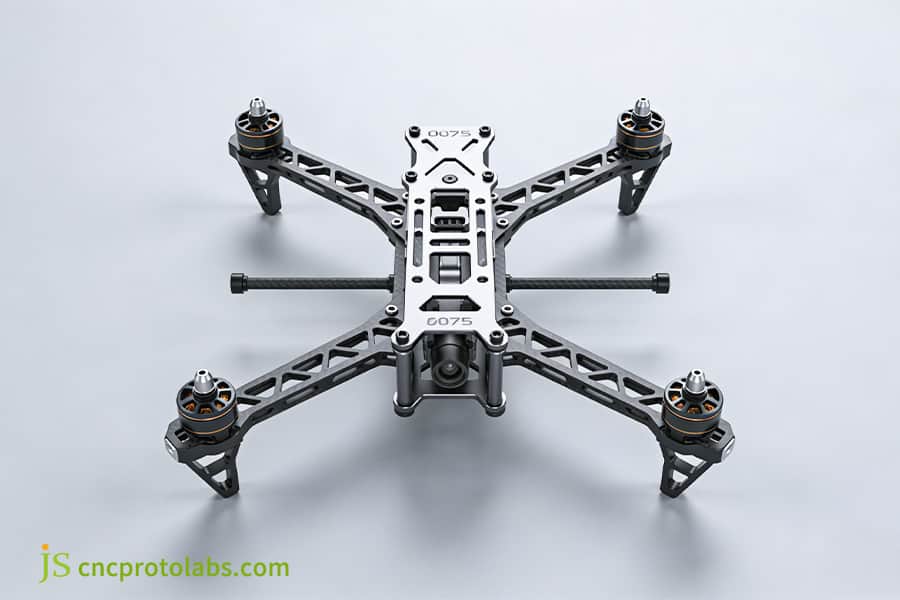 Figure 4: A close-up of a quadcopter's central frame, showcasing its carbon fiber and aluminum construction, integrated camera, and four brushless motors, designed for aerial photography.
How Does a 5 Axis Robotic Arm Optimize Deburring Paths For Complex Parts?
The 5 axis robotic arm is the main piece of equipment for post-processing in 5 axis machining. It addresses the issues of inefficiency and inconsistency in manual deburring of complex parts, and is therefore the main pathway to the automation upgrade of 5 axis industries.
Handling Complex Geometry
Different from manual teaching of traditional robots, offline programming software based on CAD models can automatically generate optimized paths for the 5 axis robotic arm that will cover all edges such as deep cavities and narrow slits. As a result, programming efficiency is improved by 80%.
Force Control Sensing and Adaptive Machining
A high-precision 5 axis robotic arm equipped with force control sensors can, like a human hand, sense and keep a consistent contact pressure, and therefore can, without any problems, deal with edge variations caused by machining tolerances to get uniform chamfering or polishing effects, thus not making overcutting or omissions.
How To Choose Among 5 Axis Machining Center Manufacturers For Custom Parts?
When choosing 5 axis machining center manufacturers, the decision shouldn't be based solely on the equipment model. Actually, it is very important to check the overall service capabilities of the manufacturers for the success of your project.
Evaluating the Entire Technology Ecosystem
Apart from focusing on the brand of the equipment, you also need to determine if the manufacturer has a dedicated process database, a certified material library, and a production environment that complies with 5 axis industries standards.
For instance, the medical industry has to comply with ISO 13485 and the aerospace industry with AS9100. Also, check out their CAM programming, simulation verification, and laser scanning inspection capabilities.
Ask the Right Questions to Locate the Experts
Questions such as, "How do you manage the machining deformation and guarantee a titanium alloy structural component thin wall thickness of 0.02mm?" or "Do you have fatigue test reports for energy components?" can be directed to suppliers. The comprehensive nature of their responses can serve as a gauge of their technical skills.
FAQs
Q1: What is the biggest advantage of 5 axis machining over 3 axis machining?
The foremost advantage is the capability to machine complex multi-faceted parts in one setup only, thus avoiding errors due to repeated repositioning. Additionally, 5 axis machining allows producing deep cavities, undercuts, and smoothly flowing complex surfaces that 3 axis machines simply can't access.
Q2: How big can a part be for 5 axis machining?
This depends on the travel of the specific machine tool. JS Precision 5 axis machinery can produce components ranging from tiny micro-medical parts (Φ20mm) to large aerospace frames (1200 x 800 x 600 mm).
Q3: What cutting tools are generally used for machining titanium alloys?
The majority of cutting tools that we use for this purpose are solid carbide tools with PVD coating. We use such small helix end mills that are also internally cooled with high-pressure channels to increase chip evacuation and cooling, thus making the process more efficient.
Q4: How accurate is five axis machining usually?
Precision parts' positional accuracy may be as good as ±0.01mm, and contour accuracy may go up to ±0.015mm. By further process optimization, even higher levels can be reached for cases requiring ultra-high precision.
Q5: How long does it take from providing a 3D model to receiving a quote?
If the 3D models and technical requirements are clear, JS Precision generally supplies the initial quotation and the appropriate technical solutions, including DFM recommendations, within 24-48 hours.
Q6: Do you support both small-batch prototyping and mass production?
Absolutely. JS Precision can produce any quantity, from a single prototype to a full scale production of thousands of units, thus allowing one to utilize the same production line and maintain consistent quality from prototype to mass production.
Q7: How do you handle residual stress during machining?
Residual stress is decreased in a very clean and systematic manner by optimizing cutting paths, such as the use of symmetrical machining, adjusting cutting parameters, and scheduling stress-relieving heat treatments between major processes.
Q8: How to ensure consistency in mass production?
Consistency in mass production is guaranteed by adhering to standardized work processes, periodically recalibrating machine tool precision, exercising SPC statistical control over the process, and conducting a thorough inspection of the first piece, patrol inspection, and final piece.
Summary
Five axis machining technology has moved from being a "luxury feature" to a "basic must-have" capability that is at the heart of 5 axis industries innovation. It provides engineers with incredible freedom of design and many complex products, which were only on paper, can be realized.
But the release of technological potential cannot be achieved without profound process knowledge and industry experience. JS Precision, a full-process solution expert, is at your service to help you remove all obstacles from the design stage to mass production.
Contact us immediately and submit your part drawings or concepts. Our application engineers will work with you to explore the optimal manufacturing path and help you win the competition.

Disclaimer
The contents of this page are for informational purposes only.JS Precision Services,there are no representations or warranties, express or implied, as to the accuracy, completeness or validity of the information. It should not be inferred that a third-party supplier or manufacturer will provide performance parameters, geometric tolerances, specific design characteristics, material quality and type or workmanship through the JS Precision Network. It's the buyer's responsibility Require parts quotation Identify specific requirements for these sections.Please contact us for more information.
JS Precision Team
JS Precision is an industry-leading company, focus on custom manufacturing solutions. We have over 20 years of experience with over 5,000 customers, and we focus on high precisionCNC machining,Sheet metal manufacturing,3D printing,Injection molding,Metal stamping,and other one-stop manufacturing services.
Our factory is equipped with over 100 state-of-the-art 5-axis machining centers, ISO 9001:2015 certified. We provide fast, efficient and high-quality manufacturing solutions to customers in more than 150 countries around the world. Whether it is small volume production or large-scale customization, we can meet your needs with the fastest delivery within 24 hours. Choose JS Precision this means selection efficiency, quality and professionalism.
To learn more, visit our website:www.cncprotolabs.com
Resource